
ACPS leaders tell council high student need, local labor costs and near-universal bargaining constrain school budgets
Get AI-powered insights, summaries, and transcripts
Subscribe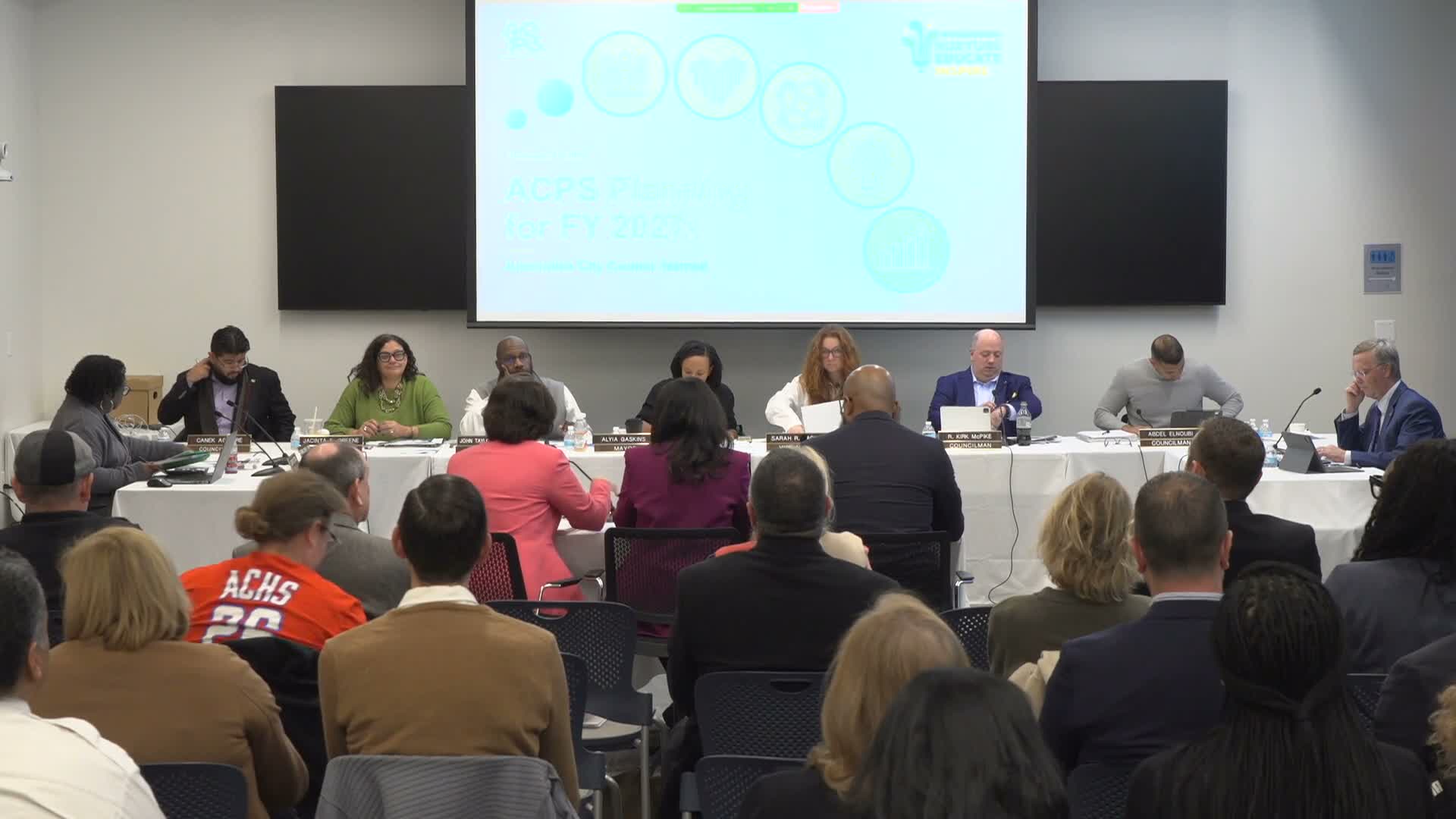
Summary
Alexandria City Public Schools (ACPS) told the council that 87%-90% of its budget goes to personnel, roughly 90% of staff are union-represented in current negotiations, and structural state funding shortfalls (ACPS receives ~20% of K-12 state funding versus a 55% state average) mean local taxpayers shoulder the lion's share of school costs.
ACPS officials presented the school division's budget context to the City Council at the retreat, arguing that structural factors beyond local control constrain the division's ability to close gaps.
"We have very high student needs in Alexandria," Superintendent (Dr.) Michelle Reif said, linking those needs to higher instructional and support requirements. Reif and Dr. K. Wyatt cited the 2023 JLARC report and explained two principal cost drivers: student needs (special education, English learners, poverty-related supports) and local labor costs, which the JLARC analysis found are materially higher in Alexandria than the state average.
Dominic Turner, ACPS finance lead, said roughly 90% of ACPS' personnel will be covered by one of two unions in the current bargaining cycle and that personnel accounts for about 87% to 90% of ACPS's budget. Turner described targeted steps the division is taking: a planned 5% non-personnel reduction across the central office, adjustments to staffing formulas (for SPED/EL), and exploring revenue measures such as local user-fee changes and a possible technology use fee.
ACPS asked council for consistent messaging and increased advocacy to the General Assembly to address structural funding inequities: "the state only contributes 20% of the cost of public education here in Alexandria," Reif said, noting the state average is about 55%. School leaders urged a coordinated push with neighboring jurisdictions to press for formula changes and additional state support.
Council members pressed ACPS for granular scenarios that quantify savings and impacts: Turner acknowledged a range of options, from modest class-size increases to adjustments in employer-employee health-care cost sharing, and said staff would prepare scenarios for council review. Both ACPS and council emphasized protecting classroom instruction and targeting central-office efficiencies where possible.
The ACPS presentation concluded with a request that council consider the timing and scale of any additional local commitments in the context of the overall city revenue forecast and competing capital needs.