Get Full Government Meeting Transcripts, Videos, & Alerts Forever!
Get email alerts on the Police Contract topic
No spam. Unsubscribe anytime.
Alexandria council adopts mixed outcome in police impasse, backing union pay scale but city parity and longevity terms
Summary
After a full impasse hearing, Alexandria City Council approved the police union's wage proposal (as recommended by the SSPBA) while adopting the city's longevity bonus and pay-parity approach; council directed the manager to consider budget offsets and potential changes to APD authorized strength.
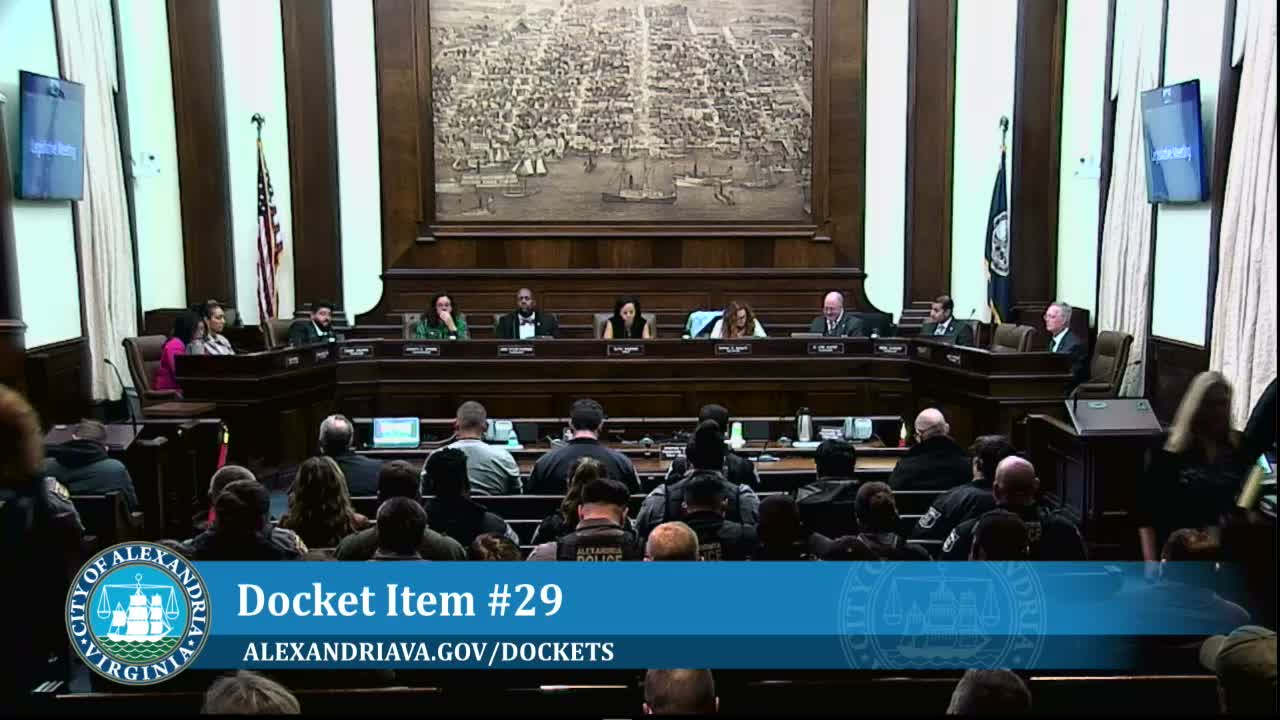
Alexandria City Council on Dec. 9 ended a months-long bargaining impasse with a set of split decisions that adopt elements of both the police union's and city management's proposals.
After a required public impasse hearing under the city's collective-bargaining ordinance, council voted to adopt the Southern States Police bargaining unit's wage position but voted separately to accept the city's proposed longevity bonus and city-drafted approach to pay parity and reopeners.
Will Thetford, the union's chief negotiator, told the council the department faces an acute staffing problem in patrol and is losing officers to neighboring agencies and federal employers. The union said authorized bargaining-unit strength is 309 but the department currently is missing about 30 officers and that patrol staffing has fallen to roughly 80 of 128 assigned patrol positions. "We're asking you to provide an inkling of hope," Thetford said, urging council to approve the union's amended package, which the union said would cost about $10.2 million over the life of the contract.
City staff, led by Deputy City Manager Jan Lambert and Budget Director Morgan Raut, said the city's last, best and final offer costs about $8 million over three years and is designed to target starting pay and preserve long-term fiscal stability. Raut told council that fully funding either package would require trade-offs: the city's wage proposal could be supported in the near term by an estimated 0.6 cent real-estate tax-rate increase or by expenditure reductions; the union package would require additional revenue or deeper cuts over the contract life.
The council's formal action after executive session: a motion by Councilman Mark McPike to adopt the SSPBA wage position carried on roll call (ayes recorded for all present). Vice Mayor Sarah Bagley moved to accept the city's longevity proposal (a $1,200 annual longevity bonus for top-of-scale officers); that motion also passed. Councilman Chapman moved to adopt the city's pay-parity and reopener language (triennial market review and limited reopeners rather than annual reopeners); that motion passed as well.
In voting to adopt the union wage position, council included guidance to the city manager to evaluate budgetary implications and consider potential savings, including a review of the Police Department's authorized force level to align costs and service priorities. Council members and staff repeatedly emphasized the trade-offs: funding significant wage increases will require either revenue generation, service reductions or position eliminations across the city's budget.
Budget staff estimated a 0.9 cent tax-rate increase would increase the average single-family homeowner's annual tax bill by roughly $434 in FY27 if the council decided to fund the union package entirely through property-tax revenue; the city noted combinations of smaller tax adjustments plus budget reductions are possible. City officials also pointed to an expected reduction in pension amortization payments in coming years as a potential long-term fiscal offset, but those savings are dated beyond the current contract period.
Council members said they were guided by public-safety priorities and fiscal constraints. The council certified a closed executive session under Virginia law to deliberate bargaining positions and returned to open session to record the roll-call decisions.
Next steps: city management will incorporate the adopted articles into final contract language and present budget options to support the decisions during the FY27 budget process; the council directed staff to return with budget implications and options for offsets.