
Des Moines County supervisors approve first reading of wind, solar and battery ordinance after hours of public testimony
Get AI-powered insights, summaries, and transcripts
Subscribe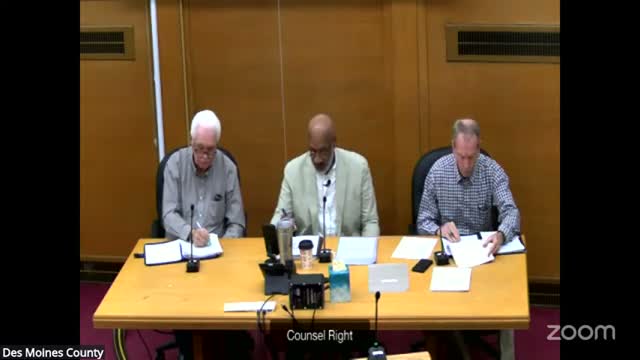
Summary
After a packed public hearing with competing testimony on wildlife, setbacks and economic benefits, the Des Moines County Board of Supervisors approved the first reading of Ordinance No. 64 by a 2-1 vote; speakers urged both approval and further study or a public referendum.
The Des Moines County Board of Supervisors approved the first reading of Wind, Solar and Battery Ordinance No. 64 after a lengthy public hearing that drew dozens of speakers and sharply divided views.
Supporters said the project would bring needed revenue and new jobs to rural parts of the county. "This project, Big River Wind, will be one of the largest tax contributors in Des Moines County," said John O'Brey of New London, who identified himself as a participating landowner. Jacob Nye, business manager for IBW Local 13 electricians, urged passage to help secure reliable power and local economic development.
Opponents raised safety, environmental and property-rights concerns. Diane Rolfes said the proposed 715-foot setback from nonparticipating property lines is inadequate for 650-foot turbines and urged a larger buffer: "They should be assuming all of the risk and all of the liability for potential land contamination," she said. Conservation and wildlife speakers, including county conservation board members, stressed that Des Moines County hosts three federally endangered bat species and recommended wider buffers and stronger mitigation. "We have every species of bat known to Iowa, including the three that are endangered," Chris Lee, the county conservation director, told the board.
Speakers also debated process and legal risk. Several members of the public and local attorneys urged extending the moratorium or putting the issue to a public vote; others warned that very large setbacks could functionally preclude development. Multiple speakers noted pending litigation at the Iowa Supreme Court involving vested rights and warned that a two-step permitting process could expand developers' claims. "That two-step process ... basically begs this county to be sued," attorney Kyler Masner said.
Board discussion and outcome The board opened the public hearing after a motion and heard hours of testimony. Supervisors Tom Broger and Jim Carey voted to approve the ordinance first reading; Supervisor Shane (identified earlier in the meeting as Shane McCampbell) recorded a dissenting vote, producing a 2-1 tally to advance the ordinance to the next step. The board also rejected a public request to extend the moratorium during the meeting.
Procedural and ancillary actions Following the ordinance discussion, the board approved routine payroll and accounts-payable claims, and approved several personnel actions, including the promotion of Becky Purchase to part-time budget director and the hiring of Blake Viera as assistant county attorney.
Why it matters The ordinance would set countywide standards for the siting, construction, operation and decommissioning of utility-scale wind, solar and battery systems, including setbacks, wildlife protections and permitting processes. Supporters said it balances local economic development and safety; opponents said it does not sufficiently protect nonparticipating landowners and local ecology, and several urged more time for review or a public referendum.
What comes next The first reading clears the ordinance to proceed toward final consideration; supervisors discussed future agenda items and legal inputs and indicated further meetings and potential revisions. Some members of the public asked the board to wait for related guidance from state agencies and a pending state Supreme Court decision that could affect how vested rights are interpreted under county permitting rules.