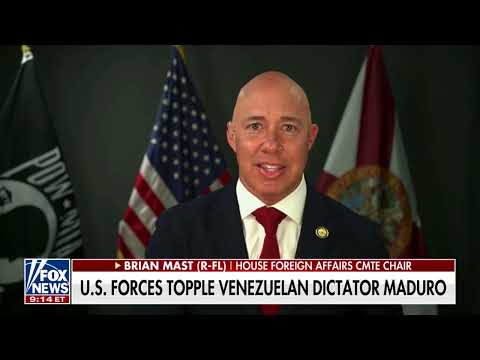
Congressional guests praise U.S. operation in Venezuela and defend secrecy over congressional notice
Loading...
Summary
On a televised program, guests identified as Carlos Jimenez and Brian Mass praised a U.S. operation reported to have captured Nicolás Maduro, defended not notifying Congress on operational-security grounds, and said the U.S. should press for free, fair Venezuelan elections; Marco Rubio warned notifying Congress would have risked leaks.
Carlos Jimenez and Brian Mass, introduced on the program as congressional guests associated with Homeland Security, lauded a recent U.S. operation in Venezuela that the host characterized as capturing Nicolás Maduro and said secrecy and careful planning were crucial to the mission’s success.
"You can't congressionally notify something like this for two reasons," said Marco Rubio during the segment, adding that prior notification would have risked a leak and that the situation was an "exigent circumstance." One guest said he had been briefed and that there were "very specific threats" of leaks that could have jeopardized the mission, and that those threats were addressed in advance.
The guests framed the operation as an example of decisive U.S. action. One guest contrasted the approach with earlier policy choices, saying a prior administration had placed a $50,000,000 bounty on Maduro and that the operation was the follow-through on that law-enforcement effort. The guests emphasized the role of planning, contingency accounting and coordination with military and intelligence assets to protect personnel who carried out the operation.
They also described broader geopolitical effects. A guest said the operation sent a message to governments and armed groups in the region — including Cuba and narco-trafficking states — and argued it signaled to China and other foreign backers that "you get no protection from [them] ... they also sell cheap friendships." The guest also named Russia, North Korea and Iran as adversaries whose presence in Venezuela should be reduced and asserted Hezbollah had a presence the U.S. should counter.
On next steps, one guest said the immediate priority is stability but argued that the U.S. should press for free and honest Venezuelan elections, adding that Venezuelans should choose their leader; the guest named Maria Corina Machado as a popular opposition figure while noting the ultimate decision belongs to Venezuelans.
The segment repeatedly returned to the theme of servicemember safety. Guests credited the operation’s success to extensive preparation and to the bravery of the personnel who executed it; the host and guests offered public thanks to those service and intelligence members.
The program did not record any formal congressional action, vote, or new policy decision during the segment. It was a broadcast discussion of the operation’s execution, the reasoning for not notifying Congress in advance, and the expected political and diplomatic consequences.
What happened next: the guests urged support for stability in Venezuela and demanded free and fair elections; no formal U.S. congressional directive or vote was announced during the segment.