Get Full Government Meeting Transcripts, Videos, & Alerts Forever!
Get email alerts on the Bank Resolution Participation topic
No spam. Unsubscribe anytime.
Committee advances measures to study expanding bidders and private participation in bank resolution
Summary
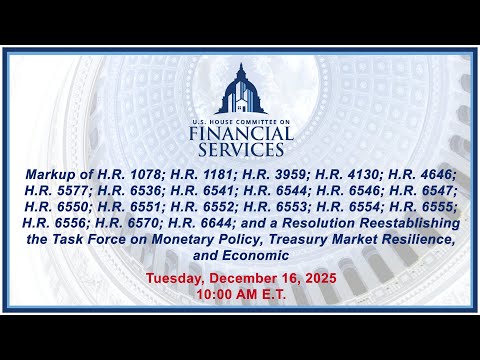
The committee advanced two related study bills — HR 6555, on shelf charters and modified bidder qualifications, and HR 6556, limiting concentration-limit waivers — seeking to increase competition in failed-bank auctions while requiring oversight and safeguards.
Members advanced a set of bills aimed at expanding the pool of potential bidders and private-capital participation in bank-resolution scenarios. Vice Chairman Heisinger described HR 6555 directing the OCC and FDIC to study "shelf charters" (pre-authorized but inactive charters) and modified bidder qualification processes so that nonbank investors could be better positioned to acquire and operate failed banks during crises. He said regulators in 2023 lacked adequate bidder participation and that studies should examine historical use and potential benefits.
Rep. Lynch's HR 6556 (Failing Bank Acquisition Fairness Act) would limit the statutory exemption that allows a bank holding more than 10% of national deposits to acquire a failing bank if other eligible bids exist; Lynch argued it would prevent mega banks from using crisis moments to expand further and would protect local banking access. Committee debate described guardrails and reporting requirements to Congress when a concentration limit is waived.
Both measures were adopted as amended by the committee and ordered to be reported; several members applauded bipartisan adjustments to address gaming of bidding processes and to preserve depositor protection, while others emphasized the need for careful rulemaking to avoid unintended market disruption.