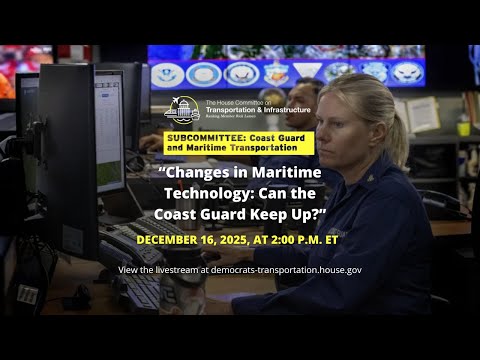
House subcommittee presses Coast Guard on plans to buy and regulate unmanned maritime systems
Get AI-powered insights, summaries, and transcripts
SubscribeSummary
Witnesses told the House Subcommittee on Coast Guard and Maritime Transportation that the Coast Guard is accelerating robotics and unmanned capabilities through Force Design 2028 and a new RAS PEO, and outlined funding and international coordination plans while GAO and the National Academies flagged regulatory gaps and data needs.
Chairman Ezell pressed the U.S. Coast Guard on how it intends to use recent funding and update regulation as maritime operators adopt autonomous vessels and other unmanned systems.
"With the reconciliation funds right now, what we have set aside, for the legislation is $350,000,000," Rear Admiral David C Bharata told the Subcommittee, adding that about $266,000,000 is intended for long‑range unmanned aerial systems and $75,000,000 for surface unmanned systems. Bharata said roughly $11,000,000 has already been used to renew remote operational vehicles and unit‑level systems and that the service expects to issue requests for information and begin procurement work over the next six to 12 months.
The Coast Guard described organizational changes meant to accelerate adoption. Bharata said the service has established a Robotics and Autonomous Systems Program Executive Office (RAS PEO) that will consolidate responsibilities for aircraft, surface, and counter‑UAS efforts; the office will oversee training, acquisition, obsolescence planning and the new robotics mission‑specialist rating.
GAO and National Academies witnesses urged caution. Mr. Von Hoff of the Government Accountability Office summarized GAO's August 2024 review and a follow‑up: "At the time of our report in August 2024, just a handful of requests had been made. Since then, Coast Guard has received 48 such requests and reported that they were able to manage the operations at the local level in all cases." He and GAO emphasized that many statutes and regulations assume vessels are crewed, which will complicate higher levels of autonomy and may require new authorities or clearer guidance.
Ms. Heidi C. Perry, who chaired the National Academies study committee, reiterated earlier recommendations to help the Coast Guard move faster and more deliberately: issue a high‑level unmanned systems strategy, designate a senior advocate for that strategy, formally establish a program office, expand experimentation, and assess funding needs for research, integration and personnel.
Committee members also discussed international work. Bharata cited the International Maritime Organization effort to finalize a voluntary maritime autonomous surface ship code by December 2026, and said the Coast Guard leads U.S. engagement with those negotiations. He also noted lessons from the at‑sea recovery operations pilot program and the importance of domestic test programs to produce operational data.
On cybersecurity and workforce, Coast Guard Cyber Command witnesses said the service conducts frequent cyber protection missions, has newly graduated an initial class of Coast Guard cyber mission specialists, and maintains close daily partnerships with CISA and Navy cyber units. At the same time they said more personnel and capacity will be needed under Force Design 2028 to operate and sustain new autonomous systems.
What happens next: the Chair requested that the Coast Guard update its unmanned systems strategic plan and provide details on procurement timelines and use of reconciliation funds; members also asked for follow‑up materials and questions for the record about pilot programs and statutory flexibility.
(Reporting note: quotes and figures above are taken from witness testimony and member questioning during the Subcommittee on Coast Guard and Maritime Transportation hearing.)