Citizen Portal

House subcommittee opens WRDA 2026 hearings; members warn DoD policy is slowing Corps communications

Subcommittee on Water Resources and Environment, House Committee on Transportation and Infrastructure · December 18, 2025

Get AI-powered insights, summaries, and transcripts

Subscribe
AI-Generated Content: All content on this page was generated by AI to highlight key points from the meeting. For complete details and context, we recommend watching the full video. so we can fix them.

Summary

The House Transportation and Infrastructure subcommittee began hearings to inform the Water Resources Development Act (WRDA) 2026, with witnesses and members urging predictable two‑year reauthorizations, faster Corps communications and clearer implementation of existing authorities. Concerns focused on a Defense Department directive limiting Corps engagement.

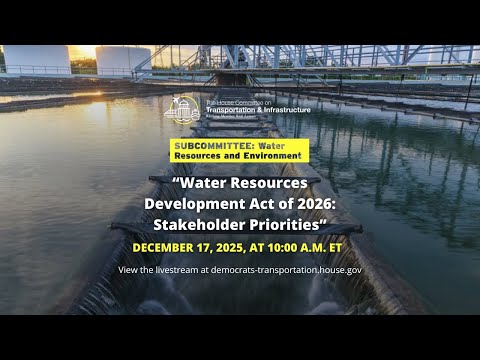
The House Transportation and Infrastructure subcommittee on Water Resources and Environment opened a series of hearings to inform drafting of the Water Resources Development Act (WRDA) 2026, and lawmakers and witnesses warned that recent changes to Army Corps of Engineers information‑sharing policies are delaying critical project work.

Chairman Collins opened the Dec. 16 hearing by stressing WRDA’s importance and the benefits of a predictable two‑year cycle for navigation, flood control and ecosystem restoration. ‘‘Water is one of the most important pieces of legislation that we work to draft and pass here at the Transportation and Infrastructure Committee,’’ the chair said during opening remarks.

Ranking Member Wilson and other lawmakers told witnesses they have observed examples where Corps districts must wait for higher‑level Department of Defense sign‑off before sharing routine project information with congressional offices and nonfederal sponsors. ‘‘We have to go ask the Secretary of Defense, Pete Hegseth, for permission to save lives in my district,’’ Rep. Larson said, describing a practical impact of the policy on flood response in his district.

Witnesses representing local sponsors and industry said the change has already complicated planning and delivery. Julie Offner, president and CEO of the National Waterways Conference, said consistent, early engagement from the Corps prevents issues that later become costly to fix. ‘‘The importance of clear, consistent communication,’’ she said, ‘‘cannot be overstated.’’

Members pressed witnesses on operational impacts: whether the directive will slow feasibility studies, delay project delivery and exacerbate the gap between WRDA authorizations and subsequent appropriations. Offner and others recommended that the Corps and Defense Department clarify and narrow any requirements that impede routine engagement with members’ offices and nonfederal project sponsors.

The subcommittee also used the hearing to emphasize implementation of authorities included in recent WRDA bills, and to encourage Congress and the Corps to identify where guidance—not new law—can resolve delays. The chair kept the record open for post‑hearing submissions and suspended the hearing for a series of House floor votes before resuming questioning.

Next steps: Committee members said they will continue these hearings as part of WRDA 2026 drafting and examine whether formal oversight or statutory clarifications are needed to restore preexisting communication channels between Corps districts, sponsors and congressional offices.