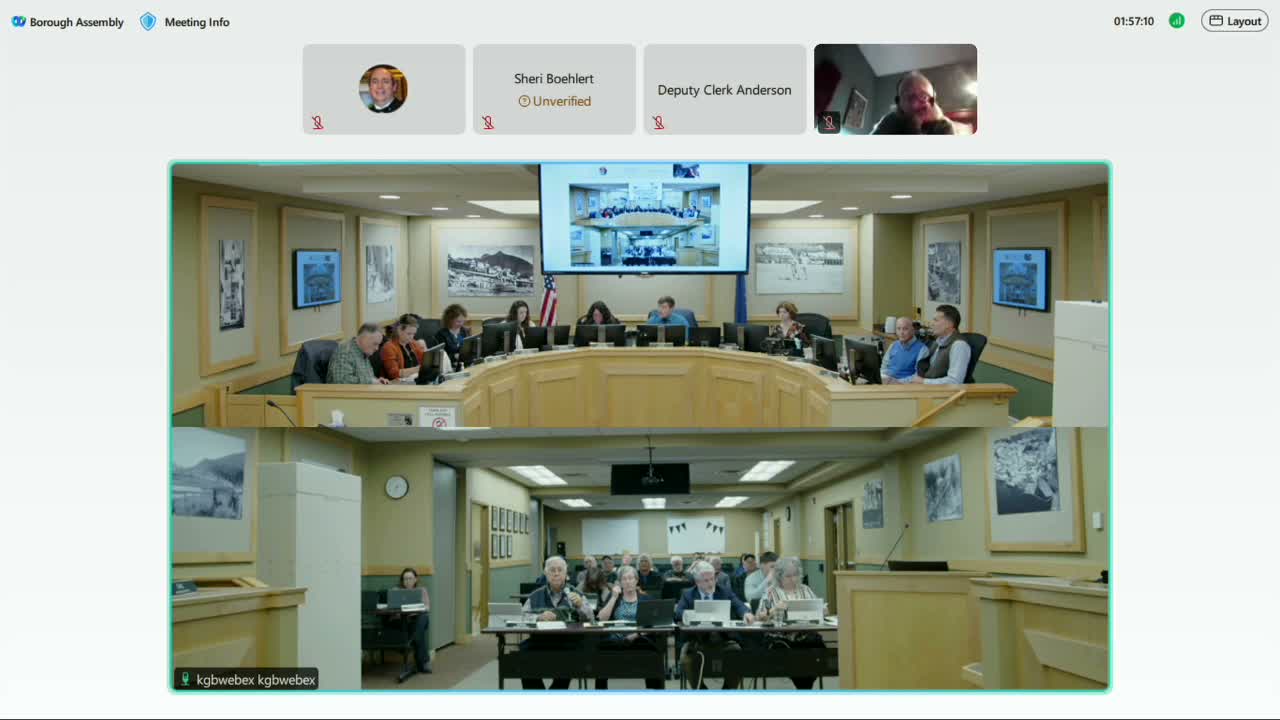
Borough assembly orders review after officials report $5.4 million shortfall in local education fund
Loading...
Summary
After a work session on Dec. 1, the Ketchikan Gateway Borough Assembly directed staff to draft stronger fiscal‑oversight options following staff reports that the district’s local‑education fund showed an accrued debt of roughly $5.4 million as of June 30, 2025; the assembly also asked for options including independent internal‑controls review and improved monthly reporting.
The Ketchikan Gateway Borough Assembly on Dec. 1 directed borough staff to produce ordinance options and other measures to strengthen fiscal oversight after staff disclosed an internal debt in the district’s local education fund (LEF) that stood at about $5.4 million as of June 30, 2025.
The directive came after a work session during which Finance Director Charlene Thomas told the assembly that ‘‘the district’s spending of local funds exceeded the LEF appropriations,’’ creating an internal debt the borough now carries. Manager and staff briefings traced the problem to timing and accounting of transfers, an advance of state foundation dollars used to cover prior payroll, and repeated instances in which LEF appropriations were exhausted while the borough continued to make payments on the district’s behalf.
‘‘This debt represents the overuse of the local dollars only,’’ Thomas said, emphasizing the LEF does not include state foundation funding. Manager Duran and other staff described steps under consideration to prevent a recurrence: a hard stop on local payments when LEF funds are exhausted, real‑time reconciliation of the LEF balance, independent reviews of internal controls, and a requirement that the district provide monthly cash‑flow statements.
Assembly members pressed for immediate and concrete protections. Assemblymember Dyle moved — and the body adopted — a direction for borough staff to review the fiscal‑oversight recommendations discussed that night, ‘‘including legal boundaries between borough and school board authority and to return with draft ordinance language or ordinance alternatives that support improved fiscal accountability, transparency, and protection of borough appropriated funds,’’ according to the motion introduced at the meeting.
School board president Catherine Tatsuta said the district plans to present an amended budget to the school board on Dec. 17 and will provide cash‑flow estimates; interim superintendent Ford Slack said she was working with auditors and that the district’s audit was near finalization. Slack also told the assembly, ‘‘We have not lost Title I funds’’ for the current year, and she said she would provide further detail as auditors and staff complete their reviews.
Staff told the assembly the LEF-related liability had swelled to roughly $7.5 million in FY2024 and had been reduced to about $5.4 million by June 30, 2025, after the borough transferred a FY2026 appropriation that temporarily altered account balances. Finance staff cautioned that while the district maintains approximately $6.5 million in a North Rim account the borough manages, only an estimated $1.5 million of that currently represents available LEF appropriations the district may legally spend without creating new LEF liabilities.
Assembly members proposed multiple remedies discussed in the work session: requiring signed memoranda of agreement for any interfund borrowing or advances; monthly reconciliations and more timely reporting from the district’s business office; an independent internal‑controls review by a third‑party firm (BDO was cited as a likely contractor); and consideration of statutory or policy changes that would alter the current ‘‘central treasury’’ relationship between borough and district accounting.
Manager Duran and audit staff emphasized the problem is operational as much as accounting: they recommended improved controls and reporting to detect unusual growth in interfund payables and to prevent the practice of using future revenues to cover prior obligations. Council members repeatedly urged the district to produce monthly reports and cash‑flow projections that the assembly can review promptly.
Next steps: borough staff will return with draft ordinance language or alternatives for assembly consideration and will work to schedule a monthly liaison meeting with the school board beginning in January to improve information flow, the assembly directed.