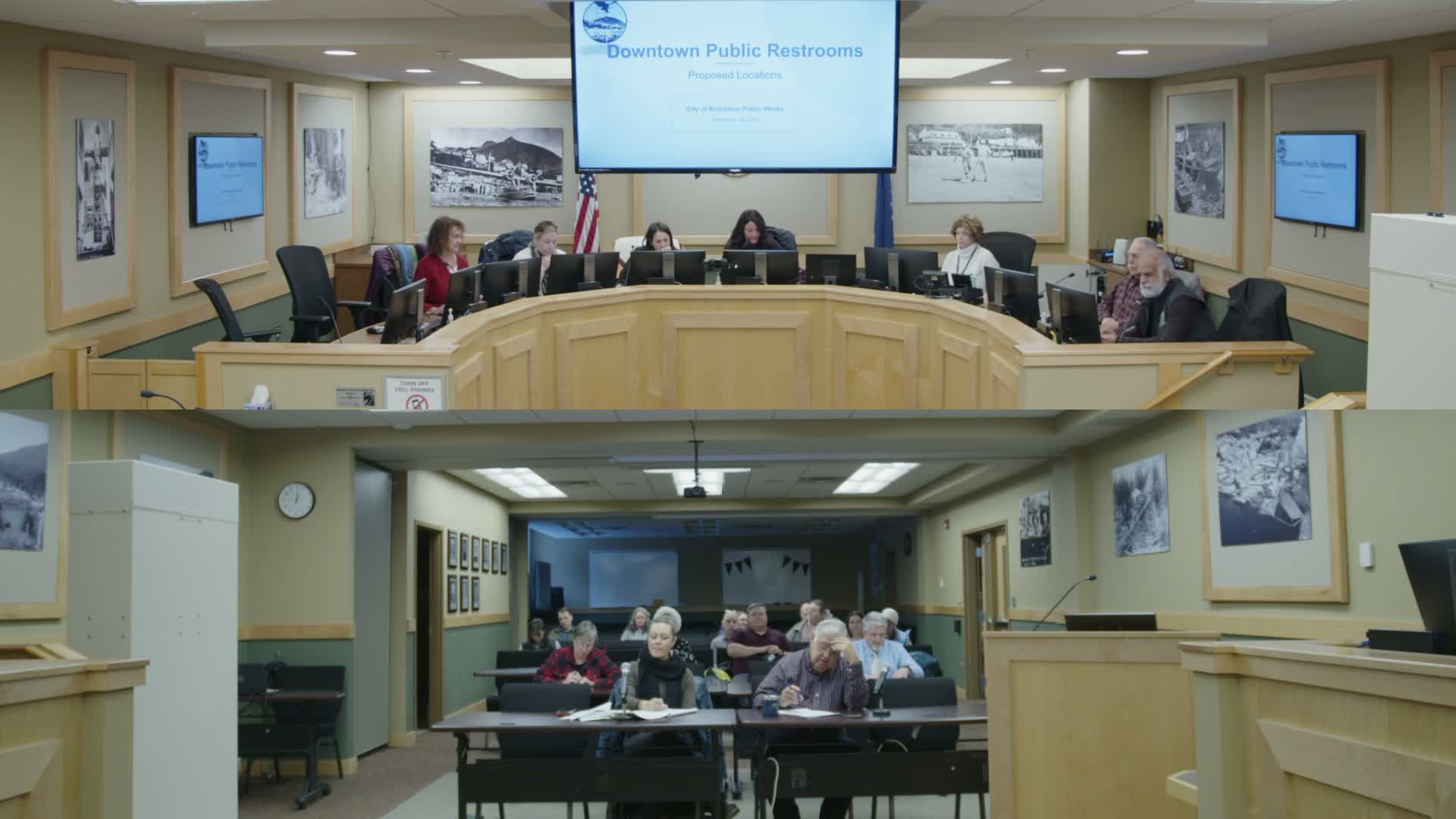
Joint Ketchikan committee directs staff to study restrooms near 24 Creek Street
Loading...
Summary
The joint Cooperative Relations Committee asked borough and city staff to analyze costs and timelines for a permanent restroom near 24 Creek Street and to produce a comparison with a nearby Stedman Street site; the directive passed unanimously after members voiced frustration about long-standing lack of downtown facilities.
The Joint Cooperative Relations Committee of the Ketchikan Gateway Borough and the City of Ketchikan voted at its noon meeting to ask borough and city staff to study the cost and timeline to develop a public restroom at the site near 24 Creek Street, and to include a nearby Stedman Street location for comparison.
The committee’s action responds to long-running complaints from residents and downtown businesses about a shortage of public restrooms in the Creek Street/downtown core, a problem raised during public comment and throughout the staff presentation. "This is to talk about bathrooms and considering infrastructure in a downtown that solely relies on tourism," public commenter Hamilton Gellhar said, criticizing the pace of local action.
City assistant public works director Amanda Robinson presented preliminary site work and identified four city-owned properties in the downtown core as viable options. "We have identified 4 properties in that downtown core area that are viable," Robinson said, summarizing basic constraints: two Creek Street parcels would require pile-supported foundations and manual material delivery because heavy equipment cannot access the sites; the Stedman Street lot could accommodate a unit but would eliminate some parking; and a Thomas Basin/Lou’s Loop location is further from the Creek Street heart but benefits from existing sewer and water.
Robinson warned that waterside work requiring pilings would face permitting timelines. "I am currently going through the Army Corps permit process for the Old Bar Harbor restaurant, and it has taken me about 6 months just for a demolition," she said, adding estimates that similar permitting could take six months to a year.
City tourism manager Laurie Boys described short-term and alternate approaches, noting a mobile restroom model used in Sitka and the possibility of siting a mobile unit in the Discovery Center parking lot, which has utilities and would use about six parking spaces. Boys cautioned that the Discovery Center charges admission and that interior restrooms are not freely accessible without a subsidy or a change in entry arrangement.
Committee members raised operational and safety concerns, including winterization of facilities, loss of parking at Stedman Street, jaywalking and emergency access if a unit were placed near the fire station, and the need for Creek Street Historical Board review for Creek Street locations. Members also asked staff to return pedestrian or visitor counts to help size a permanent facility.
The committee member who moved the directive framed it as a step toward action, not final design. Member Arntzen said the goal was to get staff traction: "We need to get some traction so that we can establish a site and move forward with figuring out how we're going to fund the bathrooms for Creek Street." An amendment to include the nearby Stedman Street site (site 3) for cost and timeline comparison passed before the final motion carried on a recorded vote of five in favor, zero opposed.
Votes at a glance: the committee unanimously approved appointments of Jamie Palmer (borough co-chair) and Abby Bradbury (city co-chair) earlier in the meeting; later it voted 5–0 to direct staff to explore costs for Site 2 (near 24 Creek Street) and to include Site 3 (Stedman Street) for comparison.
The committee set a follow-up report and next meeting for Jan. 30 at noon in the City of Ketchikan; staff were asked to return comparative cost and permitting timelines for the two identified sites. The committee adjourned after confirming other future agenda items for cooperative work on tourism-funded projects.