Get Full Government Meeting Transcripts, Videos, & Alerts Forever!
Get email alerts on the Communications Tower topic
No spam. Unsubscribe anytime.
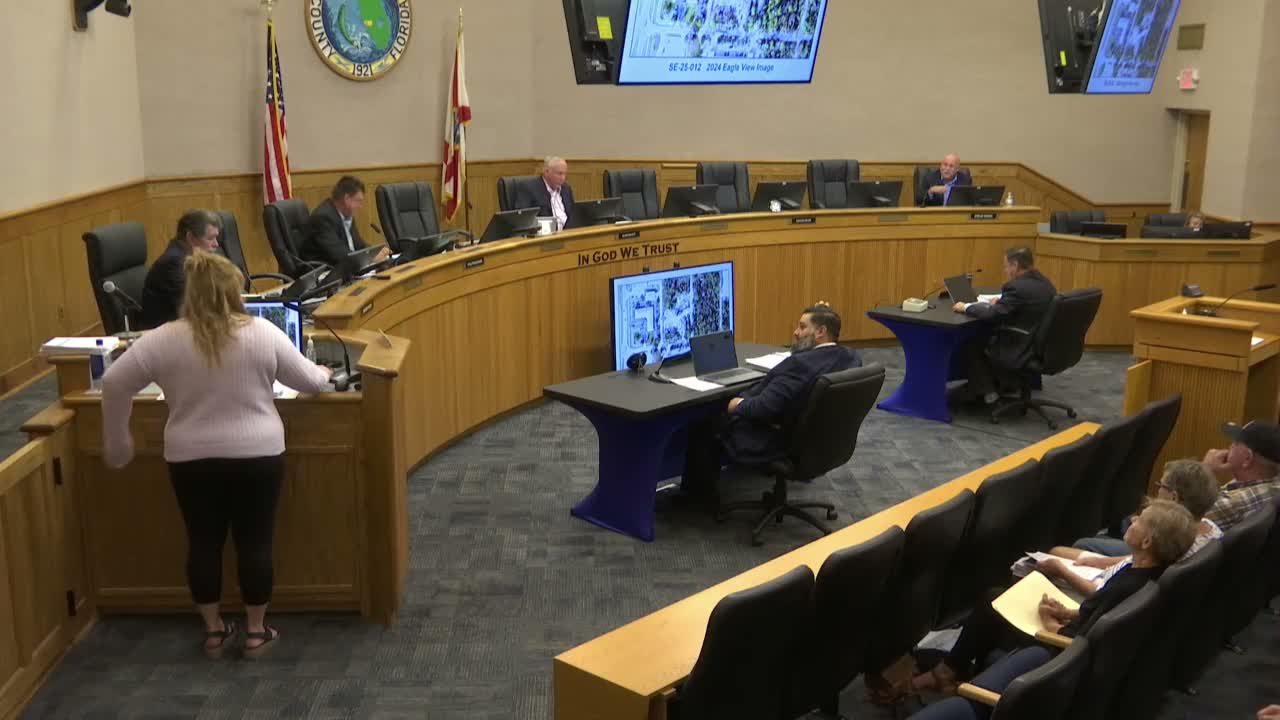
After split vote then approval, board clears 169-foot communications tower near Englewood residential area
Summary
Charlotte County's Board of Zoning Appeals approved a special exception for a 169-foot communications tower on Sunrise Baptist Church property in Englewood after extensive public comment about property values, children's safety and health, testimony from the applicant and RF engineers, an initial denial motion that resulted in a tie, and a subsequent approving motion.
Charlotte County's Board of Zoning Appeals approved a special exception Nov. 19 to allow a 165-foot monopole plus a 4-foot lightning rod (total 169 feet) to be constructed on Sunrise Baptist Church property in Englewood, despite strong neighborhood opposition focused on property values, children's safety and health concerns.
Senior planner Elizabeth Nocek presented the application for Vertex Development and Sunrise Baptist Church, explaining the county code permits telecommunications facilities above 50 feet by special exception (Section 3-9-68). The proposed tower site is a leased 4,900-square-foot area at the northeast corner of the church parcel at 11050 Wilmington Boulevard; the design includes a 2,500-square-foot equipment compound, an 8-foot fence and a Type D landscape buffer. Staff found the proposal met the three special-exception criteria (consistency with the comprehensive plan, compatibility if conditioned, and no evidence of detriment to public health, safety or welfare) and recommended approval with conditions including a maximum overall height of 169 feet, monopole design, required permits and an 8-foot opaque fence around the compound.
More than two dozen residents spoke in opposition during public comment. Amy Hibbert, a longtime real-estate broker, said industry data show a "20% decrease in property values proximal to these cell towers," and other speakers raised concerns about aesthetics, children's safety at a planned adjacent Boys & Girls Club site, and health worries about electromagnetic fields (EMFs). Lynn Dorler, executive director of the Boys & Girls Clubs of Charlotte County, said the club had purchased adjacent acreage and was not expecting a tower on the church parcel; she urged the board to weigh community impacts for children.
Vertex counsel Mary Solik and Vertex principal Alan Ruiz described the search for buildable, zonable land packages and said institutional neighbors made the church site appropriate. An RF engineer for Verizon testified a tower of the proposed height would provide coverage and capacity that many shorter 50-foot poles could not, and that antennas can be sector-directed but not perfectly confined. As Vertex's Alan Ruiz put it, "The higher you bring up the flashlight, the bigger the circle gets," illustrating coverage-area tradeoffs.
The board first voted on a motion to deny the special exception, prompted by concerns about the tower's proximity to the planned Boys & Girls Club; that motion produced a tie vote and failed because tie votes do not carry motions. The board then took a subsequent motion to approve the special exception (including staff conditions); that motion carried and the special exception was approved.
Legal counsel reminded the board that federal law (47 U.S.C. 332(c)(7)(B)(iv)) limits local governments from regulating wireless facility siting on the basis of RF environmental effects to the extent facilities comply with FCC regulations. The board adopted staff conditions concerning height, design, permitting and buffering as part of the approval.
The approval allows the developer to pursue final permitting, environmental review and construction per the conditions; opponents may have recourse through administrative appeal or other legal avenues available under local and federal law.