Get Full Government Meeting Transcripts, Videos, & Alerts Forever!
Get email alerts on the Healthcare Prescriptions topic
No spam. Unsubscribe anytime.
Charlotte County leaders press staff after GLP‑1 drugs drive sharp spike in prescription costs
Summary
Commissioners were told clinic capacity constraints and a surge in GLP‑1 and a handful of high‑cost drugs have driven prescription spending sharply higher; staff were directed to return with quarterly updates and legal/operational options, including possible co‑pay changes or restricted coverage for non‑diabetics.
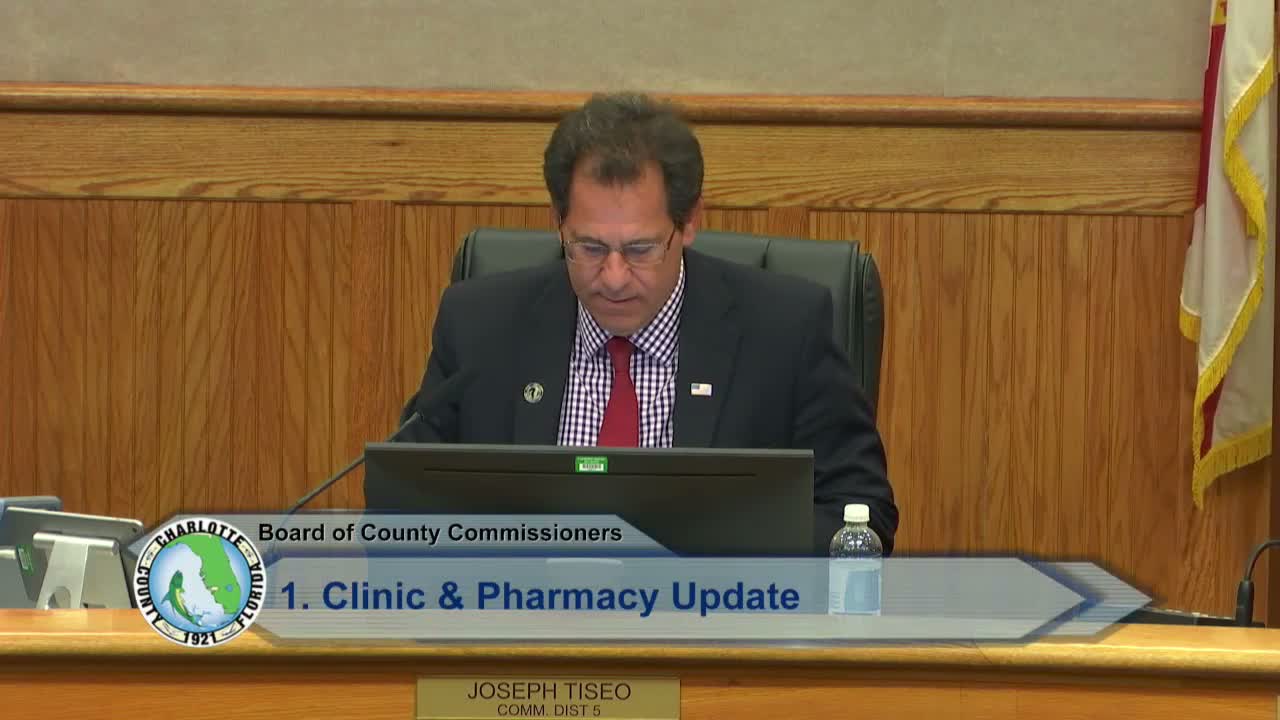
Charlotte County commissioners pressed staff on Nov. 18 after an update showing prescription spending has surged in the last two years, largely because of newer brand drugs including GLP‑1 treatments and several very expensive specialty medications.
Gordon Burger, director of budget administrative services, told the board the county health center is operating at "well over 95 percent every month," above the staff target of about 85 percent that leaves capacity for sick and emergency appointments. He said the county expects to open two exam rooms at the Gray Street clinic "by the first of the year," which staff estimate will add roughly 30 visits per day.
The spike in spending reflects two forces, Burger said: a small number of exceptionally expensive claims and a rapid increase in GLP‑1 prescriptions since 2021. "We had a claim exceed over $1,000,000," he said of a recent heart‑and‑lung case, and later added that five drugs (two cancer drugs and two biologic autoimmune therapies among them) permanently raised baseline costs by roughly $2,000,000.
Commissioners asked for more detail. The chair summarized staff calculations showing GLP‑1 drugs grew from about 7% of total prescription spending in 2021 to roughly 47% in 2025, which he said equated to about $3,700,000 in 2025 and roughly 433 employees on those drugs ("about $8,500 per year on average per employee"). The chair pressed for measurable net benefit to taxpayers if expensive non‑diabetic GLP‑1 prescriptions are covered.
Several commissioners proposed policy levers to curb costs. Commissioner Constance urged aggressive action, saying "these people could be cut off today" and arguing a temporary phase‑out or tighter access criteria would be feasible because, she said, the medications are elective for many non‑diabetic users. Commissioner Doherty and others supported analyzing options including requiring non‑diabetic GLP‑1 prescriptions to be managed through the county clinic, raising co‑pays for non‑diabetic uses, or a phased discontinuation.
Burger said the county opened a full pharmacy in Punta Gorda in July and moved from a dispensary model that limited what could be issued. He told the board staff delayed plan changes while switching insurers and will start the new protocol with Aetna on Jan. 1. "We plan to start this fresh and right from the get‑go, January 1 with Aetna," he said.
County Attorney Jeanette Knowlton told the board the office will review legal constraints and options for mandates or cost‑sharing changes: "We will have to look at all those options," she said.
Outcome and next steps: The board directed staff to return with a strategy and to provide quarterly updates beginning in January. Staff were asked to provide a more detailed breakdown of the specific high‑cost drugs, counts, and per‑user costs and to present legal and operational analyses on options such as mandated clinic routing for non‑diabetic GLP‑1 users, co‑pay adjustments, and a phased reduction in coverage.
Sources: Comments and figures presented by Gordon Burger and commissioners during the Nov. 18 Charlotte County Board workshop. The board did not take a formal vote during the discussion.