Get Full Government Meeting Transcripts, Videos, & Alerts Forever!
Get email alerts on the Special Exception Outdoor Storage topic
No spam. Unsubscribe anytime.
BZA approves outdoor vehicle‑storage special exception on Duncan Road with buffers, despite heavy resident opposition
Summary
After hours of testimony, Charlotte County’s Board of Zoning Appeals approved a special exception for outdoor storage of boats, RVs and trailers at two Duncan Road parcels owned by Paradise Palms RV LLC, conditioned on Type D buffers, a tall opaque fence, stormwater requirements and an acknowledgement of a prior DCA settlement on the property.
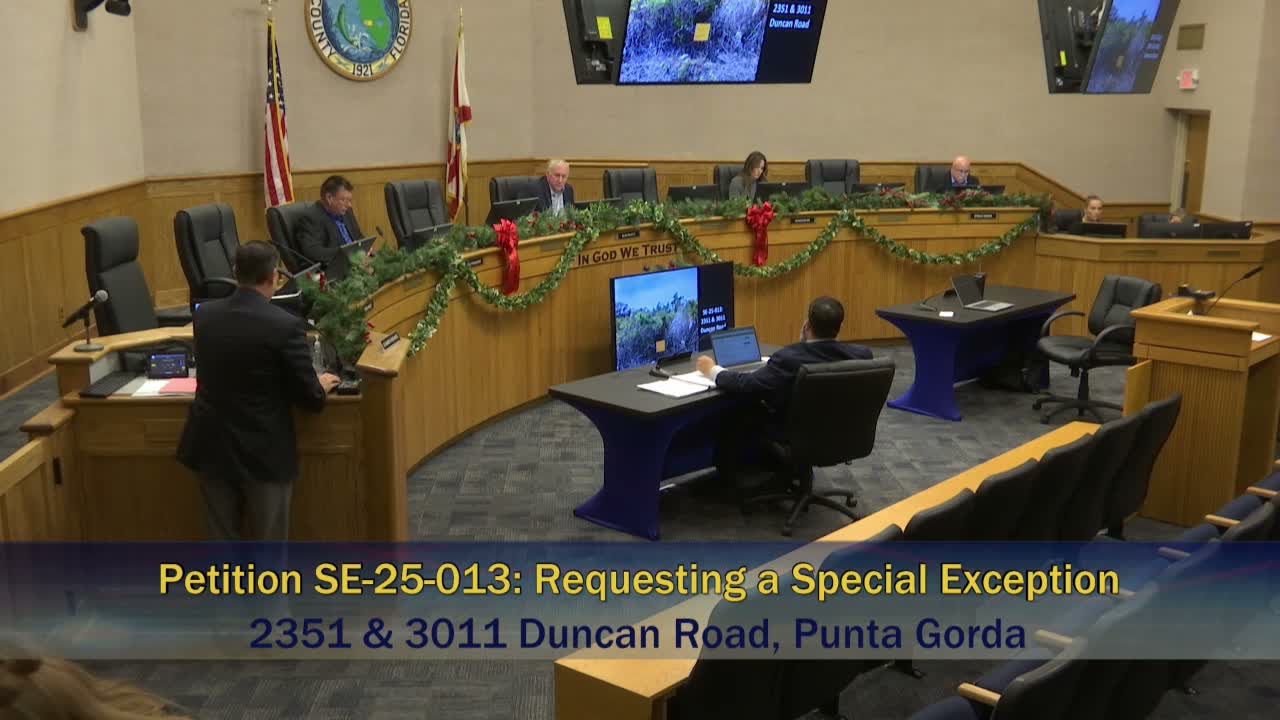
The Charlotte County Board of Zoning Appeals on Dec. 10 approved a special exception allowing outdoor storage of recreational and noncommercial vehicles at parcels on Duncan Road in Punta Gorda, subject to multiple conditions intended to reduce visual and environmental impacts.
Planning staff presented the proposal for Paradise Palms RV LLC, describing a roughly 16.8‑acre vacant site that includes jurisdictional wetlands and a 25‑foot wetland buffer. Staff said the use of outdoor storage is an industrial‑type use allowed in the Commercial General (CG) zoning district only by special exception and expressed concerns about aesthetics, compatibility with adjacent residential and preserved lands, and potential runoff into nearby preserves. "Outdoor storage is an industrial commercial type of use… staff has concerns regarding the compatibility of outdoor storage when adjacent to residential or environmentally sensitive properties," said Sean Cullinan, planning/zoning official.
County Attorney’s Office placed a stipulated settlement agreement between the Florida Department of Community Affairs and Charlotte County (case dated 07/22/2008) into the record and advised the Board that the county remains party to that agreement; staff warned the Board the county may condition permit approvals until it determines whether the settlement’s conditions apply to the current owner. The applicant’s attorney, Rob Bernsen, said the current owner was not a party to the original plan amendment or settlement and asserted the settlement was not recorded and therefore not enforceable against subsequent purchasers under state law.
Residents testified at length in opposition, citing removal of trees and habitat for scrub‑jay and gopher tortoise, runoff and potential leaks from stored vehicles reaching wetlands and the Peace River, and the cumulative effect of many nearby storage facilities along US‑17. "Once it's cleared, you can't go backwards," said Mary Anne Tipton, a retired U.S. Air Force colonel, urging denial to avoid permanent loss of habitat. Other neighbors raised concerns about visual blight, storm events, and potential for contamination.
The applicant’s engineer described technical measures intended to reduce risk: a stormwater system of engineered dry ponds with baffles to trap oils and an internal drainage design that the engineer said would keep oils on site; drive aisles would be paved and storage bays could be gravel. The applicant also agreed to added mitigation on the record, offering an 8‑foot‑tall opaque fence along US‑17 and consenting to staff‑recommended buffer adjustments.
Board members and staff discussed monitoring and remediation of stormwater features, DEP/Swiftmud remediation triggers, and the Habitat Conservation Plan requirements for preservation areas. Staff recommended approval only if a set of conditions were adopted; the board approved the special exception with the county’s recommended conditions plus the applicant’s offered 8‑foot fence along US‑17 and a record acknowledgement of the county attorney’s notice of the stipulated settlement agreement.
Conditions recorded in the approval include: adherence to the submitted site plan and legal description; required Type D landscaping buffers and a six‑foot opaque fence or wall (with an eight‑foot fence along US‑17 per applicant offer); prohibition on chain‑link fencing; prohibition of dump/wash stations and hazardous material storage on site; required stormwater controls and plantings; preservation areas to be approved and placed under a county‑approved conservation easement as required by the county’s Habitat Conservation Plan; and a three‑year term for the special exception (with specified commencement provisions). The Board carried the motion by voice vote.