Get Full Government Meeting Transcripts, Videos, & Alerts Forever!
Get email alerts on the Parks Recreation topic
No spam. Unsubscribe anytime.
Parents and coaches decry winter closures of county soccer fields; board cites safety and overuse
Summary
Charlotte County closed several sports fields for December–January maintenance after staff found approximately 2,000 annual hours of use — far above recommended levels. Youth soccer clubs told commissioners closures disrupt competitive schedules; the board and staff discussed short‑term contingencies and long‑term options including artificial turf and coordination with school fields.
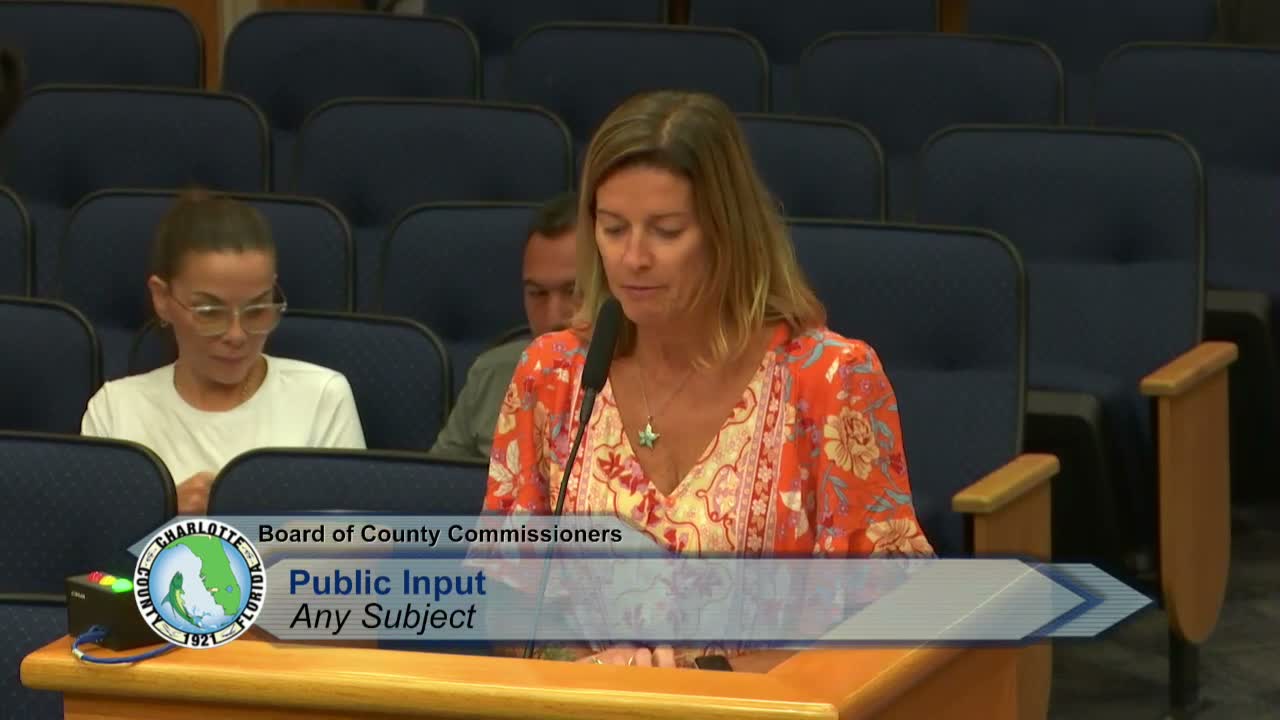
Dozens of parents, coaches and youth‑sports leaders told Charlotte County commissioners on Nov. 25 that planned December–January closures of county soccer fields would leave roughly 750–800 young players with nowhere to practice or host games.
Speakers from Charlotte County Premier and other clubs said the shutdowns were announced in June and July but that many parents and teams had not understood the extent of the winter closures until late November. Shana Baxter, representing the soccer club, said the closures affect competitive teams during their peak season and asked the board to keep at least one field open or rotate closures across locations.
Tommy Scott, community services director, said natural‑turf fields at Centennial and South County are suffering from overuse. "We are currently sitting just under 2,000 hours a year," Scott said, calling that "an unsustainable model" and noting the department’s preferred range is 400–600 hours (800 maximum) for safe play. He explained the department schedules rest and maintenance windows (a summer rest and the December–January rest period) to protect turf and keep players safe. Scott warned that if fields continue to be played through the winter, the county could be forced to strip and resod fields, extending downtime into the spring recreational season.
Commissioners discussed short‑term mitigation: borrowing high‑school fields for games, opening non‑standard open spaces for limited practice, or staging a phased closure so at least one complex remains available while another rests. Longer‑term options discussed included acquiring land for additional fields, converting at least one field to artificial turf (estimates near $2 million per field), or partnering with schools to increase capacity.
Board members urged the parks division to expand outreach to league officials, to enforce and clarify hours limits and to return with a plan to reduce overloading on natural turf. Several commissioners said they supported exploring synthetic turf fields strategically to reduce recurring closures.
Sources: public testimony by youth club representatives, staff presentation and field‑use data (Tommy Scott); board discussion.