Get Full Government Meeting Transcripts, Videos, & Alerts Forever!
Get email alerts on the Land Use Tcp2404 topic
No spam. Unsubscribe anytime.
Pulte’s proposed U.S. 17 village draws hundreds of residents; commissioners transmit plan for state review but cap density at prior limits
Summary
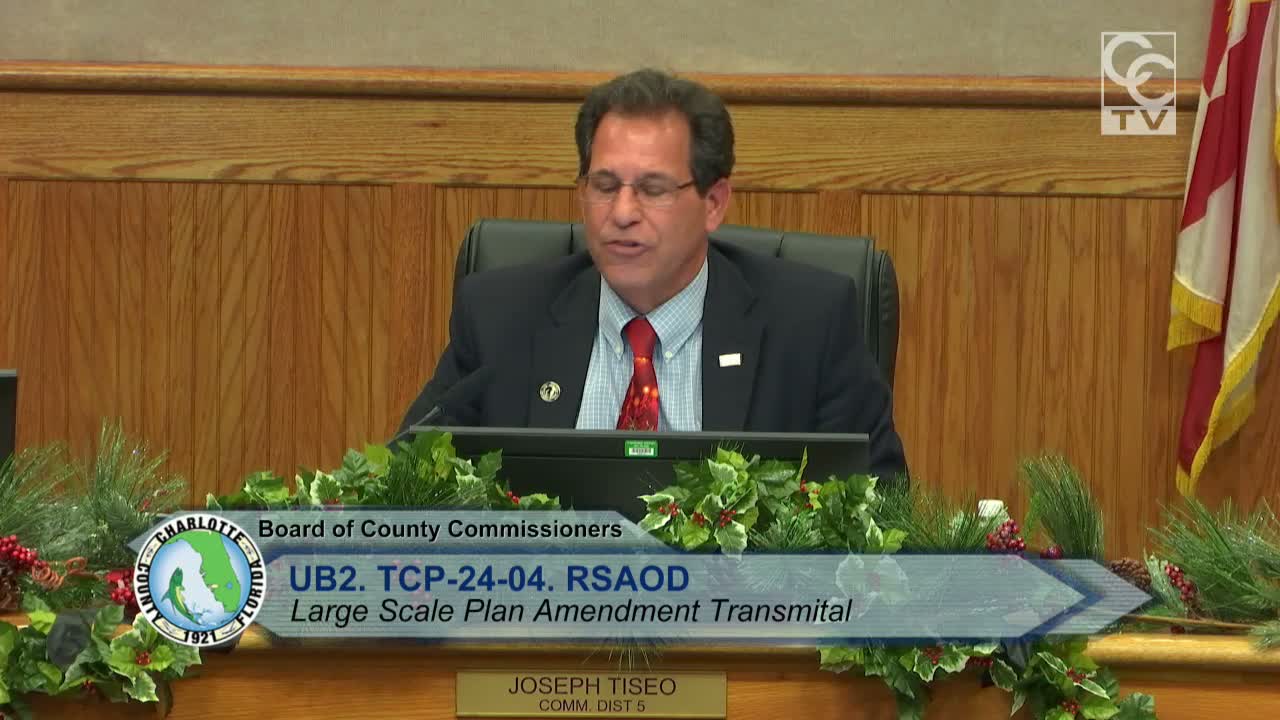
After hours of testimony and packed public comment, the Charlotte County Commission voted 3–2 to transmit Pulte Group’s proposed changes to the U.S. 17 Rural Settlement Area overlay to state agencies for review, but limited the transmittal to the overlay’s existing entitlements (6,000 residential units and the previously adopted nonresidential totals) rather than the applicant’s requested increase to 8,000 units.
Punta Gorda — The Charlotte County Board of County Commissioners on Dec. 9 moved to send a contested land‑use change sought by homebuilder Pulte Group to state review, after a marathon public hearing in which scores of residents urged denial. Commissioners voted 3–2 to transmit the application for interagency review while restricting the transmittal to the overlay’s historic entitlements rather than the applicant’s larger request.
The proposal, TCP‑24‑04, would have amended the county’s U.S. 17 Rural Settlement Area Overlay District to raise the overlay’s maximum residential allocation from the plan’s existing limit to 8,000 units and increase nonresidential intensity. Pulte says the changes are needed to cover rising infrastructure and design costs and to allow a comprehensive master plan for the 4,900‑acre overlay area. The developer has offered design measures including a pattern book, a sizable greenbelt in places, an affordable‑housing set‑aside for a portion of new units, and restoration and open‑space commitments.
Opponents — dozens of people occupying the commission chamber and more who signed up to speak — described the proposal as urban sprawl that would overwhelm local roads, strain limited water and emergency services, and permanently destroy habitat for wildlife such as scrub jays and gopher tortoises. Multiple speakers asked the commission to deny the text change, to require more study by state agencies, or to consider alternative uses such as a regional park or conservation corridor.
“If you approve this, you are changing the rules that were adopted after public workshops and careful consideration,” said former county planning official Ralph Brooks, who advised the board that plan changes are legislative choices and may be denied. Environmental advocates, long‑time residents and local landowners said the overlay’s original transfer‑of‑density mechanism — which channels development away from small, platted rural lots — must be kept to preserve the county’s policy intent.
Pulte’s planning team, represented by attorney Derek Rooney and planner Dan DeLisi, said the company is seeking a workable way to finance and deliver a planned community and its public facilities (roads, trails, schools and utilities) and offered concessions such as expanded greenbelt widths and affordable housing set‑asides to address community concerns. Pulte’s consultants also gave assurances that potable water would come from Peace River‑area wholesale providers rather than production wells on site, and that wetlands/restoration obligations would be part of rezoning and PD‑level approvals.
Commissioners pressed both sides on traffic, water availability and the legal mechanics for transferring development rights. After extended discussion the board voted to send the application to state agencies (FDOT, DEP, South Florida Water Management District/SWFWMD, Department of Economic Opportunity, Fish & Wildlife, Department of Agriculture and others) for formal interagency comment. The board’s transmittal was explicitly limited to the overlay’s existing entitlement baseline (6,000 residential units and the previously adopted nonresidential totals) and removed the applicant’s requested increase for the purpose of the transmittal; commissioners said they wanted state agency input and more time to resolve community concerns before any adoption vote.
The state review will produce technical comments on traffic, water supply and environmental impacts. If the applicant continues, any later adoption by the board would require further public hearings and a formal adoption process after the state comment period.
Vote and next steps: The motion to transmit the application with the limits described passed 3–2. If the applicant pursues adoption, the earliest likely adoption hearing would come in spring 2026 after agencies submit comments and staff prepares a recommended ordinance for the board.
What people said: “This is urban sprawl,” resident speakers told the commission, warning of school overcrowding, more emergency calls, and wildlife habitat loss. Pulte representatives said they could revise the plan and noted they were prepared to negotiate specifics at the PD (rezoning) stage. Planning staff said the overlay was drafted in 2010 to guide development along the U.S. 17 corridor and that the applicant’s requested text would change the policy framework that has governed the area for 15 years.
Why it matters: The U.S. 17 overlay was created to concentrate development where services can be efficiently provided and to direct growth away from fragile rural and platted areas. The commission’s action sends the applicant’s requested policy changes to state agencies for technical review while preserving the overlay’s historic limits for now. The decision also signals continued community resistance to large increases in density without clearer commitments on infrastructure, water, public safety and habitat protection.
The county will publish state agency comments when received; commissioners and staff said they expect further public hearings before any adoption vote.