Get Full Government Meeting Transcripts, Videos, & Alerts Forever!
Get email alerts on the Code Enforcement topic
No spam. Unsubscribe anytime.
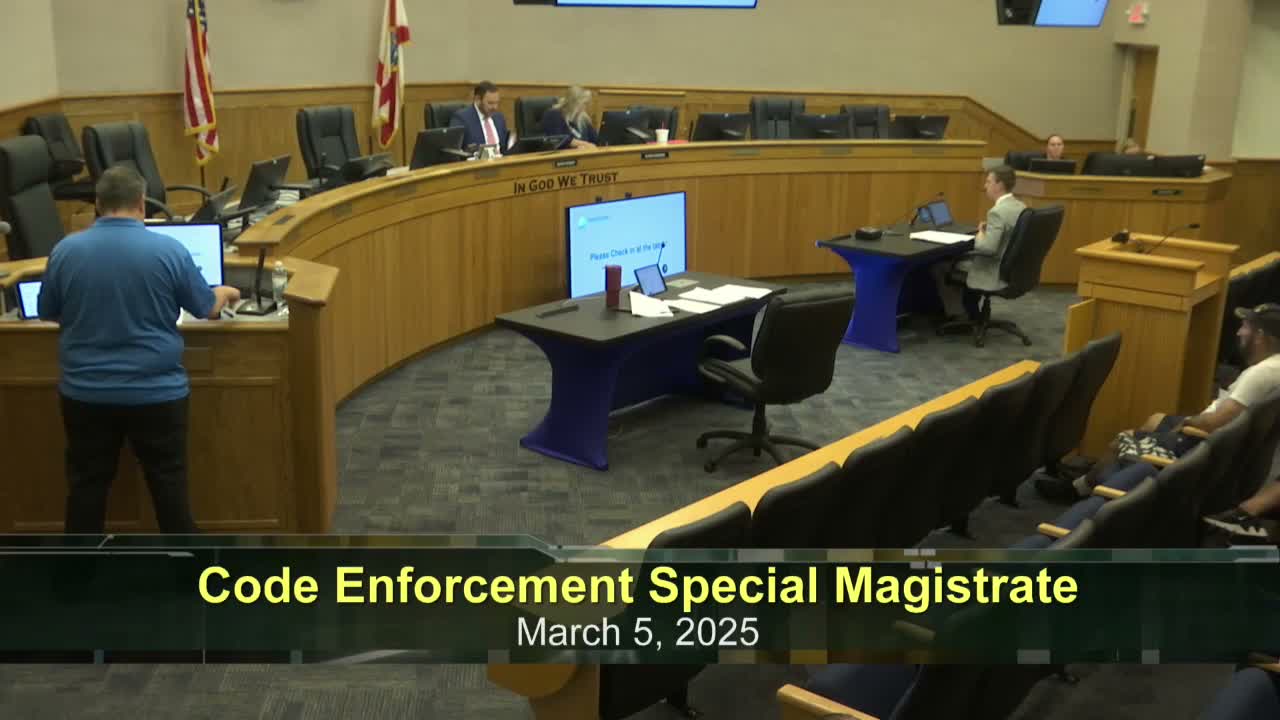
Charlotte County magistrate orders deadlines, cuts fines and dismisses one case at March 5 enforcement hearing
Summary
At a March 5 Charlotte County special magistrate hearing, the court heard dozens of property-code cases; the magistrate reduced several fines to recording fees, continued habitat-clearing cases for coordination with Fish & Wildlife, dismissed one ANC after testimony, and set compliance deadlines ranging from 15 to 120 days.
The Charlotte County special magistrate convened on March 5, 2025, to hear evidence in multiple code-enforcement cases involving unpermitted work, junk-like conditions, right-of-way encroachments and habitat clearing. The magistrate, who opened the session by reminding attendees that “this is an evidentiary hearing process under chapter 162, Florida statutes,” processed dozens of files and issued a mix of reductions, continuances and enforcement deadlines.
Many cases ended with short compliance windows and reduced fines aimed at securing corrective action rather than maximizing penalties. The magistrate reduced or knocked down fines to recording fees in several matters where respondents showed progress or had mitigating circumstances; in other matters the magistrate entered findings of violation and set deadlines for permit pulls or property cleanup.
Decisions at a glance
- COD22-02181 (Oilwell Road): Magistrate found no compliance but reduced a previously assessed $9,720 fine to recording fees (about $20) and warned the county may re-list the full fine if noncompliance continues (order entered by the magistrate during the hearing). Quote: “I m gonna enter in the order that there is no compliance, but I m gonna reduce the fine down to the recording fees, which is about $20.”
- COD24-00967 (Highlands Road, respondent Eluzzi): Continued 90 days for remediation after the respondent said relocation of gopher turtles prevented removal of debris; magistrate recognized mitigation and scheduled reinspection.
- COD24-00355 (15216 Wymore Ave., Augustine): Officer Savannah Teej testified the owner had not pulled a permit for a shed; magistrate reduced the ANC fine to $450 and ordered the owner to obtain the required building permit and final inspection.
- COD24-01068 (12602 Chamberlain Blvd., Chisano/Audette): Officer Teej reported commercial equipment and unfinaled fence permits; magistrate entered a first-ANC fine of $70 and reiterated that equipment used for commercial purposes cannot be stored on a residential lot.
- COD23-02138 (5680 Sable Palm Lane, Vaughn): After the respondent described recent serious health problems and volunteer cleanup, the magistrate dismissed the ANC fine and ordered county reinspection to verify compliance.
- COD24-00055 (6452 Austrian Blvd., Tindall): With a renewed permit on file, the magistrate reduced the sanction to $452 and required follow-up with county staff to address vehicles stored on a vacant lot that were not tied to active construction.
- COD25-00030 (28412 Pasadena Dr.): Magistrate found a motor home stored and used for living purposes on an undeveloped lot; ordered 60 days to comply, a $50-per-day penalty thereafter, and a two-year cease-and-desist order with abatement authority for the county if necessary. The owner reserved the right to move the dispute to circuit court.
What the magistrate emphasized
The magistrate repeatedly framed the process as corrective, not punitive, saying the goal is “to get compliance, not to bring in fees.” For many respondents the magistrate gave additional time to secure permits, schedule final inspections, or coordinate with county staff (permitting, maintenance/operations or natural-resources staff). For habitat-related clearing in scrub-jay/special habitat zones, the magistrate instructed respondents and contractors to bring Fish and Wildlife documentation and HCP/settlement paperwork to clarify whether an after-the-fact permit and HCP fees apply.
Representative quotes and testimony
- On the hearing process: “This is an evidentiary hearing process under chapter 162, Florida statutes.” (magistrate)
- On reducing fines to achieve compliance: “I m gonna enter in the order that there is no compliance, but I m gonna reduce the fine down to the recording fees, which is about $20.” (magistrate)
- On the shed-permit case: Officer Savannah Teej: "They have not pulled a permit for the shed yet." (Savannah Teej, case presentation)
- On personal hardship and cleanup: Donald Vaughn: “I was going through colon cancer at the time... I—een working on cleaning it up.” (respondent)
Next steps and enforcement mechanics
For cases continued for permit work or habitat coordination, the magistrate generally set reinspection windows of 30, 60 or 90 days depending on the complexity. Where respondents failed to comply after the deadline, the magistrate warned daily fines (commonly $50 per day, with higher amounts in select cases) and authorized county abatement and recovery of costs. Several repeat or serious violations also drew two-year cease-and-desist orders that allow expedited enforcement if prohibited conditions reappear.
Why this matters
The hearing shows how Charlotte County uses its special magistrate process to balance public-safety and environmental protections with practical pathways for property owners to return to compliance. The magistrate favored ordinance compliance through permit pulls, inspections and modest sanctions where respondents presented evidence of progress or hardship; in cases where unlawful uses persisted the hearing produced firm deadlines and abatement authority.
The magistrate closed the docket after issuing orders and next-step instructions, including reinspection schedules and contacts for permitting and maintenance staff for respondents who need follow-up.