Get Full Government Meeting Transcripts, Videos, & Alerts Forever!
Get email alerts on the Zoning Rezoning topic
No spam. Unsubscribe anytime.
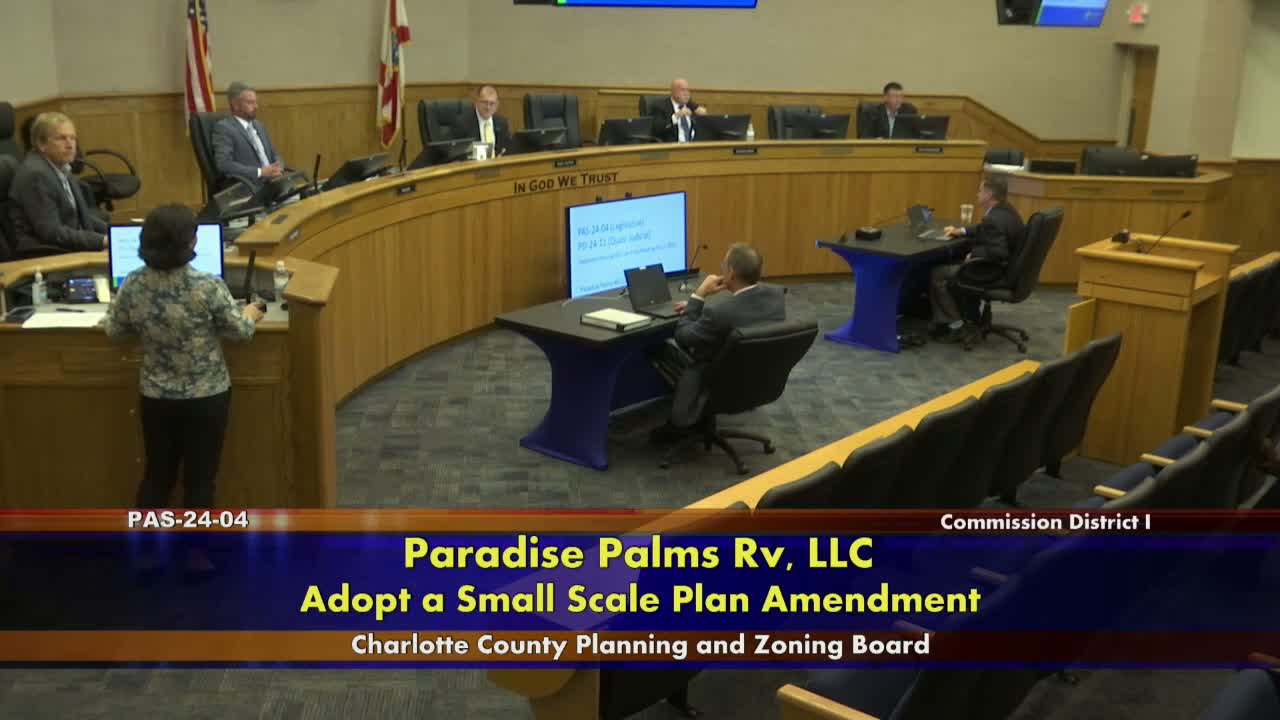
Planning board narrowly recommends Paradise Palms RV park plan after heated public debate
Summary
The Planning and Zoning Board voted 3–2 to forward a small-scale plan amendment and rezoning for the Paradise Palms RV park (limit 138 RVs) to the county commissioners despite strong neighborhood opposition raising sewage, wetland and traffic concerns.
The Charlotte County Planning and Zoning Board on March 1 voted 3–2 to forward a pair of applications from Paradise Palms RB LLC — a small-scale plan amendment (PAS-24-04) and a planned-development rezoning (PD-24-11) — to the Board of County Commissioners, recommending approval with conditions after lengthy public comment and technical rebuttal from the applicant’s team.
Jay Shell of the Community Department summarized the requests: amend roughly 16.85 acres of the site to low-density residential with a base density limited to 16 units and annotate the land-use map to allow an RV park limited to 138 recreational vehicles; concurrently rezone portions from RE-1 and Commercial General to Planned Development. Shell told the board the proposed PD would authorize approximately 4.1 RVs per acre, include conditions preventing a transfer of density, require preservation of approximately 0.7 acres of Scrub-J habitat in perpetuity, and require on-site water and septic if central utilities cannot serve the site. Shell cautioned the private utility serving the area reported insufficient capacity and that any on-site septic and well systems would be subject to state review.
Neighbors provided extended testimony opposing the project. Chris Froelich (under contract on nearby parcels) said the parcel is better suited for 16 residential estate lots and called the RV park incompatible with a maturing neighborhood: "I stand in opposition to this proposal for a number of reasons... An RV park, in that particular parcel would stop the neighborhood from maturing because we would have nothing but 138 transient RV units." Multiple residents raised similar concerns about proximity to a state-owned preserve, the potential loss of tree cover and habitat, flooding risks observed during Hurricane Milton, and whether the developer would be required to fund traffic improvements such as turning lanes.
Project engineer Reuben McCown of Southwest Engineering answered technical questions during rebuttal. He said a septic currently shown within 50 feet of wetland would be relocated to meet the county’s 50-foot setback and that the project shows a typical 25-foot wetland offset in its plans. McCown summarized traffic-review findings: the left-turn lane would need a 40-foot extension, the consultant reported no right-turn lane required now based on traffic counts, and the traffic-impact statement may be updated at final PD if needed. He said stormwater will be managed so post-development discharge does not exceed pre-development rates and referenced the wastewater narrative in the staff report showing estimated flows.
Board members pressed enforcement and regulatory questions: staff said RV parks are subject to state and local regulation limiting stays (commonly 180 days), PD conditions and county code enforcement mechanisms and that the county can audit records based on complaints. One resident asked how sewage from 138 RV sites compares to the alternative 16-house scenario; staff cited the staff report (page 134) showing an example commercial zoning could generate substantially higher daily flows while a 138‑site RV park was estimated in the report at about 10,350 gallons per day.
After deliberation, a board member moved to forward PAS-24-04 to the Board of County Commissioners with a recommendation of approval based on the staff report dated 02/26/2025; that motion passed 3–2. The board then forwarded PD-24-11 with conditions A–M on a 3–2 vote. The board noted these recommendations are an early procedural step; the applications must still pass the county commissioners’ public hearing and satisfy final PD design, permitting and state review for on-site septic/well systems.
What happens next: Both items are scheduled for the Board of County Commissioners’ adoption hearings on April 22, 2025. Final approvals will depend on development-review committee conditions, updated technical studies and any additional conditions the commissioners impose.