Get Full Government Meeting Transcripts, Videos, & Alerts Forever!
Get email alerts on the Comprehensive Plan topic
No spam. Unsubscribe anytime.
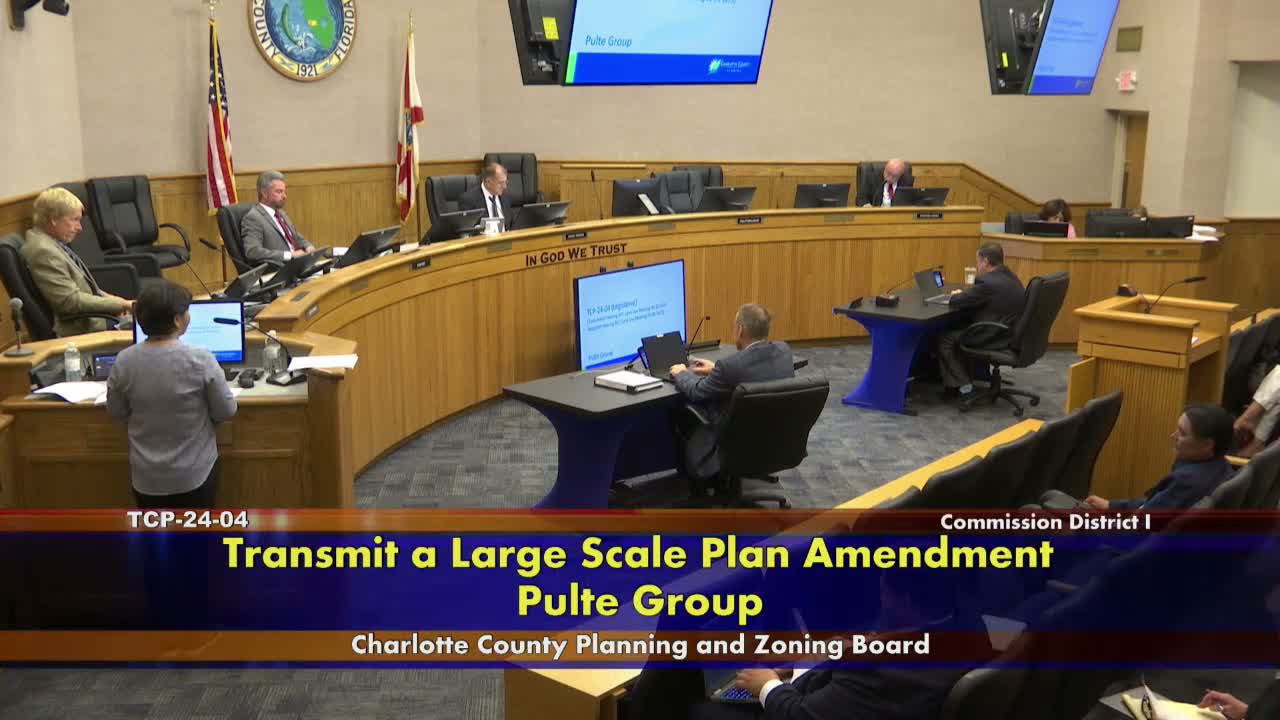
Planning board recommends denial of transmittal for TCP‑24‑04 after hours of public opposition over water, wildlife and infrastructure
Summary
Charlotte County’s Planning & Zoning Board voted 3–1 to recommend denial of transmittal of TCP‑24‑04, a large‑scale comprehensive plan text amendment proposed by Pulte to increase density and intensity in the US‑17 Rural Settlement Area Overlay District. Residents raised concerns about water supply, wetlands, wildlife and road capacity; applicant stressed master planning and infrastructure phasing.
The Charlotte County Planning & Zoning Board voted 3–1 to forward TCP‑24‑04 to the Board of County Commissioners with a recommendation of denial of transmittal to state review, after an extended public comment period in which dozens of residents raised concerns about water supply, wildlife habitat, traffic safety and infrastructure financing.
Staff presented TCP‑24‑04 as a large‑scale text amendment affecting the 4,900‑acre Rural Settlement Area Overlay District east of US‑17. Jay Shaw, Community Development staff, described nine major proposed changes including requiring a pattern book and master development plan, raising maximum residential entitlements from 6,000 to 8,000 units, increasing regional economic development floor area from 1,000,000 to 1,500,000 square feet, revising infrastructure and utility language to reflect a new private utility receiver, and adding alternative open‑space options such as a golf course subject to environmental best practices.
The applicant’s team — represented by attorney Derek Rooney and planner Dan Delisi — said the amendment is intended to implement the 2010 US‑17 area plan and enable a master‑planned community that would reserve open space, fund infrastructure and provide neighborhood commercial services. Delisi said the applicant holds about 1,885 acres under contract and described the plan’s mix of residential, commercial and regional economic uses; he argued the additional density would support the infrastructure and commercial uses needed on the corridor.
Residents and community groups spoke at length in opposition. James Thomas said the proposal was "an egregious assault on the very fabric of our community" and warned of wildlife displacement and traffic; Jennifer King told the board the amendment "terrifies" her because of water reliability concerns and said the petition would "conservatively demand apparently 1,100,000 gallons of water per day." Multiple speakers cited fears of groundwater depletion, nutrient runoff to Shell Creek and the Peace River, inadequate wastewater capacity, impacts to endangered species and the loss of rural character.
Several speakers asked the board to require central water and sewer and proof of concurrent infrastructure capacity before approving any increase in entitlements. Others urged denial or more study; Mark DeGrove and others pointed to statutory concurrency requirements and urged a thorough water and traffic analysis.
In rebuttal, Rooney acknowledged neighbors’ concerns but said this step is part of the comprehensive planning process: "This is a process. It's a continuum...a lot more focus and detail will come into conditions" during PD rezoning and permitting, and he stressed the applicant’s willingness to work with the community and provide required technical studies.
A board member moved to forward TCP‑24‑04 to the Board of County Commissioners with a recommendation of denial of transmittal to state review, citing unresolved utility and funding questions; the motion passed 3–1. The transcript records that the motion was based on staff findings and public testimony and flagged the need for clearer utilities and financing commitments before a transmittal would be supported.
The matter will be considered next by the Board of County Commissioners. If the commission transmits the amendment to state review or adopts any changes, the applicant would still be required to complete PD rezoning and detailed permitting (stormwater, water/sewer, traffic) before site development moves forward.