Get Full Government Meeting Transcripts, Videos, & Alerts Forever!
Get email alerts on the Transportation Finance topic
No spam. Unsubscribe anytime.
Finance staff urges dedicating 50% of proposed 2026 sales tax to roads amid multimillion‑dollar shortfall
Summary
County fiscal staff told commissioners Charlotte County has about $332 million in programmed transportation needs and projected revenues that leave a sizable shortfall; staff recommended allocating 50% of a proposed 2026 sales‑tax extension to road projects and commissioners debated raising the share or using short‑term financing.
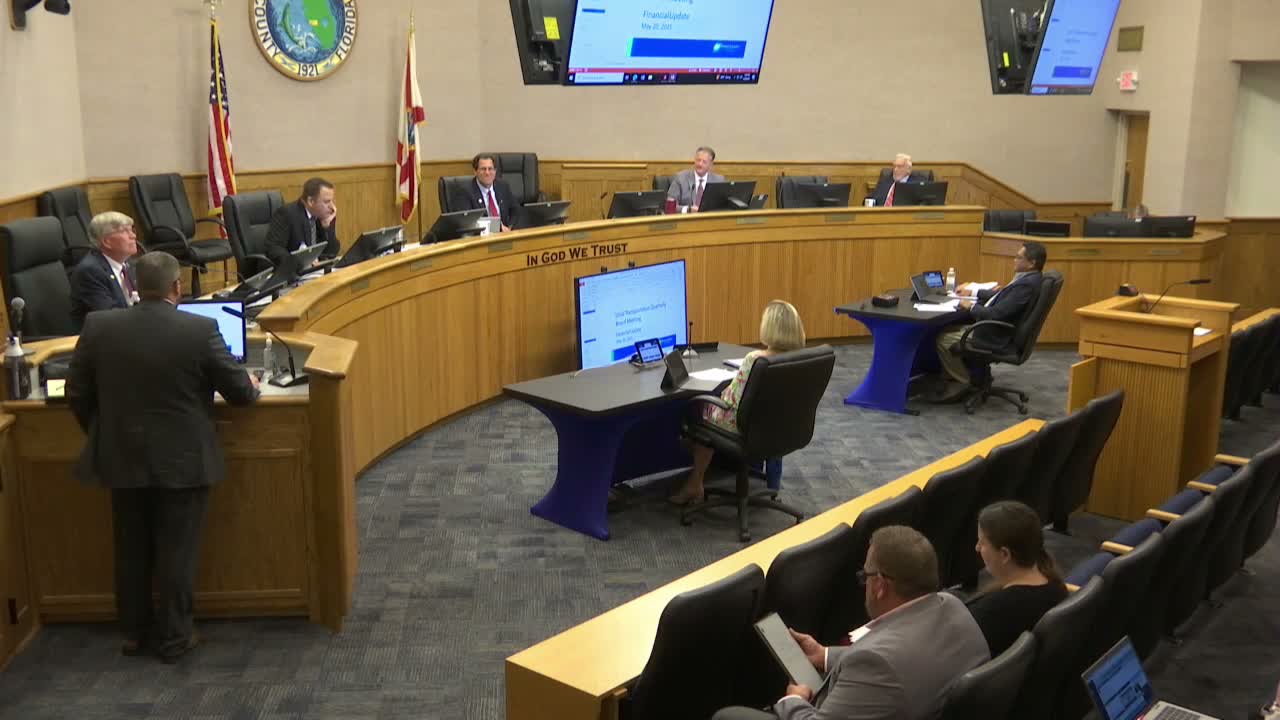
Rick Arthur, the county’s fiscal services representative, told the Charlotte County Board of County Commissioners on May 20 that transportation projects in the county’s capital needs assessment total about $332 million in the six‑year window while projected revenues fall far short.
Arthur said estimated impact‑fee revenue for the period was roughly $17 million (held flat in projections) and that other programmed revenues and grants leave a significant gap between project costs and available funds. “If you pull everything that’s transportation, road projects related from our CNA together ... $332,000,000 is what we have programmed in the 6 year window on our CNA,” Arthur said.
To address the gap, Arthur recommended allocating 50% of a proposed 2026 sales‑tax extension to road projects. He projected a conservative sales‑tax receipt of $36 million annually and estimated a 50% allocation would yield about $113 million for roads over the sales‑tax period. “We are suggesting that we allocate 50% of the 2026 sales tax extension to road projects,” he told the board.
Commissioners debated whether 50% should be a floor rather than a ceiling. Commissioner Jackson proposed examining a slightly higher share so the sales‑tax allocation could cover the full six‑year shortfall; staff and others noted timing and cash‑flow effects mean the six‑year totals don’t map perfectly to annual receipts. Several commissioners said they would not go lower than 50% and raised the option of short‑term financing or a line of credit to front‑load construction and avoid escalating deferment costs.
Gordon Berger, director of budget administrative services, told the board that cash‑flow tools and reimbursement resolutions can be used to smooth timing differences and that financing could enable the county to use the first years’ sales‑tax proceeds to begin major projects sooner.
The board directed staff to start with a 50% planning assumption but left the door open to adjust the final allocation and to provide additional financial analyses, including reimbursement resolution language and options to manage cash flow and deferment costs. The county’s sales‑tax advisory process will validate project prioritization during community outreach before the board finalizes a ballot proposal.