Get Full Government Meeting Transcripts, Videos, & Alerts Forever!
Get email alerts on the Capital Needs topic
No spam. Unsubscribe anytime.
Charlotte County staff warn six-year capital needs outpace identified revenues; prioritization planned
Summary
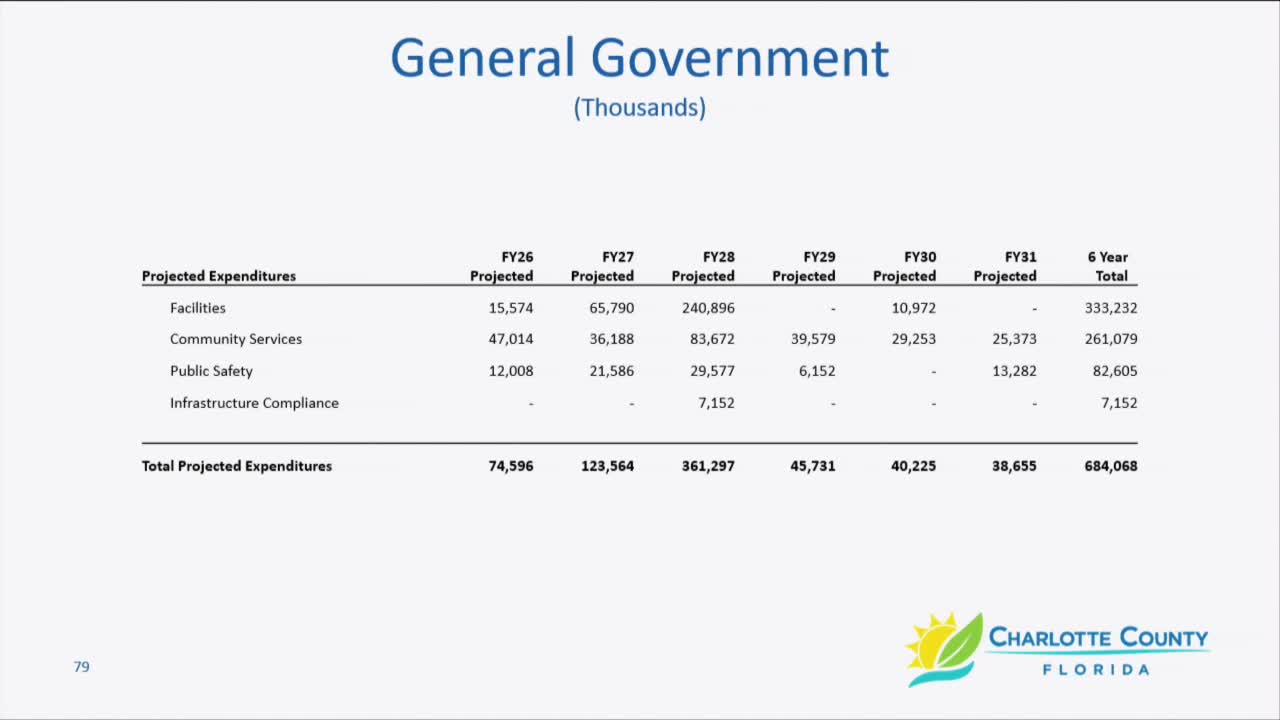
Staff told commissioners May 22 that Charlotte County's six-year capital needs assessment totals roughly $684 million while currently identified revenue sources total about $470 million, leaving a significant shortfall; staff recommended project prioritization and updated revenue estimates in June–July.
Charlotte County staff told the Board of County Commissioners at a May 22 workshop that the county's six-year capital needs assessment (CNA) significantly exceeds currently identified funding, and they will return with prioritized options and updated revenue projections.
Francine Lisby, assistant budget director, summarized the county's funding picture and said staff currently count roughly $470 million in revenue sources available to offset approximately $684 million in general-government capital projects across the six-year window. Lisby said the gap means commissioners must either rescope or reprioritize projects or identify new revenue sources.
Lisby outlined the revenue assumptions that produced the shortfall: conservative ad valorem growth (10% for FY26, then 6.5% annually), a 1% annual projection for local gas-tax receipts and capital gas-tax revenue of roughly $4 million a year, assumed impact-fee collections (transportation at about $17.4 million annually), and cautious sales-tax projections (~$40 million per year for FY25–26). She said staff included the $102 million appropriations identified for Hurricane Ian hazard-mitigation projects in revenue projections but cautioned that some appropriations remain unfinalized and many projects require formal approvals and matching funds.
Lisby said staff have already updated the CNA in places where project timing changed (for example, Edgewater Phase 4 and Mid-County Annex) and added recently identified projects (elevator renovations, sheriff equipment). She acknowledged a data discrepancy flagged by commissioners for the Port Charlotte Beach complex and agreed to verify and plug in the board's more recent cost estimates ($25 million for a recreation center and roughly $5–5.5 million for the pool) into the CNA.
Public-works revenues tied to the Transportation Trust Fund also showed improvement after earlier policy changes, Lisby reported, but transportation projects in the six-year window still carry an estimated shortfall of about $18 million. Lisby recommended staff and administration spend the next weeks working through priorities, and return with recommendations at an efficient-and-effective-government session on June 19 and as part of the recommended budget in July when preliminary and final property-appraiser valuations are available.
The workshop produced no formal vote. Lisby emphasized that the numbers are conservative projections and that revenue clarity from the property appraiser and pending grant appropriations will inform final recommendations. The board did not adopt new revenue measures at the workshop.