Get Full Government Meeting Transcripts, Videos, & Alerts Forever!
Get email alerts on the Tarpon Waterfront topic
No spam. Unsubscribe anytime.
Board forwards Tarpon Waterfront Village proposals after debate over urban service area, wetland buffers and yacht club
Summary
The Planning & Zoning Board recommended forwarding a package of map amendments and a PD rezoning for Tarpon Waterfront Village — a proposal that would extend the urban service area, change future‑land‑use designations and allow up to 156 clustered units while preserving wetlands and keeping the Charlotte Harbor Yacht Club — after proponents and many yacht‑club members supported the project and staff highlighted coastal‑policy concerns.
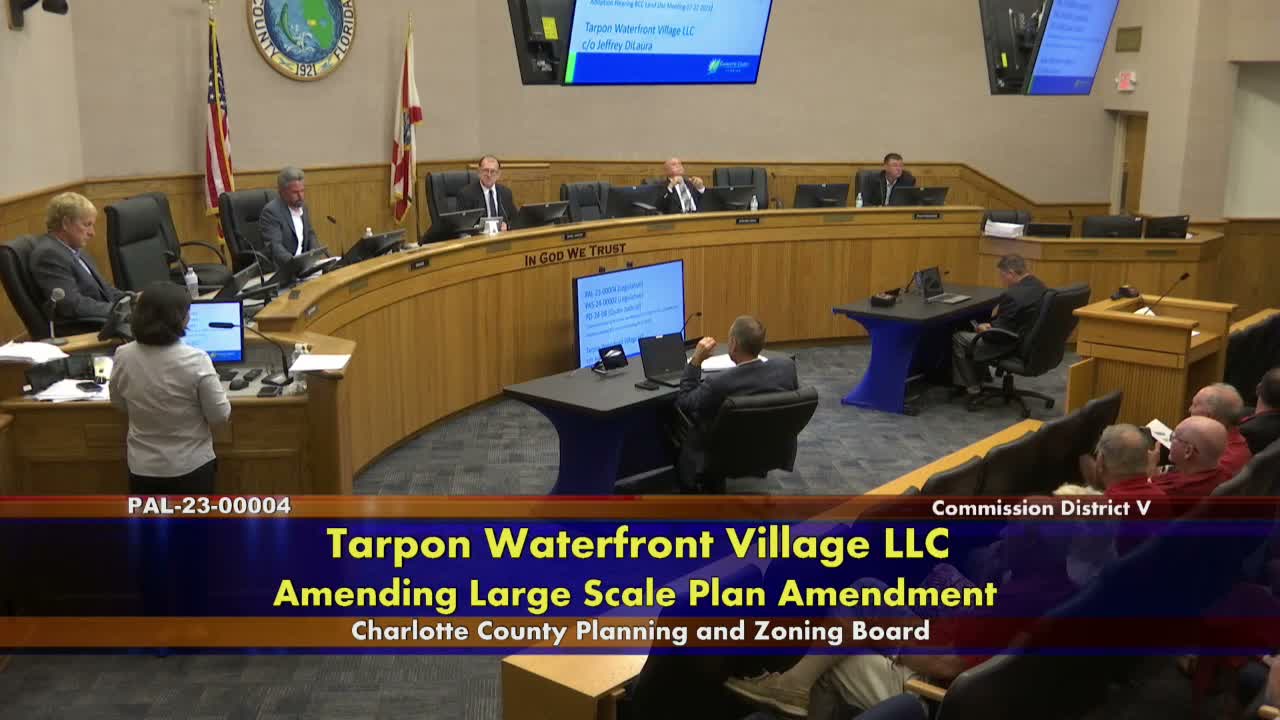
The Planning and Zoning Board voted to forward three related applications from Tarpon Waterfront Village LLC — a large‑scale plan amendment to expand the urban service area (PL‑23‑00004), a small‑scale future‑land‑use amendment (PAS‑24‑00002) and a companion PD rezoning (PD‑24‑048) — to the Board of County Commissioners with recommendations for approval.
County staff told the board that expanding the urban service area and increasing residential rights on what is currently rural or preservation land raises coastal planning and urban‑sprawl concerns under the Charlotte County comprehensive plan. Staff recommended conditions (A–V) to address wetland restoration, a habitat management plan, minimum wetland buffers (staff asked for 25‑foot minimum widths along wetlands), and monetary contributions to coastal policy programs. Staff concluded the proposed large‑scale and small‑scale plan amendments are “generally not consistent” with some aspects of the comprehensive plan but that the PD rezoning would be consistent if the other map changes are adopted and mitigation conditions are included.
Applicant counsel Michael Hamans and planner Ben Smith argued the site is a logical, walkable infill area that should be returned to urban service designation, noting nearby commercial services and recent adjacent approvals. The team said they would cluster residential development on uplands, preserve mapped wetlands, elevate first habitable floors 2–6 feet above base flood elevation, provide a marina and amenities tied to the Charlotte Harbor Yacht Club and fund wetland enhancement and monetary contributions required by coastal policy.
Members of the Charlotte Harbor Yacht Club spoke in support, saying the developer’s purchase and lease arrangements have preserved the club and funded youth sailing programs; several attendees called the plan an improvement over the site’s current condition and welcomed the proposed investment and amenities. Supporters argued the project would be walkable infill with preserved wetlands and club amenities that serve residents and the public.
Opponents and some staff cautioned that the site was removed from the urban service area during the 2010 comprehensive‑plan rewrite because of sensitive habitats and coastal considerations, and staff said the proposed increase from 4 base units to up to 156 residential rights on uplands would be a material change requiring careful review. The applicant said density increases are to be achieved only through transfers of density and that wetland buffers and habitat management will be required at site plan and permitting stages.
After discussion and applicant rebuttal, the board forwarded the transmittal and map amendments and the PD rezoning to the Board of County Commissioners for adoption hearings and state review, recording the board’s recommendations and the proposed PD conditions. The items will proceed to the county commission for final policy and ordinance decisions.