Get Full Government Meeting Transcripts, Videos, & Alerts Forever!
Get email alerts on the Water Quality topic
No spam. Unsubscribe anytime.
Charlotte and Lee counties outline coordinated push on water quality as state rules approach
Summary
County staff from Charlotte and Lee briefed commissioners on monitoring, restoration and regulatory impacts — including state stormwater rules due Dec. 2025 — and urged regional cooperation while warning of high retrofit costs for private development.
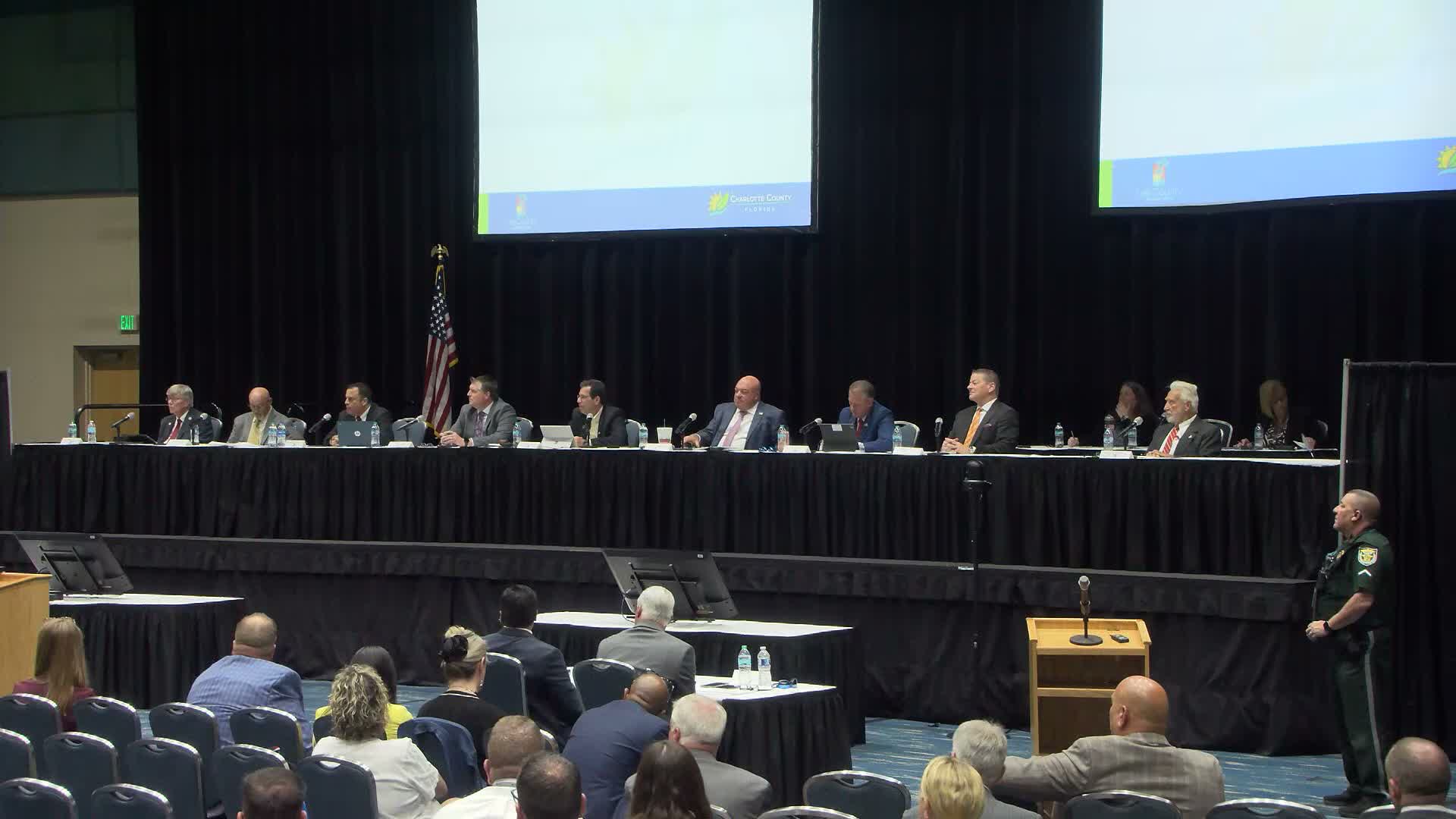
County and staff leaders from Charlotte and Lee Counties used a joint meeting on [date not specified] to map overlapping water‑quality programs, warn of new state stormwater standards and ask elected officials for continued regional advocacy and funding support.
Brandon Moody, Charlotte County’s water quality and resiliency manager, described a newly formed monitoring program and a county effort he called the One Charlotte, One Water plan to draw together work that previously lived across utilities, public works, community services and planning. "As you have just heard, when we talk about economy and quality of life down here, invariably water quality gets into the conversation," Moody said, framing monitoring and targeted projects as essential to protect fisheries, tourism and the tax base.
Lee County’s Roland Dottalini framed his county’s work as more mature and heavily shaped by federal and state requirements: "What driving that is our water quality data," Dottalini said, pointing to total maximum daily loads, basin management action plans and monthly sampling programs that have driven earlier nitrogen reductions. He told commissioners Lee County has removed more than 123,000 pounds of total nitrogen annually to date through multiple initiatives.
The meeting also heard from residents and local stakeholders. Van Hubbard, a longtime local fisherman, warned of lost seagrass and algal blooms, saying the region risks reaching an ecological tipping point that would damage fisheries and tourism.
Several public speakers and commissioners singled out recently adopted state rules—referred to in the meeting as HB7053 and SB7040—that Lee County staff said will be implemented in December 2025 and will require rigorous nutrient reductions on many new developments. Tara Jenner, a Lee County resident and local commenter, summarized the new rule's projected local costs: "These costs will hit local governments, private builders, school districts, taxpayers very hard," she told the boards, citing per‑acre retrofit estimates of $35,000 to $150,000.
Both county staffs urged a regional approach to funding and implementation. Moody asked the elected officials to back programs with evidence of benefit when specific projects come forward and recommended pooling resources to pursue larger grants and federal or state funding. Dottalini highlighted the need for coordinated advocacy on Lake Okeechobee operations and other upstream drivers of nutrient loads affecting the Caloosahatchee estuary.
Commissioners questioned staff on Corps of Engineers release schedules from Lake Okeechobee and on whether releases are balanced east and west; staff said they meet regularly with Corps personnel but have limited direct control over federal operations. The presenters and multiple commissioners described regionalization—combining projects or grant applications across counties—as a practical way to strengthen funding proposals for expensive measures like septic‑to‑sewer conversions.
Next steps described in the meeting included follow‑up briefings to the respective county commissions, additional data releases (presenters noted updated seagrass figures had just been published), and continued cooperation on grant applications and public education campaigns. No formal policy action or commitments were adopted at the joint meeting; staff emphasized that the statutory authority for the session prohibited taking formal votes there.