Get Full Government Meeting Transcripts, Videos, & Alerts Forever!
Get email alerts on the Ems topic
No spam. Unsubscribe anytime.
Charlotte County updates EMS plan as call volumes climb and costs rise
Summary
EMS leaders told commissioners call volume rose more than 22% over five years and daily averages approach 110–120 calls; staff cited staffing vacancies, increased transport distances after a hospital closure, programmatic costs and ad valorem contributions projected at $10–11 million for FY25.
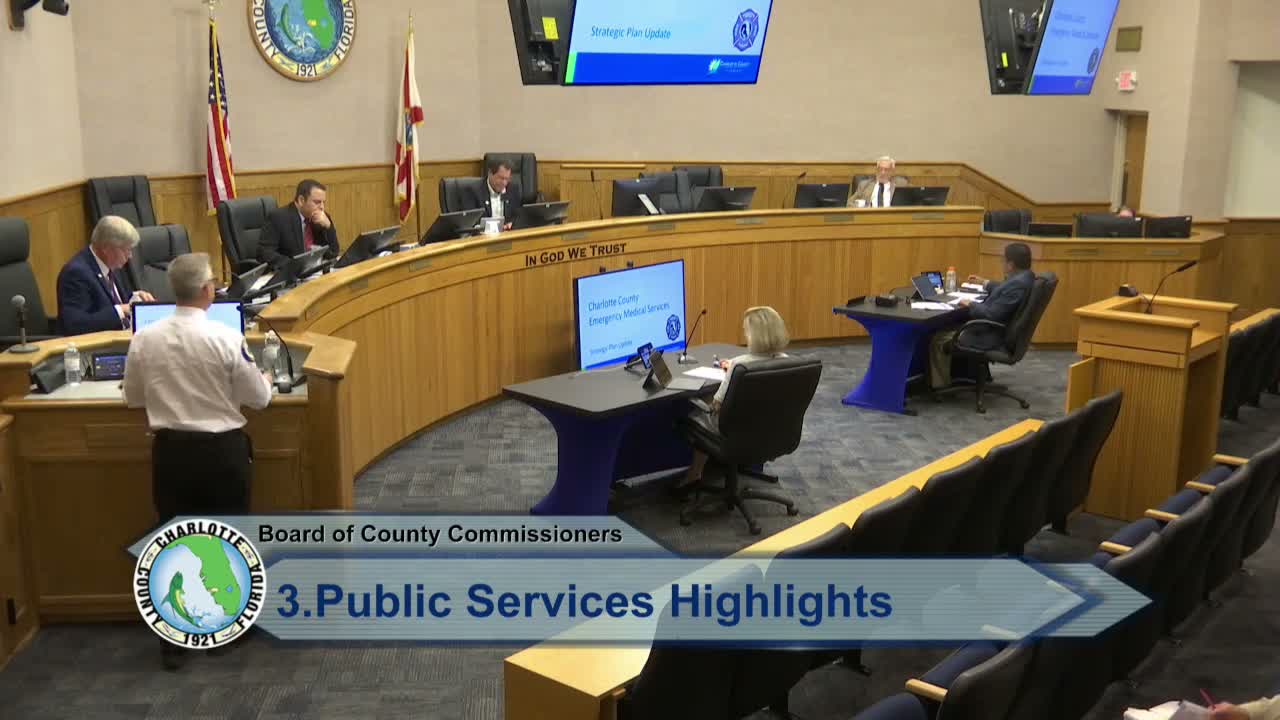
Charlotte County public-safety officials told commissioners on May 8 that emergency medical service (EMS) demand and costs are rising and that staffing and operational changes are underway to maintain response reliability.
Jason Fair, public safety director, said total call volume increased about 22.3% over five years and EMS calls rose roughly 18.6% in that span. He said daily call averages during the last reporting period ran about 110 calls per day and have recently approached 120. Fair said improvements at the 90th-percentile turnout time show a 2 minute 11 second improvement since the strategic plan began; he identified station alerting as the single improvement likely to produce the most immediate gains.
Fair described operational steps taken under the strategic plan: converting engines to advanced life support, adding two 10-hour peak-load 'medic' rescue units (Medic 1 and Medic 2) to reduce system strain, and increasing hiring cadence to four recruitment events per year. He said the county still plans a third peak-load unit once staffing and funding permit, and noted about 22 open positions remain in EMS; onboarding to full operational capacity typically takes five to six months.
On finances, Lisby said the ad valorem contribution to EMS operations was about $5 million in 2011 and is projected to be a little over $10 million toward $11 million in FY25. Fair and Lisby said transport fees and an external collections vendor help recover some costs, and the county participates in a Public Emergency Medical Transport (PEMT) reimbursement program that subsidizes Medicaid transports, but they said fee revenue alone is unlikely to cover total operating costs.
Fair cautioned that a recent hospital closure in the southern county increased transport distances and unit-hour utilization for some rescue units. He also said a collective-bargaining agreement under negotiation may affect staffing patterns and hours, which the county is monitoring before implementing further unit additions.
Next steps: staff will return with retention and staffing metrics on request, continue hiring and training cycles, evaluate station-alerting options (estimated at $1.5 million), and refine financial assumptions as the county fee policy and budget process move forward.