Get Full Government Meeting Transcripts, Videos, & Alerts Forever!
Get email alerts on the Industrial Development topic
No spam. Unsubscribe anytime.
County staff propose industrial land strategy; board signals interest in workshops on zoning and utilities
Summary
Planning staff said Charlotte County could support roughly 1.3 million square feet of industrial development by 2030 and asked the board for direction on zoning, urban service-area expansion and incentives; economic development staff emphasized ECAP’s role in recent taxable-value growth and workforce partnerships.
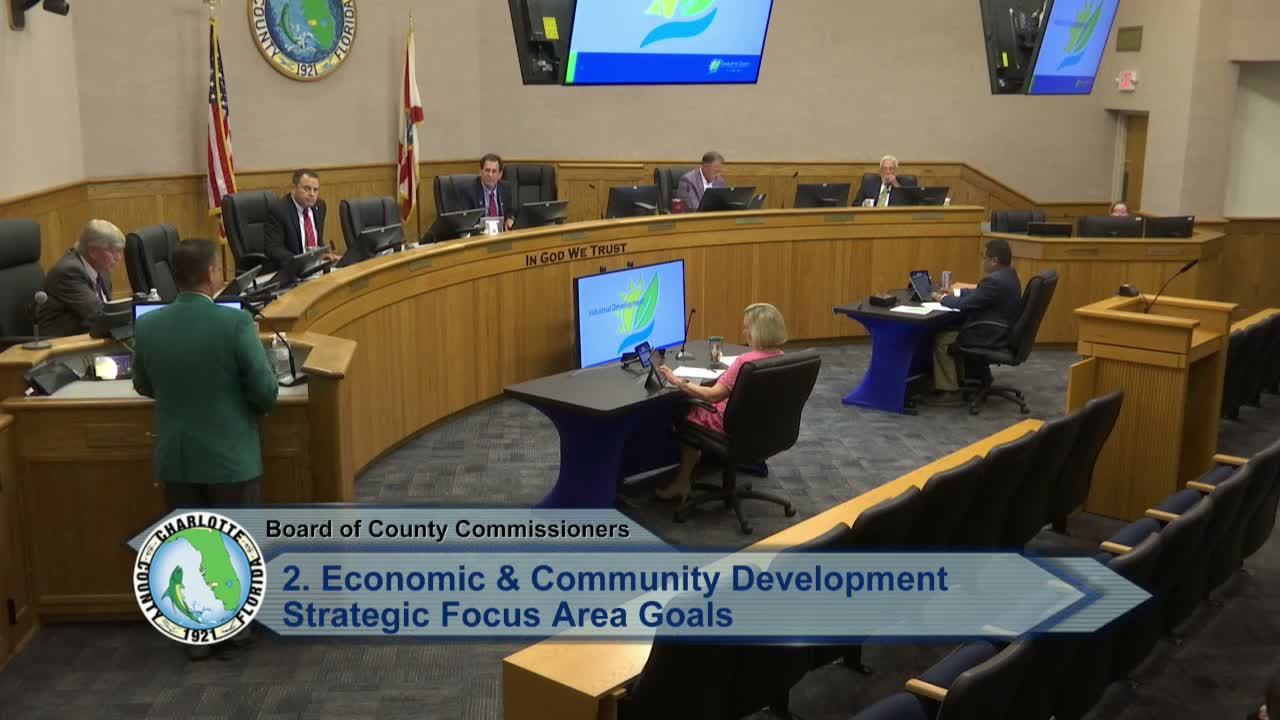
Charlotte County planning and economic development staff on April 17 asked commissioners whether to pursue a targeted industrial expansion strategy and outlined options for zoning changes, urban service area expansion and incentives to attract higher-wage, technology-driven industry.
"The metro forecasting model study found that by 2030, the county could support an additional 1,300,000 square feet or 184 acres of industrial development," Sean Cullinan, a planning and zoning official, said during the workshop. He said staff are exploring whether to reclassify certain commercial parcels, expand the urban services area or develop an industrial overlay to concentrate compatible industrial uses.
Board members raised concerns about compatibility with existing neighborhoods, necessary utility infrastructure, and the types of industry the county should pursue. Cullinan noted the difference between heavy industrial users and modern, advanced-manufacturing or logistics uses, and he recommended defining target industrial types before pursuing zoning changes.
Economic development director K. Tracy highlighted the ECAP area as a local strength, saying it added about 1,000,000 square feet of industrial space and drove roughly $51,000,000 in increased taxable value between 2023 and 2024. Tracy said the office is focusing on aviation/aerospace, advanced manufacturing, logistics, life sciences and workforce development partnerships with local colleges and CareerSource.
Commissioners asked staff to return with more detailed recommendations and maps identifying candidate parcels and utility availability. Several commissioners said they would support additional workshops focused specifically on industrial land strategy and workforce housing data to understand the labor and housing market implications of industrial growth.
Next steps: planning staff will refine options, prepare GIS-based maps and return with recommendations on zoning tools, overlay concepts and utility needs for board review.