Get Full Government Meeting Transcripts, Videos, & Alerts Forever!
Get email alerts on the Emergency Management topic
No spam. Unsubscribe anytime.
Charlotte County emergency management details local mitigation strategy and recovery coordination
Summary
Emergency Management outlined five resiliency goals, a three-part local mitigation strategy (financial, environmental/historical, infrastructure) and plans to keep the EOC involved in longer-term recovery with departmental liaisons. Fuller emphasized complexity of damage assessment and federal engagement.
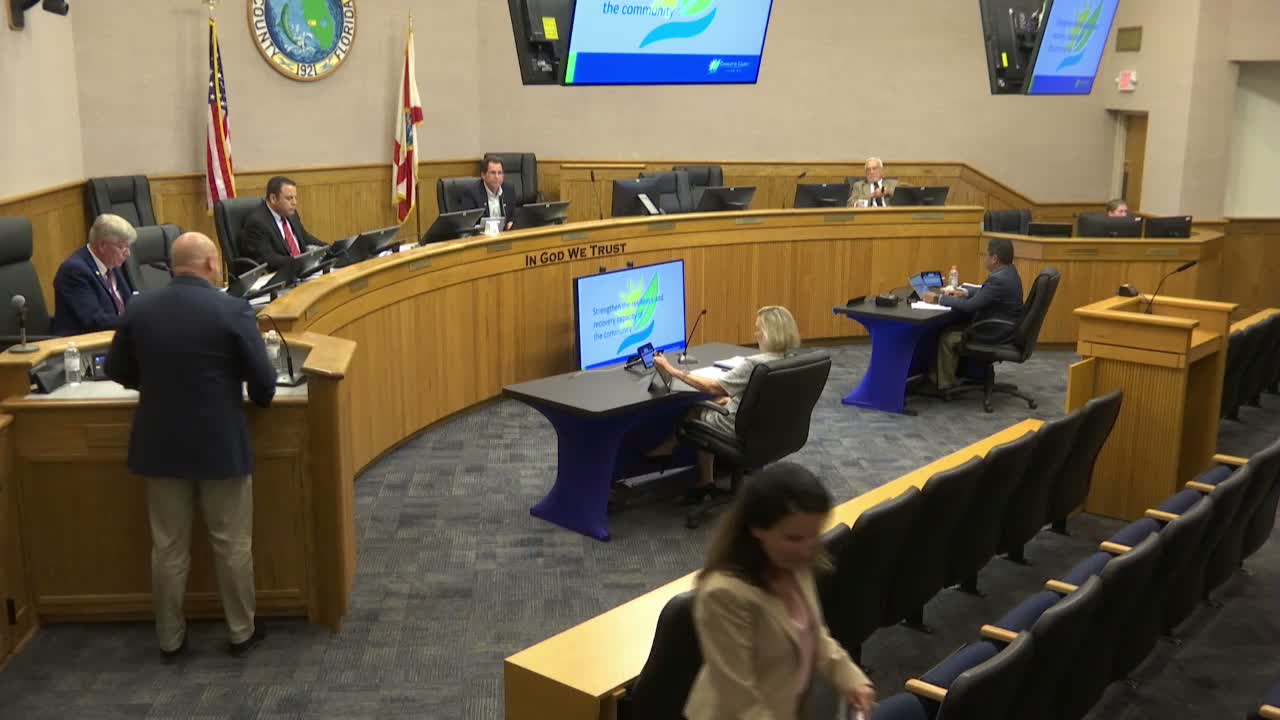
Emergency Management staff told the Charlotte County Board of County Commissioners on May 8 that the county is retooling how it prepares for and recovers from disasters, with a focus on long-term resiliency and coordinated recovery.
Patrick Fuller, Emergency Management, described five goals: cultivate a culture of preparedness, enhance recovery coordination, create standards that meet external-agency requirements, expand institutional knowledge across departments and pursue mitigation activities to reduce future impacts. Fuller said the county has maintained a local mitigation strategy since the late 1990s and reviews it every five years to remain eligible for certain mitigation funding.
Fuller described three functional mitigation groups—financial resiliency (cost recuperation), environmental and historical resiliency (water quality, beaches, cultural landmarks) and infrastructure resiliency (the largest and costliest, covering public works, utilities and community services). He explained the damage-assessment process used to establish potential federal public-assistance declarations: initial windshield assessments, individual damage assessments that generate dollar estimates, a joint preliminary damage assessment with state and FEMA, and then detailed assessments.
Fuller said the county plans to maintain the Emergency Operations Center (EOC) into the longer-term recovery phase to coordinate departmental liaisons, standardize reporting and make joint decisions. He described ongoing work to identify mitigation projects—projects are funding-neutral on the mitigation list but must demonstrate a mitigation nexus to be considered for federal funding.
Fuller also flagged likely federal-level changes to mitigation and recovery requirements and said local agility will be important. He asked that departments provide subject-matter representatives to the mitigation working groups and noted training, best-practice identification and a project-reporting standardization are priorities.
Next steps: continued local mitigation strategy work-group meetings, twice-yearly reviews of project lists, identification of mitigation projects with partners and staff assignments to support sustained EOC coordination during long-term recovery.