Get Full Government Meeting Transcripts, Videos, & Alerts Forever!
Get email alerts on the Sales Tax Referendum topic
No spam. Unsubscribe anytime.
Charlotte County outlines 2026 sales‑tax referendum process, highlights major road and facility proposals
Summary
Deputy County Administrator Emily Lewis presented a plan May 13 to recruit a citizen focus group and rank projects for a proposed 2026 local option sales tax. Staff estimated conservative revenue of about $36 million per year and put transportation projects (Harborview, Edgewater, Burnt Store) and public‑safety facilities high on the priority list.
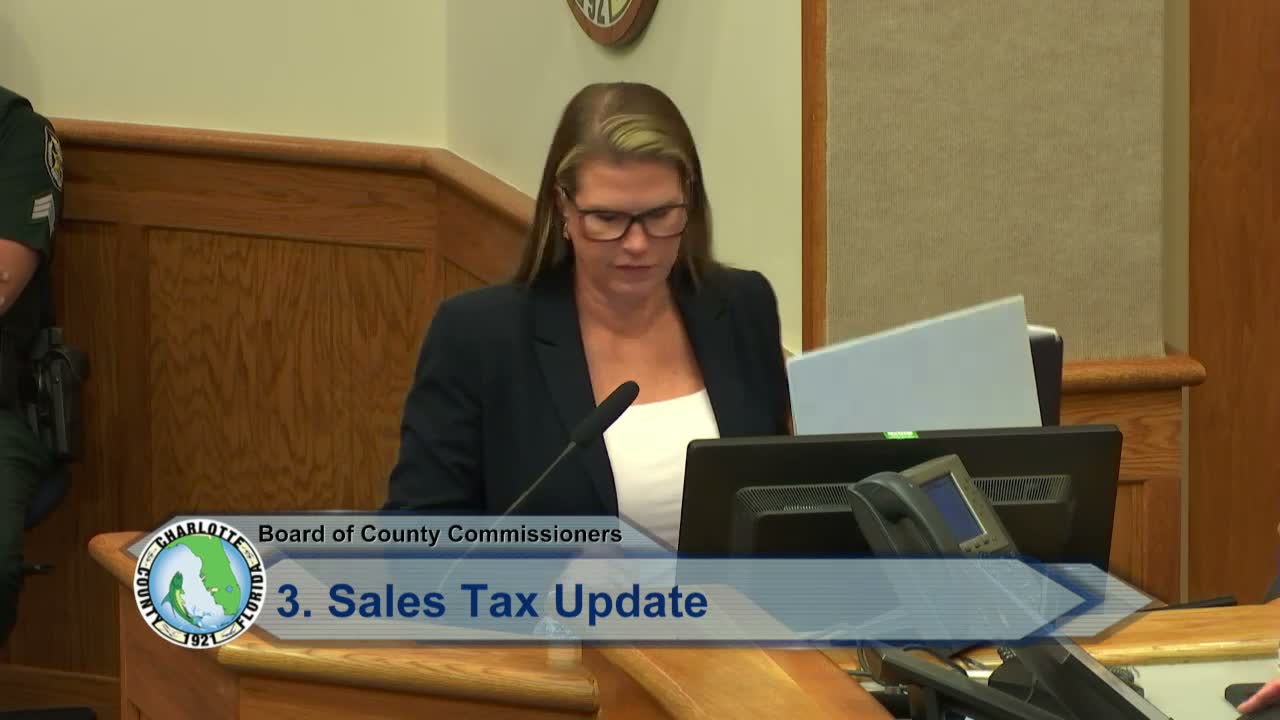
Deputy County Administrator Emily Lewis briefed commissioners May 13 on the framework for a potential 2026 local‑option sales‑tax referendum and presented a project list and schedule for a citizen focus group.
Lewis reminded the board that the county has levied a 1% local option sales tax since 1994 and that previous extensions have funded about $686 million in capital projects. For 2026, staff proposes a focus group drawn from chambers, the Tourist Development Council, building industry and real‑estate stakeholders, the school district, the airport authority, and one resident appointed per commissioner; members would be non‑elected residents and the group would help prioritize projects for a ballot referendum.
Staff provided conservative planning assumptions of about $36 million per year in sales‑tax revenue (roughly $216 million over a six‑year program), although total proposed projects on the current list total roughly $593 million. Major transportation projects highlighted in the presentation included Harborview Road widening (Date Street to I‑75) with an estimated cost of about $52,452,000 and Edgewater Drive widening (listed in the materials at roughly $541,040,000). Other candidates included the Burnt Store Road east–west corridor, Taylor Road widening (Airport to U.S. 41) and a continuing bicycle/pedestrian sidewalks/trails program.
Lewis said the process aims to produce a ranked Tier 1 project list sized to the board's preferred duration (six years was the working assumption) and a Tier 2 overflow list for excess collections. The focus group is scheduled to convene in August and to report recommendations by March 2026, with the board deciding the final project list in April 2026 and adopting an ordinance for the ballot in May.
Commissioners repeatedly emphasized transportation as a top priority. Several asked staff to break larger projects into phasing options (for example, Taylor Road Airport–Jones Loop as a potentially fundable subsegment), to provide right‑of‑way cost breakdowns, and to coordinate impact‑fee studies with sales‑tax planning. Commissioners discussed whether to use an internal facilitator or an independent facilitator for the focus group (board consensus favored internal facilitation to save cost, while noting optics and public transparency considerations).
Lewis also presented a proposed education/outreach budget of about $30,000 for signage and printed materials (subject to state restrictions on direct mail) and confirmed that the county will not bond sales‑tax revenue but will pay as revenue is collected. School district requests submitted for possible inclusion were a $10,000,000 scalable security improvements item and a $5,000,000 career and technical training facility item.
Next steps: staff will advertise focus‑group vacancies, present detailed project scopes and cost breakdowns (including right‑of‑way components) to the board, and convene the focus group in August for ranking and recommendation.