Get Full Government Meeting Transcripts, Videos, & Alerts Forever!
Get email alerts on the Public Transit topic
No spam. Unsubscribe anytime.
Williamsburg transit agency reports ridership rebound, plans phased expansion and new transit center
Summary
The Williamsburg Area Transit Authority told council it exceeded 2019 ridership in FY25, plans phased frequency increases through 2030, will open a north transfer center this summer and aims to add 20–30 bus-stop improvements this year; mobile ticketing and a donor-backed assistance fund were also described.
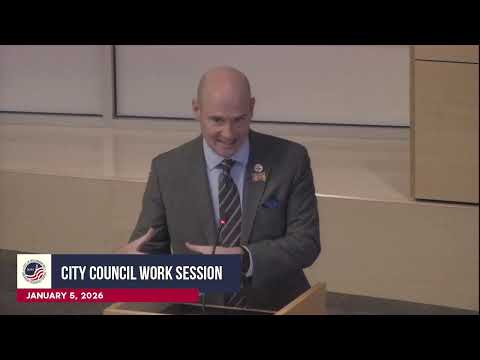
Mister Scalia, a representative of the Williamsburg Area Transit Authority, told the Williamsburg City Council during its Jan. 5 work session that the agency finished fiscal 2025 with higher ridership than in 2019 despite operating fewer hours and later evening service.
Scalia said operator hiring and retention have improved and that the authority has authorized hiring above full strength to build capacity. "We are now at actually over 100% in operators," he said, and added that six new buses—four compressed natural gas vehicles and two clean-diesel buses—are on order for spring delivery.
The presentation laid out a three‑phase strategic plan through 2030. Phase 1 targets all-day 30‑minute service on the network spine (Route 1 toward Lee Hall and Route 2/Richmond Road), with the agency aiming to implement expanded frequency in late March to coincide with spring break and amended FY26 budgets. Phase 2 (FY28) would extend 30‑minute frequency to Route 3 (Merrimack Trail) and Route 7 (Mooretown Road), shorten Route 11 headways from 90 to 60 minutes and improve route connections. Phase 3 would pursue a 15‑minute frequency route by 2030.
Scalia highlighted customer-facing changes already under way: WATA launched mobile ticketing last year and recorded a peak of about 15,000 ticket activations in June, he said. For riders without smartphones or credit cards, agency staff noted that retail cash purchase options remain available and that tickets can be purchased without creating an account.
The authority is planning two major facility projects. Scalia said construction of a new operations and maintenance building began in late spring and is expected to consolidate administrative and maintenance space in 2027. Separately, WATA plans to open a dedicated north transit center off Mooretown Road—near the Walmart/Lowe's area—this summer; the center will provide indoor and outdoor waiting areas, signage, restrooms and staff space and will require rerouting four routes (2, 7, 9 and 4). Scalia said the agency will publish a public-comment process for the route changes.
City capital funding will support nine bus-stop amenity improvements, Scalia said, and WATA expects 20–30 visible stop upgrades across the network this year. He also announced a donor-supported Greater Williamsburg Transportation Assistance Fund, administered with the Williamsburg Community Foundation, to help nonprofits and municipal social services purchase tickets for clients and to support small bus-stop improvements.
Scalia described regional coordination tied to Virginia 250 events, a bus-art contest to wrap three buses with local art, a zero-emissions feasibility study and a regional fare-pass study with Hampton Roads Transit and Suffolk Transit. "Public transit is worth the investment," he said, calling it a high-return public service and arguing that increased frequency is necessary to attract riders who have other transportation options.
Council members thanked the agency and asked follow-up questions about rider composition, student fare policies and mobile-payment integrations. A city staff member responding on payment options said current regulations limit some integrations (for example certain digital-wallet features) and reiterated that retail cash purchase options are the primary equity solution for riders without smartphones or bank cards.
The session included a public comment from Kaiser of Richmond Road, who urged the council to preserve Williamsburg's historic, small‑town character and cautioned against applying modern urban-planning trends such as the "15‑minute city." The meeting ended with a routine adjournment motion that passed on a roll-call vote from the named council members.
Next steps: WATA and city staff will proceed with the public-comment process for route changes tied to the new north transfer center, work on the FY26 budget adjustments needed to implement Phase 1 service increases, and pursue the zero-emissions and regional fare studies described in the presentation.