Get Full Government Meeting Transcripts, Videos, & Alerts Forever!
Get email alerts on the Traffic Adaptive Signals topic
No spam. Unsubscribe anytime.
Mill Valley council advances adaptive traffic signal pilot, residents press for immediate calming measures
Summary
City Manager Cusumano described a proposed adaptive signal timing pilot for the Blythe Blythedale/Camino Alto corridor with first-year software and maintenance at $218,000 and a stated fiscal impact of $255,000. Council approved the consent calendar (which includes the item) and staff pledged follow-up checks; residents urged quicker neighborhood fixes such as signage or a redwood fence.
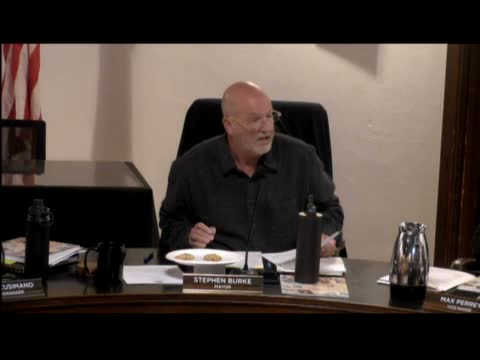
City Manager Todd Cusumano told the Mill Valley City Council that staff is recommending the city pursue an adaptive traffic signal pilot to give staff real-time awareness of signal outages and to dynamically manage seven intersections along the Camino AltoEast Blythe Blythedale corridor.
"Ultimately, the fiscal impact of this is $255,000," Cusumano said, adding that "software and maintenance services for year one ... is going to be a $218,000 project." He said the procurement yielded a single bidder familiar with Mill Valley and noted the scope includes a feasibility assessment (task 3) that would allow staff to pivot if the results do not meet expectations.
The council discussed limits of the approach: Cusumano and staff cautioned that the technology optimizes signal operation but cannot fix upstream capacity constraints controlled by Caltrans at the interchange. He said the vendorwhich also works with Caltranscould, if agreements are reached, provide coordinated control of the Kipling/Tower interchange signals.
Council members pressed staff on metrics and recurring costs. A council member noted a $40,000 line item in the fiscal impact for upgrading signal components and asked whether that comes from CIP funds; staff confirmed the $40,000 is from a CIP allocation. Cusumano said ongoing monitoring costs could run about $12,000 a year but that year one covers the major fees and staff will return with a post-task-3 recommendation about whether the city needs vendor monitoring or can operate the system in-house.
Public comment during the same segment focused on local safety complaints along the Blythe Blythedale corridor and nearby neighborhoods. John Hanley, a resident on East Blythedale, told the council that speed bumps had not solved the problem and urged a sound wall or redwood fence, saying, "Sooner or later, someone's gonna get hurt." Other residents described increased parking and off-leash dogs near the Escalon trailhead and asked the city to install no-parking signage, improve enforcement and re-evaluate hedges and sightlines.
Staff answered that the city had trimmed failing hedges after disease was detected, ordered no-parking signs to be installed "next week," and would reengage neighbors to test short-term measures (signage, paint, selective no-parking installation) while monitoring the pilot and the traffic-report metrics. Cusumano said reversing a street direction or instituting resident permit parking were possible but would require additional study and broad neighborhood support.
The consent calendar containing the professional services authorization was moved, seconded and approved by the council; the city manager and staff will bring back task-3 findings and recommended metrics and a check-in report to council for further direction.
Whathappens next: staff will install no-parking signage in the affected neighborhood, monitor outcomes, complete the feasibility assessment under task 3 of the adaptive signals procurement, and report back to the council with measured travel-time and volume data and a recommendation on ongoing monitoring versus in-house operation.