
Nevada launches school‑health Medicaid pilot to expand billing for students' services
Get AI-powered insights, summaries, and transcripts
Subscribe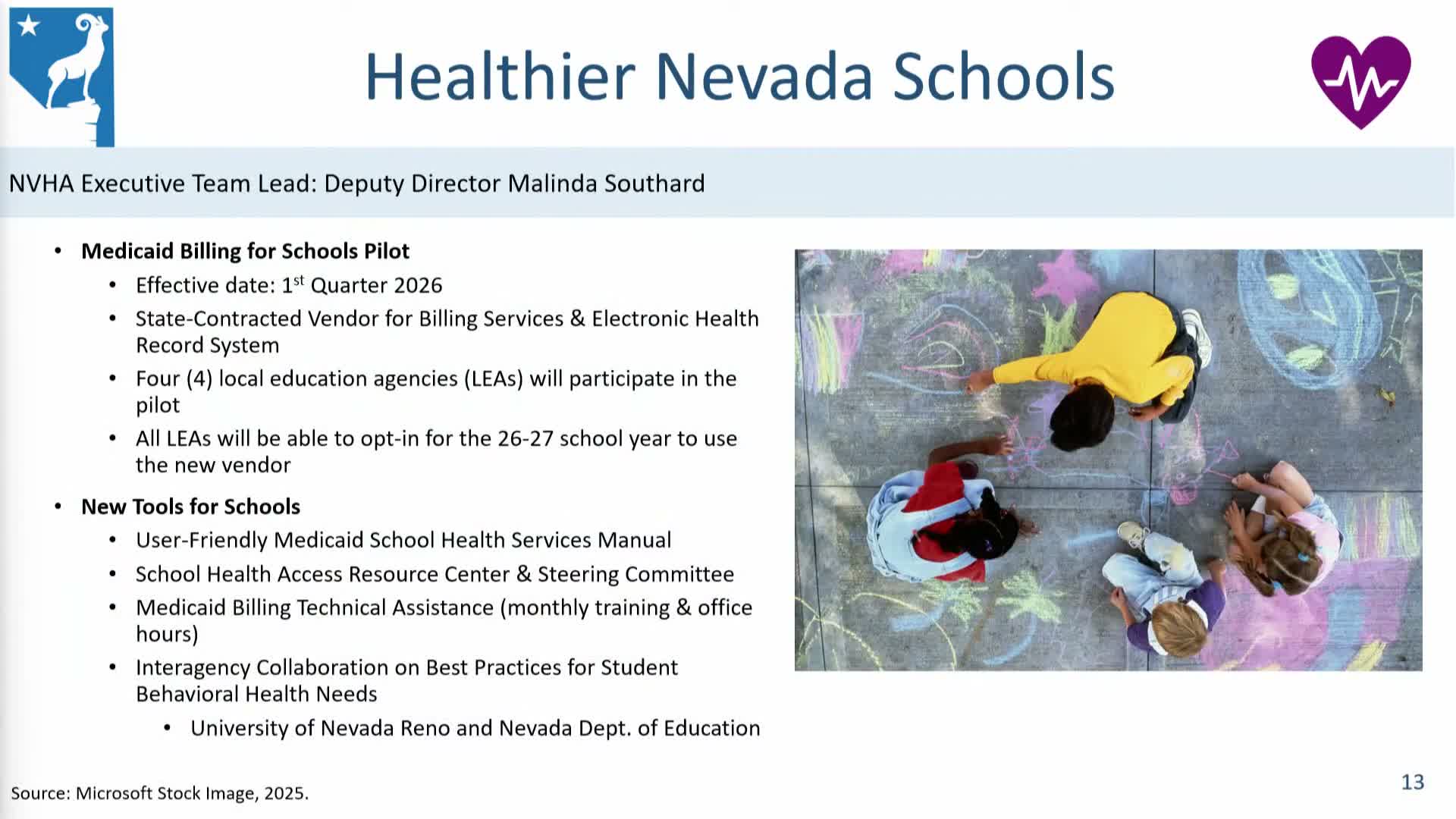
Summary
The Nevada Health Authority described a federally funded pilot to provide electronic health record and Medicaid‑billing vendor services to local education agencies; staff said roughly 10 LEAs applied and four will be selected for a one‑year pilot, after which the state plans to scale the vendor model statewide.
Nevada Health Authority officials told the Joint Interim Committee on Jan. 6 they are launching a federally funded pilot to help schools bill Medicaid for preventive and behavioral‑health services. Deputy Director Melinda Southard said the state's goal is to make it easier for local education agencies (LEAs) to bill for services they already provide but have not consistently billed because of capacity or EHR limitations.
"We are having an application process that's actually going on right now, for all the LEAs to be able to apply to participate in this pilot," Southard said; she told the committee NVHA received about 10 applications and expects to notify the four LEAs selected within the month. The vendor model will give participating LEAs an electronic health record and Medicaid‑billing components so the districts can submit claims through the vendor rather than build internal billing capacity immediately.
Chair Tracy Brown May and members asked about parental consent, steering‑committee membership and whether pilot selection would leave rural or other districts behind. Southard said the steering committee includes Department of Education and both urban and rural districts, plus UNR technical partners; the Department of Education handles parental‑consent policy and NVHA will follow up if needed. Weeks said CMS pushed for a pilot approach to test implementation and scale after one year. "To have all the schools, if there's any issues, would be challenging," Weeks said.
Members pressed whether the pilot accelerates long‑standing billing shortfalls and whether state or district billers could be hired instead; agency staff said schools with capacity can bill now and the pilot targets districts that lack billing infrastructure. Weeks said NVHA will continue monthly training and office hours to support schools and will evaluate pilot results to inform any broader legislative or budget requests to fund long‑term expansion.