
Glendale charter committee coalesces around changes to civil-service rules, directs staff to draft language
Get AI-powered insights, summaries, and transcripts
Subscribe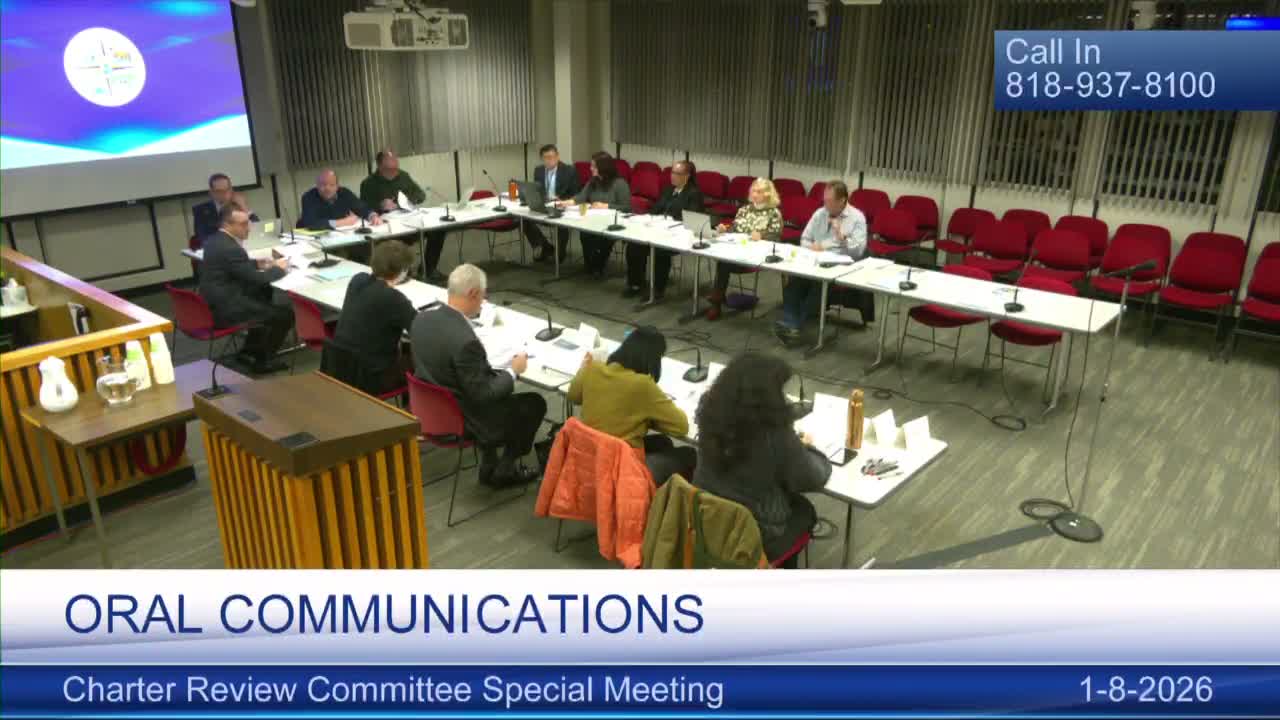
Summary
The Special Charter Review Committee signaled support for keeping a 1–2 year eligibility list, replacing the strict 'rule of three' with a '3 whole scores' approach, and permitting civilian probation extensions up to 18 months while retaining a 12-month cap for public-safety positions; staff will return formal redlines for a vote.
The Glendale Special Charter Review Committee moved toward several charter changes affecting the city’s civil-service system at its Jan. 8 meeting, directing staff to draft formal language on eligibility lists, appointment procedures and probation periods.
Committee members heard from city human-resources staff, who said the current recommendation is to keep an eligibility-list floor of one year and a ceiling of two years after meet-and-confer sessions with bargaining groups. “A floor of 1 year, a ceiling of 2 years, is satisfactory to the city,” a staff representative stated during the meeting.
On appointment mechanics, staff and bargaining groups recommended replacing the existing “rule of three” with what staff called a “3 whole scores” system, which would allow more ranked names to be considered for appointments. Members generally agreed with the concept but asked staff to return cleaned redline language to avoid unintended consequences—particularly a concern that adding more names could cause candidates to drop to the bottom of lists if not handled precisely.
The committee also debated the charter’s cap on probationary periods. The existing charter language sets a maximum probation period of 12 months. Staff proposed allowing up to an 18-month limit for civilian positions with an explicit exception keeping public-safety probation capped at 12 months. The committee’s direction was to permit a civilian probation extension up to 18 months, with the civil-service commission to establish the specific criteria and approval process; public-safety positions would remain capped at 12 months. As staff summarized, the practical approach would keep job bulletins at 12 months while authorizing an administrative mechanism—subject to civil-service rules—to extend probation in narrowly defined circumstances.
Public-safety advocates cautioned against altering the 12-month standard for police. Mike Wenz, president of the Glendale Police Officers Association, told the committee that police officers gain certain statutory protections once off probation and that the department’s training and evaluation timelines make a 12-month cap appropriate: “Once you graduate the academy, you’re with training officers for up to five months,” Wenz said, arguing commanders generally can determine whether an officer will succeed within the existing timeframe.
Other civil-service topics discussed included reinstatement-within-one-year language, the reallocation/promotion process (and whether proposed text improperly broadens suspension-of-competition authority), and bumping rights; staff and bargaining groups asked staff to redraft or relocate problematic language. The committee voiced particular caution about wording that could be interpreted to circumvent competitive recruitment.
Chair and staff indicated they will return a formal packet with redlined charter text incorporating tonight’s direction at the committee’s next meeting; staff said they expect additional input from the civil-service commission by March. The committee did not adopt final charter amendments at the Jan. 8 meeting but gave staff clear direction to prepare vote-ready language.