Get email alerts on the Airport Development topic
No spam. Unsubscribe anytime.
Chino Valley planning commissioners hear strong opposition to proposed Perkins Ranch airfield
Summary
At a Jan. 6 public hearing, town staff and the Perkins family outlined a phased plan for a 5,000-foot private airfield and requested rezoning of roughly 390 acres; staff recommended forwarding the zone change and CUP to council, while dozens of residents, the Garchin Buddhist Institute and conservation groups urged further study on noise, safety, wildlife and infrastructure. No formal council decision was made.
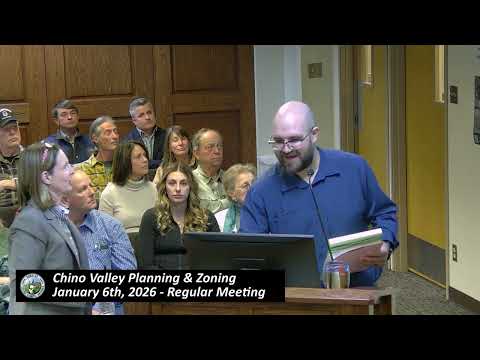
CHINO VALLEY, Ariz. — The Chino Valley Planning and Zoning Commission on Jan. 6 heard a three-hour public hearing on a request to rezone roughly 390 acres of Perkins Ranch and approve a conditional use permit (CUP) for a privately owned airfield proposed by the Perkins family in partnership with Embry Riddle Aeronautical University.
Staff and the applicant described the first phase as a 5,000-foot runway with visual (non‑tower) flight operations, training using Cessna 172s and Diamond DA42NGs, operating hours roughly 05:30–23:30 and a phased development plan that would require separate development agreements and council review for phases 2–4. Heidi Short, the applicant’s representative, said flight operations are projected to begin in “late 2026 or early 2027” and that the initial airstrip would be about a $15,000,000 investment.
Why it matters: The proposal would change long-standing land use in an area designated in the town’s general plan as ranch/agricultural, allow training operations that include repeated takeoffs and landings, and create infrastructure demands for roads, emergency services and habitat mitigation. Staff recommended the commission hold the public hearing and forward a recommendation to town council on the rezoning (DC202503) and the CUP (CUP202505), but the commission did not record a final council decision during the meeting.
What staff and the applicant told the commission
Will, identified in the record as assistant director of Development Services, summarized the site and zoning context and said a boundary survey increased the project acreage to about 390 acres. Laurie (staff) explained that the CUP would authorize only the phase‑1 airfield concept and that each phase would require a development agreement approved by town council. Staff said those agreements are the primary enforcement vehicle for operational limits and mitigation measures.
Heidi Short, speaking for the Perkins family, described a phased plan to create an aviation training hub and said the team is working with Embry Riddle. She described Phase 1 elements — runway, taxiway, apron, tie‑downs — and said the plan aims to route training flights over undeveloped land where feasible. Staff reported a neighborhood meeting on Nov. 26, 2025 and a demonstration/test flight on Jan. 5, 2026. During that test staff recorded decibel readings at five locations ranging from about 45 to 62 dB on the ground, depending on aircraft maneuvers.
What residents and stakeholders said
Opponents focused on noise, public safety, wildlife and infrastructure burdens. Christina Lundberg, executive director of the Garchin Buddhist Institute (located about 1.2 miles from the proposed strip), said the institute ‘‘serves thousands of people’’ and argued the project would “not just be an annoyance, it would be a death kneel for our sanctuary.” Other nearby residents described repeated overflights, cited recordings of dozens of planes passing over some properties, and urged a formal noise study and greater transparency before any rezoning is recommended.
Supporters — including several Perkins family members and residents who live adjacent to the site — cited property rights, the family’s longstanding presence in Chino Valley and potential economic and road‑improvement benefits. A number of speakers urged the commission to require a governance structure that would allow municipal oversight of airport operations even if the land remains privately owned.
Technical and procedural questions from commissioners
Commissioners pressed staff and the applicant on definitions and enforcement: how a ‘‘flight’’ versus an ‘‘operation’’ is counted (staff proposed counting a touch‑and‑go as two operations), what minimum altitudes would be required over developed areas, how changes to aircraft type or operational profiles would be approved, and whether monitoring should be quarterly rather than semi‑annually. Commissioners also asked that subsequent development agreements for phases 2–4 be returned to Planning & Zoning for additional oversight and that any costs for monitoring or enforcement not fall to the town.
Staff recommended conditions the development agreement should include: explicit operational caps matching the project narrative, designated training routes to minimize repetitive overflight of residential areas, minimum overflight altitudes, compliance with FAA regulations while allowing the town to enforce local limits, dark‑sky lighting standards, coordination with Arizona Game and Fish on wildlife protections, coordination with the State Land Department where state trust land abuts the site, and semi‑annual reporting to town council on operations and compliance.
What’s next
Staff asked the commission to (1) hold the public hearing and (2) recommend that town council consider the rezoning and CUP subject to the staff report and proposed conditions. The commission took public comment from dozens of residents at the meeting and did not take a final council action; staff noted that each subsequent phase would require a development agreement approved by town council. The town council is the final decision‑making body for the rezoning and any development agreements.
Key numbers and details (from the hearing)
• Site acreage: approximately 390 acres. • Phase 1 runway: 5,000 feet by 75 feet (with partial parallel taxiway and apron). • Projected operations in staff/applicant materials: an average maximum cited of roughly 20 takeoffs and 20 landings per hour (applicant narrative); staff noted an initial average projection of about 50 operations per day used in the CUP narrative. • Hours of operation proposed: approximately 05:30–23:30. • Test‑flight decibel readings recorded by staff (01/05/2026): 45–62 dB at five locations. • Preliminary capital estimate for the first airstrip: about $15,000,000.
Quotes to remember
• ‘‘The proposed airport would not just be an annoyance, it would be a death kneel for our sanctuary,’’ — Christina Lundberg, executive director, Garchin Buddhist Institute. • ‘‘Without the airstrip, there’s really nothing,’’ — Heidi Short, applicant representative, describing the project’s phased approach and the runway’s role as Phase 1. • Staff’s cited test‑flight noise readings: ‘‘45 decibels to 62 decibels’’ at five on‑site observation points.
Reporting note
Reporting in this article is based on the Planning & Zoning Commission public hearing transcript and statements made on the record during the Jan. 6 meeting; the commission did not record any final council action on the rezoning or CUP in this meeting. Where speakers used different spellings or shorthand in the transcript for organizations (for example, Embry Riddle Aeronautical University), this article uses the institution’s common, verified name.
Ending
The Planning and Zoning Commission heard extensive public testimony and technical questions and did not finalize a recommendation during the Jan. 6 meeting; staff asked that the commission hold the public hearing and forward a recommendation to town council. The council will consider rezoning and any development agreements at a future meeting.
AI generated
The text on this page is AI generated. Summaries, highlights, and analysis are all produced from the original source material.
AI can make mistakes, so if you spot one, and we will fix it for everyone.
Note: the source content is unaltered by us. Any content source we link to, be it a video, an audio recording, a transcript, or a document, is presented exactly as its publisher released it. That publisher is usually a government body, sometimes an individual official or another organisation.