Get Full Government Meeting Transcripts, Videos, & Alerts Forever!
Get email alerts on the Industrial Incident Response topic
No spam. Unsubscribe anytime.
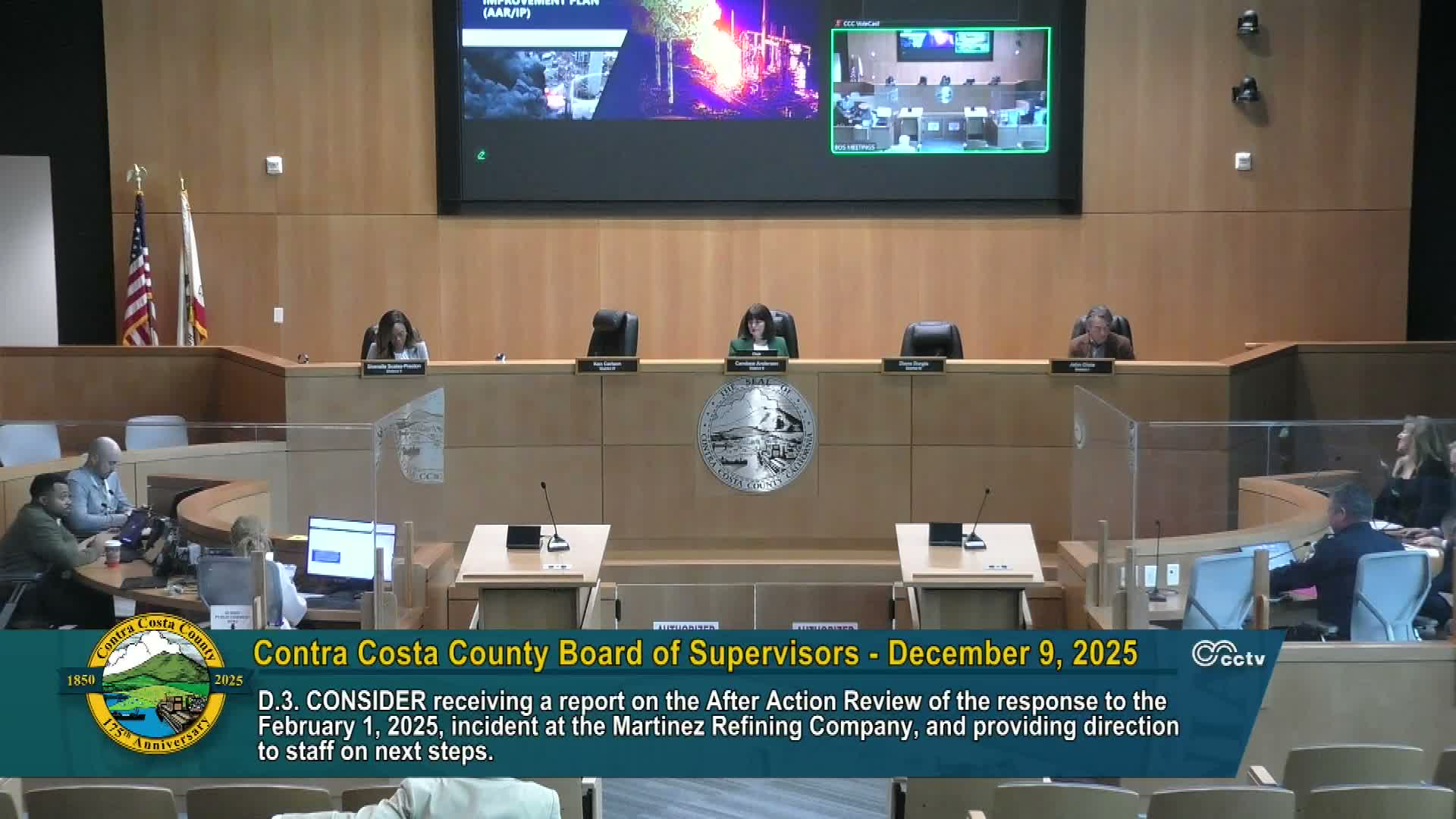
Board accepts after‑action report on Martinez Refining Company incident, flags radio and information gaps
Summary
Supervisors accepted an after‑action review of the Feb. 1, 2025 Martinez Refining Company incident that praised interagency coordination but recommended improvements in radio interoperability (eBrix use), hazmat identification processes, unified command clarity and public information procedures.
The Board of Supervisors voted Dec. 9 to accept an independent after‑action review of the Feb. 1, 2025 incident at Martinez Refining Company (MRC). Deputy Chief Aaron McAllister and Adam Springer, assistant director of hazardous materials, summarized a multi‑agency review of planning and incident readiness, operational coordination, and public information and warning.
The report noted strengths — preexisting interagency relationships, available hazmat resources and resource‑tracking capabilities — but identified several areas for improvement. Among the report’s operational findings was that refinery‑side EBRICS radios were available but not used during the incident, hindering interoperable radio communications. McAllister recommended targeted training so refinery personnel routinely use EBRICS frequencies and practice radio discipline during joint exercises. He said the incident also exposed gaps in quickly identifying the specific product(s) released because the rupture occurred in a complex pipe/valve area; that delayed definitive hazardous‑materials identification and patient treatment.
Public information and warning were another focus. The report recommended clarifying who serves as the public information lead in a multiagency unified command and better integrating jurisdictional PIOs so government messaging is consistent and timely. McAllister said high‑priority improvements — response plan packages, interagency training and exercises, and PIO integration — should be carried out within 12 months; medium priorities include resource‑tracking integration and hosting a unified‑command TEEX course within 12–24 months.
Public commenters criticized aspects of the initial response. One resident urged inclusion of the Bay Area Air District and Martinez city officials in unified communication and said fence‑line monitoring and a hazardous‑materials inventory were not available during the incident. “I am appalled to learn that Unified Command was not given a list of hazardous materials so that they could help the individuals who were injured,” a commenter said.
Supervisor Chanel Scales Preston moved to accept the after‑action report; Supervisor Ken Carlson seconded and the board approved the action unanimously with Supervisor Diane Burgess absent. Staff said they will implement the improvement plan and return with progress updates and a timeline.