
County legal update: retail‑theft response, parking changes aimed at car camping, and alignment with federal HUD policies
Get AI-powered insights, summaries, and transcripts
Subscribe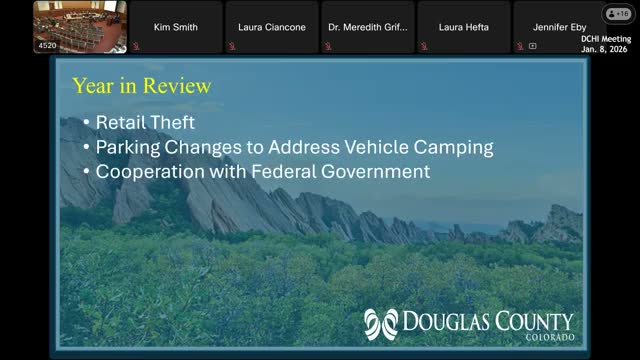
Summary
County attorney’s legal update outlined a non‑punitive retail‑theft initiative that emphasizes resources and collaboration with businesses, described new parking restrictions to address vehicle camping, and said the county’s prior policies position it to pursue HUD grants and comply with recent executive orders.
In a legal update, Jeff Garcia summarized several policy efforts tied to public safety and homelessness.
On retail theft, Garcia said the county’s approach is to equip businesses with tools and collaborative resources rather than impose immediate fines. "We said, no. We're not gonna fine you 1000 dollars," he said, describing early meetings with retail stakeholders and indicating a pending second reading to adopt recommended measures.
Garcia also said recent county work has focused on parking restrictions aimed at reducing car camping (vehicle‑based habitation) while offering clear pathways to services: the county has targeted oversized and recreational parking where communities opt in and emphasized connecting people staying in vehicles with HEART resources.
He reviewed federal executive orders and HUD interactions, saying Douglas County is documented as a non‑sanctuary community and that existing local policies have positioned the county to pursue HUD grants. Garcia emphasized the county’s stance as a non‑safe‑consumption community and noted the county will continue to support law enforcement and federal/state policy related to crime and disorder.
On fraud reporting and benefit integrity, county staff and the county attorney said local investigations find very low rates of fraud: Garcia characterized the figure discussed at a recent meeting as "three‑hundredths of a percent," and county staff reiterated strong QA, audit and recoupment practices.
County leaders said the initiatives are intended to protect businesses and the community while coordinating services for people experiencing homelessness rather than to impose blanket punitive measures.