Get Full Government Meeting Transcripts, Videos, & Alerts Forever!
Get email alerts on the Remand Procedure topic
No spam. Unsubscribe anytime.
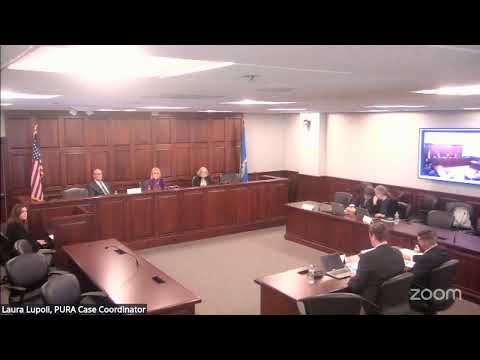
PURA procedural conference ends with no agreement; authority will treat CNG/SCG applications "anew" absent court clarification
Summary
At a PURA procedural conference on the remand of two 2023 gas rate cases, the companies urged using the prior evidentiary record to avoid years of delay and millions in costs; interveners and state agencies pushed back, saying the superior court ordered the applications be treated "as if newly filed." PURA said it will consider the original applications anew unless the court provides guidance.
Interim Commissioner Holly Cheeseman said the Public Utilities Regulatory Authority would treat the remanded rate applications "anew" unless the court clarifies how evidence from the prior proceeding should be used.
The authority convened a procedural conference to address the remand of two 2023 rate-case decisions—docket 23-11-O2—and to hear parties on whether the evidentiary record from that case should be incorporated into two new dockets (25-11-13 for Southern Connecticut Gas Company and 25-11-14 for Connecticut Natural Gas Corporation). The companies asked PURA to adopt a targeted, expedited process that would rely on much of the prior record; interveners argued the court's remand required a newly filed application.
The companies, represented by counsel Bridal Vaughn and company witnesses including Jacob Pruetz (senior director of revenue requirements) and Christy Prescott (UIL vice president, regulatory), presented a five-step approach: a scheduling conference, a company statement of issues on seven identified drivers, an opportunity for party responses, technical meetings or hearings, and a staggered briefing schedule leading to a draft and final decision. "We are seeking an efficient and timely resolution of this matter," Jacob Pruetz told the authority.
Company representatives argued the existing record in 23-11-O2 is extensive—multiple panels of testimony, thousands of data requests, many late-filed exhibits and days of in-person hearings—and that starting fresh would be costly and slow. They estimated roughly $2,800,000 in rate-case expense per company (including about $750,000 of consultant costs) and said relitigation could add one to two years before resolution because of the 350-day statutory rate-case timeline.
Interveners and state agencies said the superior court's remand order instructed PURA to consider the applications "as if newly filed." The Office of Consumer Counsel (OCC) and Education, Outreach and Enforcement (EOE) said that, while some parties might not object to moving audit materials, prefiled testimony, hearing transcripts or late-filed exhibits, motion rulings and procedural protections tied to the prior process are in dispute and cannot be assumed carried over without risking noncompliance with the court's instruction. "The remand decision from the superior court specifically states that the application should be remanded as if newly filed," EOE attorney Britney Wyman said during the conference.
The Office of the Attorney General and the Department of Energy and Environmental Protection said they would generally not object to incorporation of certain record elements (audits, prefiled testimony, transcripts) provided parties retain the opportunity to question witnesses and raise timely objections. Several interveners asked that, if any prior material is incorporated, the transfer be comprehensive rather than piecemeal to avoid inconsistent rulings.
Parties also discussed potential recusals. Counsel noted that Chairman Weil and Vice Chairman Arconti had recused themselves in the underlying docket; interveners and other parties said they would defer to the commissioners' counsel and the commissioners themselves in making any recusal decisions.
In closing remarks, company counsel reiterated that requiring a new filing would be "incredibly unfair" and burdensome in time and money, citing credit-rating downgrades and operational impacts they attribute to the 23-11-O2 outcome. Company witnesses repeated the seven targeted issues they want revisited—cost of capital (including ROE), depreciation, plant-addition treatment, recovery of a regulatory asset, treatment of SCG tax reform liabilities, O&M adjustments including legal expenses, and the removal of DIMP caps—and said their proposal is designed to correct those drivers without a full relitigation.
Commissioner Cheeseman concluded that parties had not reached agreement about what evidence should be incorporated into the new dockets. "Absent clarification from the court on how to proceed, the authority must consider the original application in 23-11-O2 anew," she said. The procedural conference was adjourned; PURA will wait for either further court guidance or develop a remand process consistent with the court's instructions and the record developed in these procedural conferences.
The authority opened a companion procedural conference for docket 25-11-14 (Connecticut Natural Gas Corporation) and adopted the statements made in the first conference. Both conferences were adjourned for further action by the authority or clarification from the superior court.