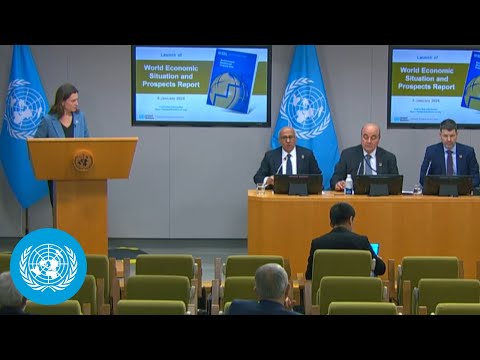
UN launches World Economic Situation and Prospects 2026, warns resilience alone won’t meet SDGs
Loading...
Summary
The UN Department of Economic and Social Affairs released the World Economic Situation and Prospects 2026, forecasting global growth of about 2.7% and inflation easing to roughly 3.1% while warning that underlying debt, fiscal constraints, trade tensions and concentrated AI investment threaten inclusive recovery.
The United Nations Department of Economic and Social Affairs on Tuesday released its World Economic Situation and Prospects 2026, forecasting global gross domestic product growth of about 2.7% in 2026 and projecting headline inflation to decline to roughly 3.1%. Under‑Secretary‑General Lee, in remarks read at the launch, framed the year ahead as one of resilience that masks persistent vulnerabilities.
"Resilience alone will not deliver the Sustainable Development Goals," the Under‑Secretary‑General said, urging that existing international blueprints be turned into implementation at scale.
The report — prepared by UN DESA in partnership with the UN Conference on Trade and Development, the five UN regional commissions and contributions from the UN World Tourism Organization — stresses that headline growth conceals deep imbalances. Shantanu Mukherjee, director of the Economic Analysis and Policy Division, said that many developing countries face heavy financing constraints: "In developing countries, about 12% of public revenues go towards interest payments in 2025," with the share closer to 20% in the least developed countries.
Ingo Pitterle, officer in charge of the Global Economic Monitoring Branch, highlighted stronger‑than‑expected trade in 2025 and the role of technology: "Trade expanded far more than expected according to our estimates — by 3.8% — a full percentage point faster than global GDP," he said, citing front‑loading ahead of tariffs, supply‑chain reconfiguration, and demand tied to semiconductor and digital‑services investment as drivers.
Despite these positive signs, the authors warned that gains were uneven. The report projects modest developed‑economy expansion (about 1.6% in 2026) and identifies South Asia and parts of Africa as brighter spots; it also notes the least developed countries remain far below the 7% growth target called for under the Sustainable Development Goals. The report highlights risks from elevated public debt, shrinking fiscal space, protectionist measures and climate shocks, and cautions that concentrated AI investment could deepen inequalities.
As policy prescriptions, the report emphasizes a balanced domestic mix of monetary, fiscal and industrial policies, strengthened social protection and medium‑term investment strategies to stabilize prices and expand supply capacity. It also calls for stronger international cooperation and effective regulatory frameworks to translate recent global commitments into action.
The World Economic Situation and Prospects 2026 is available online; the briefing closed with a question‑and‑answer session in which presenters clarified regional forecasts and the report’s scope.