Get Full Government Meeting Transcripts, Videos, & Alerts Forever!
Get email alerts on the Elections Vs Appointments topic
No spam. Unsubscribe anytime.
New Canaan subgroup weighs electing versus appointing local boards
Summary
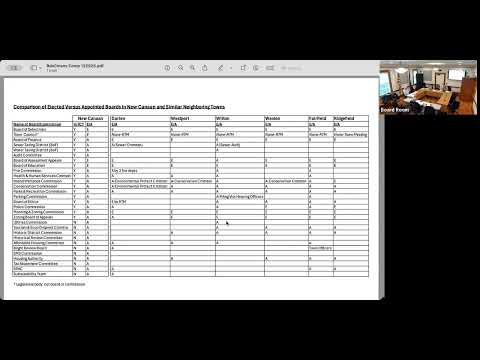
At a Jan. 7 meeting, the Charter Revision Commission’s Group 1 debated whether New Canaan’s boards and commissions should be elected or appointed, weighing accountability and public responsiveness against recruitment of technical expertise and continuity.
The Charter Revision Commission’s Group 1 opened a substantive discussion on Jan. 7 about whether New Canaan’s town boards and commissions should be elected by voters or appointed by town authorities. Chair Angela Jamieson, who led the subgroup, said the commission’s task is to provide the full CRC with “issues and questions” to guide decisions about the governance of roughly 25 town boards and commissions.
Jamieson said elected boards “enhance democracy and accountability” but warned that elections can be dominated by single-issue candidates, party dynamics and may make it harder to recruit technically qualified members. She described appointed boards as being “easier to find candidates with appropriate skills and experience” and better at building expertise, but less directly accountable to the electorate. Jamieson noted Connecticut law constrains party-majority representation on some boards and suggested the CRC could require additional diversity in the charter.
Members debated trade-offs at length. One participant summarized the two approaches as tools that serve different goals: appointments offer upfront efficiency while elections create accountability over time. Another argued for hybrid approaches combining elected and appointed seats for some bodies to preserve technical capacity while adding direct accountability.
Tucker, who spoke from the meeting’s legal/administrative perspective, cautioned members about conducting discussions by email, saying private email exchanges among members would risk violating open-meeting rules. The subgroup agreed Jamieson would prepare a draft of high-level guidance on when election or appointment is preferable, circulate it to the subgroup and then revise it in open meetings.
The discussion produced several practical questions for the full CRC to consider: which boards’ functions demand electoral accountability; which require independence from the first selectman or board of selectmen; whether functions are legislative, regulatory or advisory; whether elections would impair boards that need technical expertise; and whether the charter should mandate greater diversity than state law requires. The subgroup agreed to aim for a revised draft at the next meeting in mid-January.