
House subcommittee urges Senate to pass Fix Our Forests Act to protect Western water and power
Get AI-powered insights, summaries, and transcripts
Sign Up Free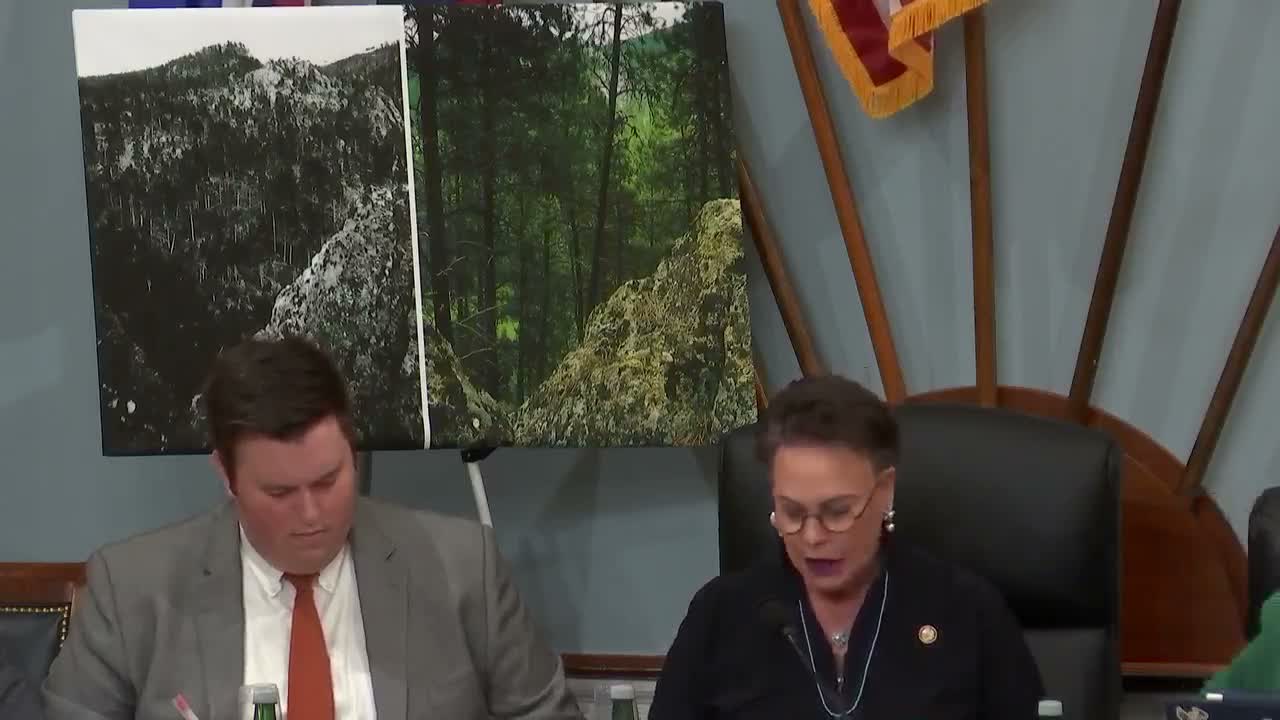
Summary
Witnesses from utilities and water agencies told a House Natural Resources subcommittee that federal forests left dense by decades of fire suppression threaten water supplies and electric reliability and urged Congress to pass the House-passed Fix Our Forests Act to speed treatments, fund staffing, and grant targeted authorities such as categorical exclusions and improved post‑fire recovery.
WASHINGTON — A House Natural Resources subcommittee hearing on federal forest health heard near‑unanimous calls from utilities, water providers and public‑power associations for congressional action to accelerate active forest management to protect water supplies and electricity infrastructure.
The Subcommittee on Water, Wildlife, and Fisheries convened to examine the connection between unhealthy national forests, wildfire behavior, and impacts on downstream water and power systems. Chairwoman Hageman opened the hearing by saying, "We are here today to hold an oversight hearing titled Fix our forests for affordable and reliable water and power supplies," and framed the issue as a combination of a century of fire suppression and policy constraints that have left forests overstocked and vulnerable to large, high‑severity fires.
Witnesses described the practical impacts on customers and communities. "Healthy, actively managed forests are essential protecting our communities and maintaining the clean, reliable water supplies that our communities and ecosystems depend on," said Travis Deal, CEO of Colorado Springs Utilities, which relies on headwater forest lands for much of the city’s water supply. Deal told members that the House version of the Fix Our Forests Act would "enable a more holistic approach" by designating high‑priority fire sheds and promoting shared stewardship agreements that speed treatment in high‑risk watersheds.
Madeleine McDonald, watershed scientist at Denver Water, said proactive investment has paid off for her utility: Denver Water’s Forest‑to‑Faucets partnership has invested $96,000,000 in proactive forest management. "Our first $60,000,000 that our partnership spent ... avoided $234,000,000 in costs," she said, summarizing a retroactive cost‑benefit analysis that Denver Water completed with economists at Colorado State University. McDonald added that federal programs for post‑fire recovery — such as the Emergency Watershed Protection program — need dedicated funding and greater flexibility to protect drinking water supplies after a burn.
Representing public power, Randy Howard, general manager of Northern California Power Agency and speaking for the American Public Power Association, urged streamlined permitting and categorical exclusions under NEPA and NHPA for hazard tree removal near utility corridors. "We need streamlined hazard tree removal, alignment of federal treatment with utility hardening, and expedited post fire recovery," Howard said, adding that liability reform or a federal wildfire risk pool should be explored to stabilize costs borne by utilities and customers.
Members pressed witnesses on several recurring themes: the need for more staff and stable funding at federal land management agencies; the benefits and risks of expanding categorical exclusions to treat more acres (including higher‑elevation fire regimes); how to coordinate across multiple federal and state agencies; and the challenges of wood utilization and disposing of treatment byproducts.
Ranking Member Huffman cautioned that management tools should be used with ecological and social nuance, emphasizing prescribed and cultural burning and warning against wholesale weakening of environmental laws. Several Republican members and witnesses countered that current processes and limited authorities often create operational bottlenecks that prevent timely on‑the‑ground treatments, and they urged congressional fixes to remove those barriers.
Members from Western states highlighted local costs: wildfire‑forced power shutoffs, increasing insurance premiums, loss of hydropower generation because reservoirs fill with post‑fire sediment, and the economic strain on small rural communities. Deal testified that Colorado Springs Utilities treats about 1,800 acres annually under current shared‑stewardship authorities but warned that, "without continued federal investment, our ability ... to treat priority watersheds will diminish."
The hearing did not produce formal committee action or a vote. Chairwoman Hageman closed by entering additional material into the record and asking for written follow‑up from witnesses. Several members urged prompt Senate consideration of the House‑passed bill.
What’s next: The subcommittee left the record open for members’ questions and asked witnesses to respond in writing; members said they would continue outreach to Senate counterparts to press for action on the legislation.