
Council authorizes 66‑year lease amendment with Long Beach Yacht Club after extended debate over public benefits and worker protections
Get AI-powered insights, summaries, and transcripts
Subscribe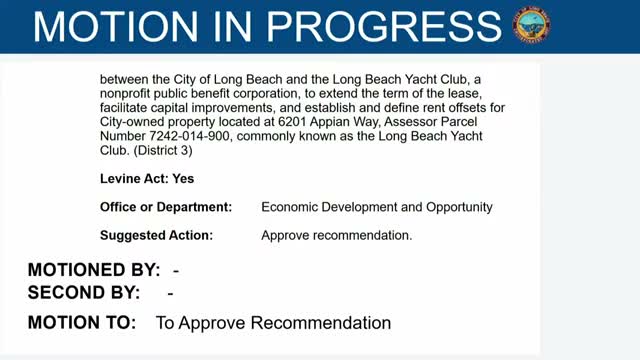
Summary
The council approved a fourth amendment to the Long Beach Yacht Club lease, resetting the term to 66 years (effective 1/1/2026) and requiring a minimum $10 million private capital investment and a $200,000 annual base rent (up to 90% eligible for rent offsets tied to agreed community benefits); members and public speakers debated term length, accountability and whether offsets should support wages and benefits for club staff.
After extensive public comment and council questioning, Long Beach City Council on Jan. 6 approved a negotiated fourth amendment to the lease with the Long Beach Yacht Club that extends the term to 66 years (effective Jan. 1, 2026, through Dec. 31, 2091), requires a minimum private capital investment of $10 million, and sets base rent at $200,000 annually with 10% payable in cash and the remaining 90% eligible for rent offsets tied to defined community benefits.
How it works: Staff said the lease term length reflects financing realities — lenders commonly require a long lease term to secure loans for major capital projects — and that the capital investment will revert to city ownership at the end of the lease. Rent offsets include an annual 600 hours of no‑cost community room use (valued at $200/hour for $120,000 in rent credit), scholarships, swim and sailing programs, youth outreach and other documented nonmember reduced or free services. If the documented community benefits do not equal at least 90% of the base rent when reporting begins, the yacht club must pay the difference in cash.
Debate summary: The item drew substantial public engagement. Supporters — including labor unions, youth sailing programs and civic leaders — argued the lease enables substantial community programs, union jobs and waterfront investment. Opponents and labor/community groups urged a continuance to negotiate stronger, enforceable wage and healthcare commitments for workers and questioned turning public coastal land over for such a long term (65+ years). The city attorney and deputy city attorney explained that directly requiring wage or benefits levels in a lease could implicate federal labor‑law limits on interfering in private collective bargaining; several councilmembers encouraged the yacht club and union to continue bargaining in good faith.
Accountability and enforcement: Staff described reporting requirements, third‑party valuation of community benefit credits and an annual reconciliation process. Credits cannot be banked across years; if offsets fall short they must be paid in cash within 30 days. Councilmembers requested the city and yacht club develop clear, transparent reservation and programming processes to ensure equitable district access to the 600 community‑use hours and to return with implementation details during the construction and pre‑opening period.
Vote and next steps: Council approved the amendment by roll call. Councilmembers requested staff and community partners refine outreach and program metrics, ensure equitable distribution across council districts, and continue engagement with workers and unions on employment terms outside the lease negotiation framework.