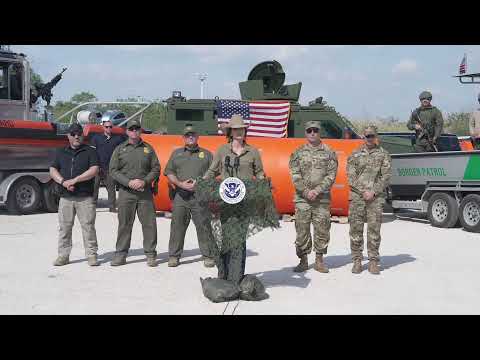
DHS, CBP announce deployment of floating buoy barriers along U.S. waterways
Loading...
Summary
Department of Homeland Security and U.S. Customs and Border Protection officials announced deployment of more than 500 miles of floating buoy barriers to deter illegal river crossings, saying 130+ miles are already under contract and that the buoys are made in the U.S.; officials attributed sharp drops in apprehensions to current policies.
Kristi Noem, identified in the transcript as secretary of homeland security, announced that the Department of Homeland Security and U.S. Customs and Border Protection are deploying "over 500 miles of border barrier in the form of water barriers" and said more than 130 miles were already under contract and would begin deployment that day.
The announcement described the barriers as floating buoys "4 to 5 feet in diameter and up to 15 feet long" manufactured in the United States. "The buoys that you see here today behind me are ones that are made right in America by a family owned company down the road here in Texas," Noem said. Chief Michael Banks of the U.S. Border Patrol explained design changes, saying the new cylindrical buoys use a ratchet system that "rolls backwards preventing you from... climb on" and provide better flotation and control compared with earlier state designs.
Noem said Customs and Border Protection is coordinating with the state of Texas and the U.S. International Boundary and Water Commission to ensure the barriers are installed properly and last for years. She and other speakers framed the barriers as a tool to make water crossings harder for drug smugglers and human traffickers and to improve agent safety. "These very barriers will make it much harder for illegal aliens to drug smugglers and human traffickers to cross the river and other waterways where they will be deployed," Noem said.
Officials also invoked enforcement statistics while describing the program. "In 2025, daily illegal alien apprehensions at the Southwest Border have dropped by 95%," Noem said, and she stated that "we have also seen 2,600,000 illegal aliens removed from The United States Of America," including "almost 700,000 that have been arrested and deported and brought to justice, and then almost 2,000,000 that have left voluntarily." The officials attributed recent declines in crossings to current policies and the layered approach that includes the buoy barriers.
The Department of Homeland Security and CBP provided technical and procurement details in the briefing but did not provide independent verification of the enforcement figures cited. Installation, maintenance responsibilities and the schedule for specific river segments were described only in broad terms; officials said work under contract would begin immediately for the 130-plus miles already awarded.
The agencies named coordination partners including state authorities and the U.S. International Boundary and Water Commission, and said the barriers would be used in waterways where crossings occur. No formal vote or rulemaking was announced; the briefing presented the buoy barriers as an operational deployment funded through recent appropriations referenced during remarks.
Questions remain about long-term maintenance, environmental permitting and the specific locations of planned deployments; those details were not specified during the event. The agencies said they would continue to work with partners on installation and with the State Department on return travel logistics for certain detainees.