Get Full Government Meeting Transcripts, Videos, & Alerts Forever!
Get email alerts on the Urban Forest topic
No spam. Unsubscribe anytime.
Fairfax releases draft Urban Forest Master Plan, recommends new forestry division and KPIs
Summary
City staff presented a draft Urban Forest Master Plan that catalogs benefits of the city’s tree canopy, recommends forming an Urban Forestry Division, sets five objectives and lists KPIs and an implementation timeline; staff plans a public hearing for Jan. 27, 2026.
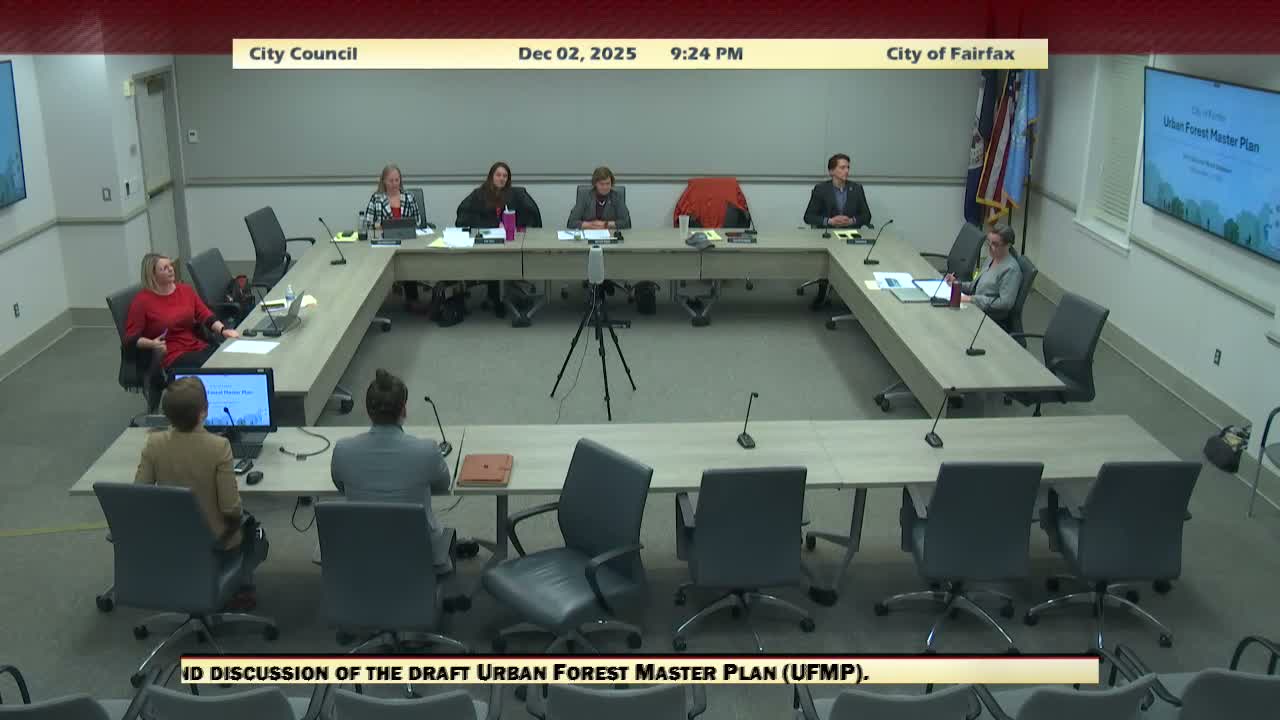
City staff presented the draft Urban Forest Master Plan to the Fairfax City Council on Dec. 2, laying out findings from two planning phases, community engagement results and an implementation framework that includes a recommended urban forestry division and key performance indicators.
Anna (city staff) and Dr. Garrett Wolf, the plan’s consultants, summarized three technical takeaways: the plan’s baseline estimates of benefits from the city’s tree canopy, benchmarking against peer cities, and the implementation approach. Wolf reported annual ecosystem-service benefits that the plan used for valuation: about 31 tons of air pollutants removed, roughly 66,000 tons of carbon sequestered (lifetime value estimated at about $28 million) and avoidance of roughly 20 million gallons of stormwater loading to municipal systems each year; the plan’s calculated annual measurable value for the urban forest was about $1.2 million.
The draft organizes implementation into five objectives — Protect, Regulate, Grow, Manage and Engage — and identifies short-, mid- and long-term actions, lead and supporting roles, and a set of 12 KPIs tied to three goals (resilience and equity; capacity to care for trees; community support). The plan recommends creation of an Urban Forestry Division within a 1–5 year window, but it also includes interim actions that can begin under current staffing.
Council members sought clarity on how the plan would be translated into budget and policy decisions. Councilmember Peterson pressed for an operational calendar and budget requests to ensure the plan’s recommendations become action items rather than a shelf document. Staff said appendix F contains an implementation table and that staffing and budget requests will be bundled into the manager’s proposed budget process; a public hearing and consideration of adoption are tentatively scheduled for Jan. 27, 2026.
Members also discussed forecasting and impact analysis. Several council members asked whether the plan can support scenario and cumulative-impact analysis (for example, comparing canopy changes with or without a proposed trail or development). Staff said the plan includes a decision-making tool and recommended next steps — a natural areas assessment, baseline data updates and a best-management-practices form to help staff evaluate project-level urban-forest impacts.
Council members praised the outreach approach (tabling, photo contest, stakeholder interviews and surveys), asked for greater emphasis on translating plan recommendations into calendarized budget and policy actions, and discussed opportunities for regional coordination on canopy assessment, pests and climate risks.
The council did not vote tonight; staff will incorporate any council and planning commission feedback and return in January for the public hearing on the final draft.