Get Full Government Meeting Transcripts, Videos, & Alerts Forever!
Get email alerts on the Housing Affordability topic
No spam. Unsubscribe anytime.
Fairfax advisory board urges council to explore home-sharing pilot and formal housing trust fund
Summary
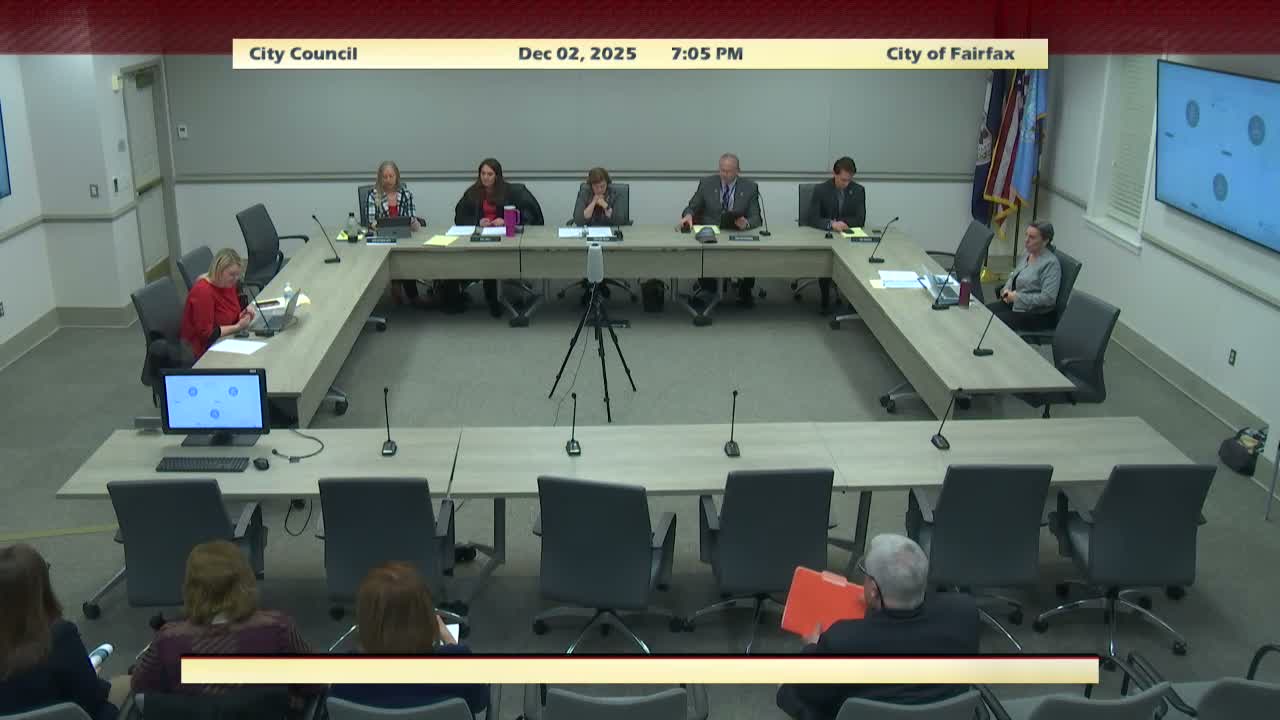
The Housing & Healthy Communities Advisory Board told the City Council on Dec. 2 it wants direction to develop a home-sharing program and to formalize a housing trust fund to preserve and expand affordable units; council members expressed support for further study and asked for details on liability, targeting and funding sources.
The Housing & Healthy Communities Advisory Board (HCAB) presented council members with data on Fairfax City’s housing shortage and two near-term proposals — a home-sharing program and creation of a formal housing trust fund — and asked the City Council for guidance on whether to pursue further development of those options.
HCAB chair Mark Light and staff housing program manager Jamie Ergas told the council that the board was created from recommendations of the 2023 homelessness task force and has spent its first 10 months assembling data, partnerships and a work plan. Ergas said the city’s housing stock is predominantly single-family detached (about 47.6% of residents live in that type), which informs opportunities for home sharing.
“Home sharing has some unique possibilities in the fact that this does not require building additional housing,” Ergas said, describing three approaches: a passive information-and-checklist model, a vetting model that would include background and credit checks, and a matchmaker model that would actively pair hosts and guests and provide case management. The board asked council whether the city should pursue any of those options and at what level of city involvement.
HCAB also described the city’s current one-time housing account balance and a menu of uses for a trust fund. “The city technically does not have a housing trust fund…as of now we have $542,000 in that particular account,” Light said, and staff outlined possible revenue sources including a half-cent allocation of the real estate tax rate and a portion of the transient occupancy tax. The board listed preservation of existing multifamily housing, acquisition/rehab, rent and mortgage relief, and new construction as typical trust-fund uses.
The presenters framed the proposals with local data. Ergas said the September 2025 median house price in the city was $883,725, a 20.9% increase year-over-year; she reported that about 20% of homeowners and roughly 50% of renters pay more than 30% of their income on housing. The board also identified recent losses of affordable units (a combined 148 units from Knowles and Fairfax Gardens) and noted pending affordable developments do not fully replace those losses.
Council members questioned feasibility and priorities. Councilmember McQuillan said she was “interested in learning more about what the home sharing would look like” and asked about safeguards against exploitation and how enforcement would work. Councilmember Hall raised the risk that a broad home-sharing program could become primarily student housing given Fairfax’s proximity to George Mason University and recommended legal review and clear program definitions. Several members, including Bates and Peterson, urged that any housing trust fund emphasize prevention and emergency rental assistance so aid can be delivered quickly to stop evictions.
Ergas and Light acknowledged data and implementation gaps. HCAB does not have a reliable measure of how many local households already engage in informal home-sharing; the board said it can examine survey or vendor options to estimate baseline usage. On the trust fund, HCAB said it would need council direction about whether to pursue a recurring revenue source (which would require policy and budget action) or to develop spending processes for the existing one-time balance.
Council feedback was generally favorable toward further study rather than immediate action. Several council members said they supported HCAB continuing to refine program options and return with recommendations that include legal review, target populations, operational costs and proposed eligibility criteria. The board asked for council guidance on priorities and whether to devote staff or budget resources toward pilot work in the coming year.
HCAB’s request closes a first-year reporting loop from the homelessness task force to an advisory board charged with translating recommendations into implementable options. HCAB said next steps would include developing a more detailed work plan, drafting a process to spend the $542,000 if council wants that used now, and returning with proposed program designs and scoring criteria for trust-fund disbursements.
The council did not take a formal vote on either project tonight; members signaled support for more detailed analysis and recommended the board focus on prevention, targeting, and ensuring timely delivery mechanisms for any rent-relief or emergency assistance programs.