Get Full Government Meeting Transcripts, Videos, & Alerts Forever!
Get email alerts on the Comprehensive Plan Mixed Use topic
No spam. Unsubscribe anytime.
Fairfax planning staff urges pause on expanding mixed‑use beyond activity centers; commissioners ask for more data
Summary
Planning staff recommended against a broad rewrite of the Comprehensive Plan to allow mixed‑use development outside designated activity centers, citing potential loss of commercial tax base and lack of market urgency; the Planning Commission generally agreed to pause and asked staff for more granular vacancy and demand data before advising City Council.
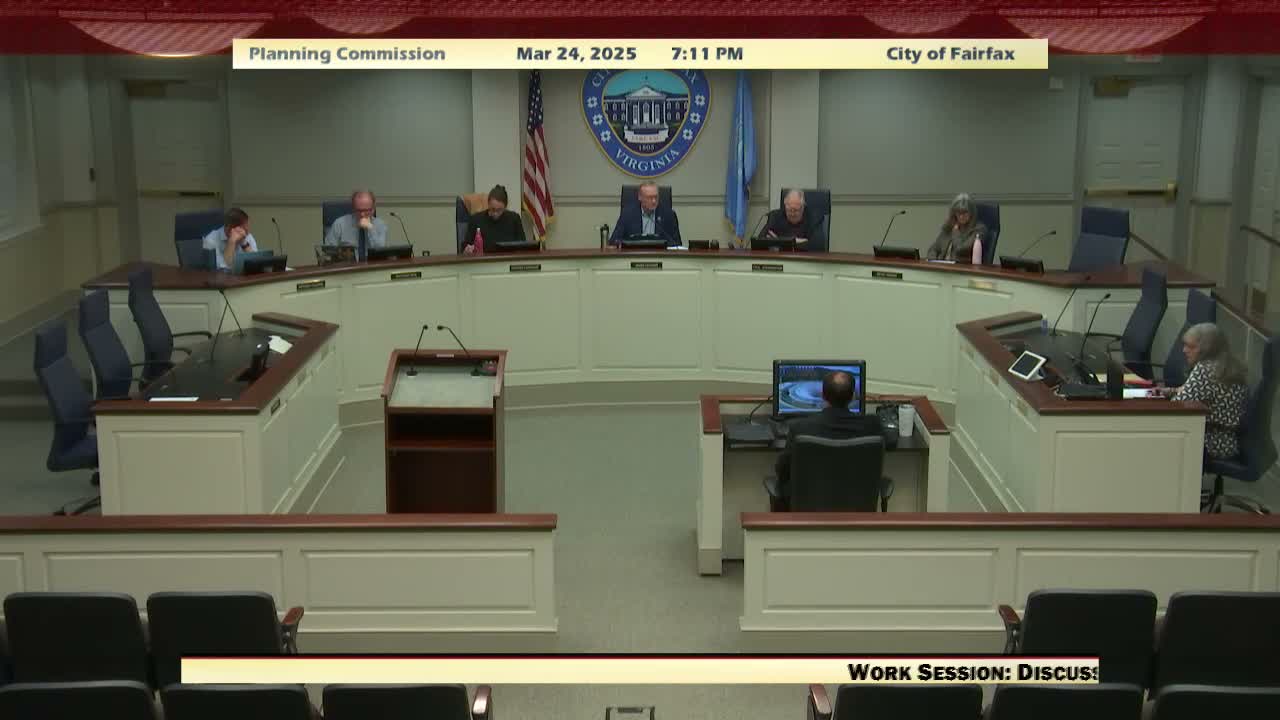
Planning staff told the Fairfax City Planning Commission on March 24 that the Comprehensive Plan’s recent guidance — which confines new mixed‑use development primarily to designated activity centers and two parcel‑specific sites — should not be broadly reauthorized to cover additional commercial corridors at this time.
The presentation, delivered during a work session, traced the policy’s history from the 1997 comprehensive plan and the Fairfax Boulevard master‑plan work through the 2019 rewrite and the 2024 review, and summarized the analytic filters staff used to identify candidate parcels (building‑to‑land value, parcel consolidation, proximity to activity centers and environmental constraints). City staff said those filters singled out Fairfax Square as a primary candidate and noted separate parcel language already existed for the Inova site.
"The market does not indicate urgency," planning staff said, presenting office‑vacancy data that show Fairfax City’s vacancy rate has remained below 10% in recent years and has not experienced the spikes seen in some peer jurisdictions. Staff also cited the city’s housing studies: a 2022 Housing Assessment estimated roughly 4,589 units of regional demand and the combined capacity of completed small area plans totaled about 4,650 units, suggesting activity centers could theoretically meet much of the near‑term demand.
Staff urged caution for four reasons: the fiscal risk of replacing productive commercial property, potential displacement of industrial or office stock the city still needs, dilution of investment planned for activity centers, and the resource‑intensive public process that a plan‑level change would require. Staff recommended not to proceed with a broad reevaluation but said a process is available to add parcel‑specific considerations if future circumstances warrant.
Commissioners probed the data and tradeoffs. Commissioner Cunningham emphasized the fiscal implications of shifting taxable commercial uses to residential and the original intent of mixed‑use to keep ground‑floor commercial accessible to residents. Commissioner Rice and others asked for more granular information on vacancy geography and building type (for example, whether vacancies are concentrated in large floorplates that are hard to re‑tenant). Commissioner Coleman argued that an unfocused expansion could undercut the purpose of activity‑center planning and small area plans.
Several commissioners acknowledged the two parcel examples discussed — Fairfax Square and the Inova property — are near‑term candidates but said changing plan language citywide would be premature. "We should not do anything about it at this point and let the council know that's our feeling," one commissioner said in support of staff’s recommendation.
The Planning Commission directed staff to compile the commission’s feedback for City Council, to seek additional targeted market and vacancy data (including more granular CoStar or EDA figures where available), and to return with follow‑up information before any Council briefing. Staff agreed to gather the requested data and said it would share a draft summary of commission comments before meeting with the council.
No formal amendment to the Comprehensive Plan was proposed or adopted at the meeting; the commission’s action was limited to providing feedback and asking for further analysis. The commission then reconvened its regular meeting, heard staff reports on upcoming hearings and scheduling, and adjourned.
Next steps: staff will provide the requested additional market and vacancy analysis and a written summary of the Planning Commission’s feedback to circulate before staff meets with City Council.