Get Full Government Meeting Transcripts, Videos, & Alerts Forever!
Get email alerts on the Mental Health Court topic
No spam. Unsubscribe anytime.
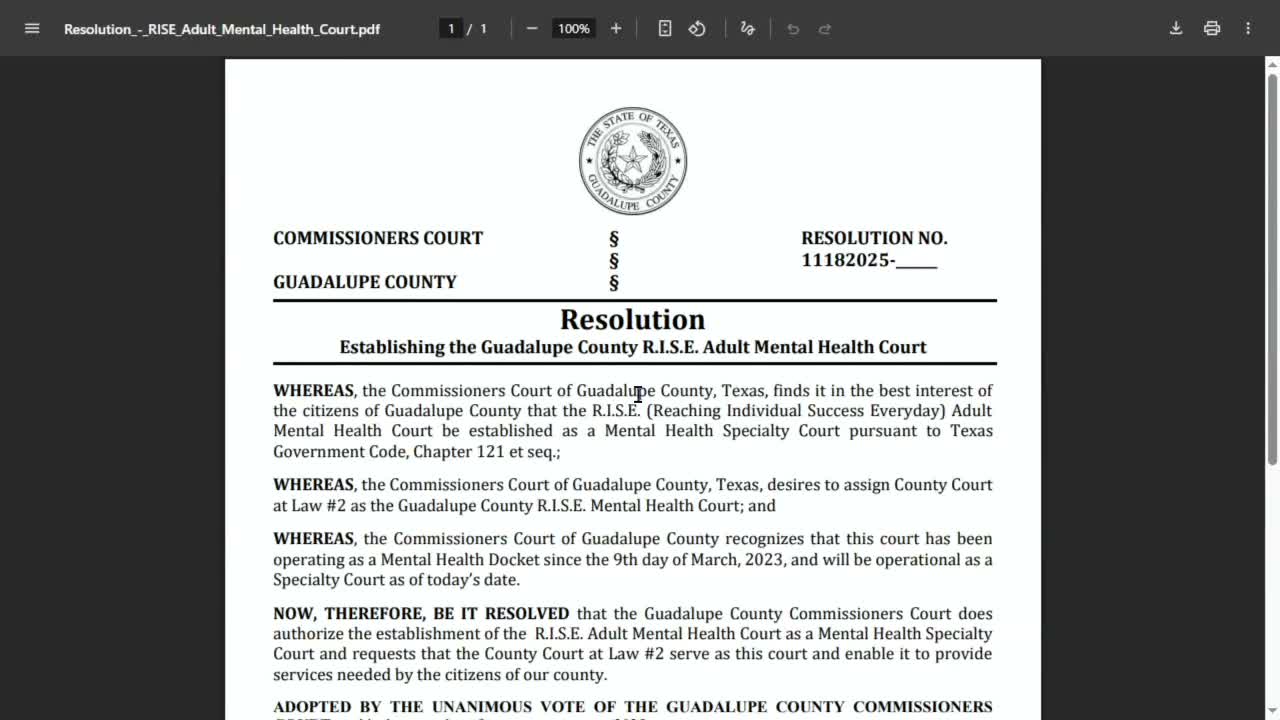
Commissioners approve resolution to establish Guadalupe County RISE Adult Mental Health Court
Summary
The court unanimously approved a resolution formally establishing the RISE Adult Mental Health Court, a specialized misdemeanor docket begun in 2023 that the judge said aims to reduce recidivism by coordinating treatment and court supervision. State recognition with the Office of Court Administration is the next step.
The Guadalupe County Commissioners Court on Nov. 18 approved a resolution to formally establish the RISE Adult Mental Health Court, a specialty docket designed to connect defendants with coordinated treatment, case management and enhanced court supervision.
Judge Legor, who outlined the proposal, said RISE — Resilience, Intervention, Support and Empowerment — began in 2023 as a misdemeanor docket pilot coordinated with the county attorney's office, adult probation and the local mental health authority, Bluebonnet Trails. "RISE standing for Resilience, Intervention, Support, and Empowerment," Legor said, describing the effort to provide a more structured, goal-based, multiphase program for people whose criminal behavior is driven by untreated or unstable mental health conditions.
The program has involved 32 people since March 2023, Legor said, and staff have reported fewer crisis situations and improved long-term stability for participants. Presenters from Bluebonnet Trails and the county attorney's office described ongoing coordination with law enforcement, probation and defense counsel to identify appropriate cases and track progress.
Supporters told the court the designation matters because state recognition through the Texas Office of Court Administration would allow the program to pursue grant funding and expand its mental-health support team. "We could potentially make a difference," Legor said, summarizing the collaborative aim to reduce recidivism and improve public safety.
Commissioners moved and seconded the resolution; the court approved the measure by voice vote with no recorded opposition. The next formal step, Legor said, is applying for OCA recognition and pursuing eligible grant funds to expand services and team capacity.