
Lake County planning commission backs draft Climate Adaptation Plan, urges edits on data and implementation
Get AI-powered insights, summaries, and transcripts
Subscribe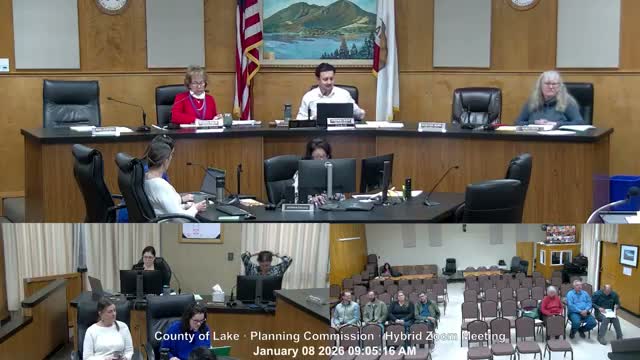
Summary
The Lake County Planning Commission voted to recommend the Board of Supervisors approve the county'wide Climate Adaptation Plan, while flagging concerns about survey methods, map usability, implementation funding, and greater specificity on drought and wildfire actions.
The Lake County Planning Commission voted Jan. 8 to recommend the Board of Supervisors approve a draft countywide Climate Adaptation Plan, while asking staff and consultants to tighten data presentation, clarify funding and timelines for actions, and add metrics to ensure accountability.
Deputy Community Development Administrator Shannon Walker Smith told commissioners the plan has been two years in the making and was developed with county departments, the Office of Climate Resilience, the Resource Conservation District and the cities of Clear Lake and Lakeport. Jacqueline Protsman Rohrer, project manager for consultant Placeworks, summarized the plan's process and products, including a climate vulnerability analysis and an action-oriented set of strategies organized around 10 "Pillars of Landscape Resilience." She said wildfire and smoke emerged as the hazards creating the most vulnerabilities across sectors, and named groups the analysis found most vulnerable: people of color and immigrant communities, financially constrained households, people with chronic illnesses or disabilities, older adults, outdoor workers and tribal communities.
Commissioners and members of the public urged improvements in several areas before final adoption. Commissioner Rosenthal (named in the record) and other commissioners said maps and figures would be more useful if they were interactive and better sourced. One commissioner noted inconsistency in reported survey counts (staff and materials referenced both 718 countywide general‑plan survey responses and 151 responses specific to the climate vulnerability survey) and asked staff to reconcile the figures in the final packet. Several speakers asked for more precise, measurable implementation metrics'deadlines, responsible parties, and funding sources'so the plan is not "an attractive document with limited utility," in the words of public commenter Margo Kambara.
On technical priorities, commissioners discussed the role of prescribed burning versus alternatives such as chipping or composting and asked staff to clarify where tribal traditional ecological knowledge and cultural burning practices are integrated into actions. Staff and consultants emphasized the plan is intended as a "living document" that will be refined during the Lake County 2050 General Plan update and integrated with the Community Wildfire Protection Plan, hazard mitigation plans, and capital improvement programming.
Before voting, staff reminded the commission that the draft had been released for a 20‑day public review and that the planning commission's recommendation may include proposed revisions that will be considered by the Board of Supervisors and city councils. The motion to recommend approval passed by voice vote with one absence. The Board of Supervisors is scheduled to hear the plan next week, according to staff.
What happens next: the commission's recommendation will be forwarded to the Board of Supervisors, along with any edits requested by the commission. Staff said they expect to incorporate commission and city council input into a final draft before Board consideration.
Sources: presentation and staff remarks by Shannon Walker Smith and Jacqueline Protsman Rohrer at the Jan. 8, 2026 Planning Commission meeting. The commission voted to forward a recommendation for adoption to the Board of Supervisors.