
TEU committee approves seven items, including JEA pay‑range correction and emergency construction funding
Get AI-powered insights, summaries, and transcripts
Sign Up Free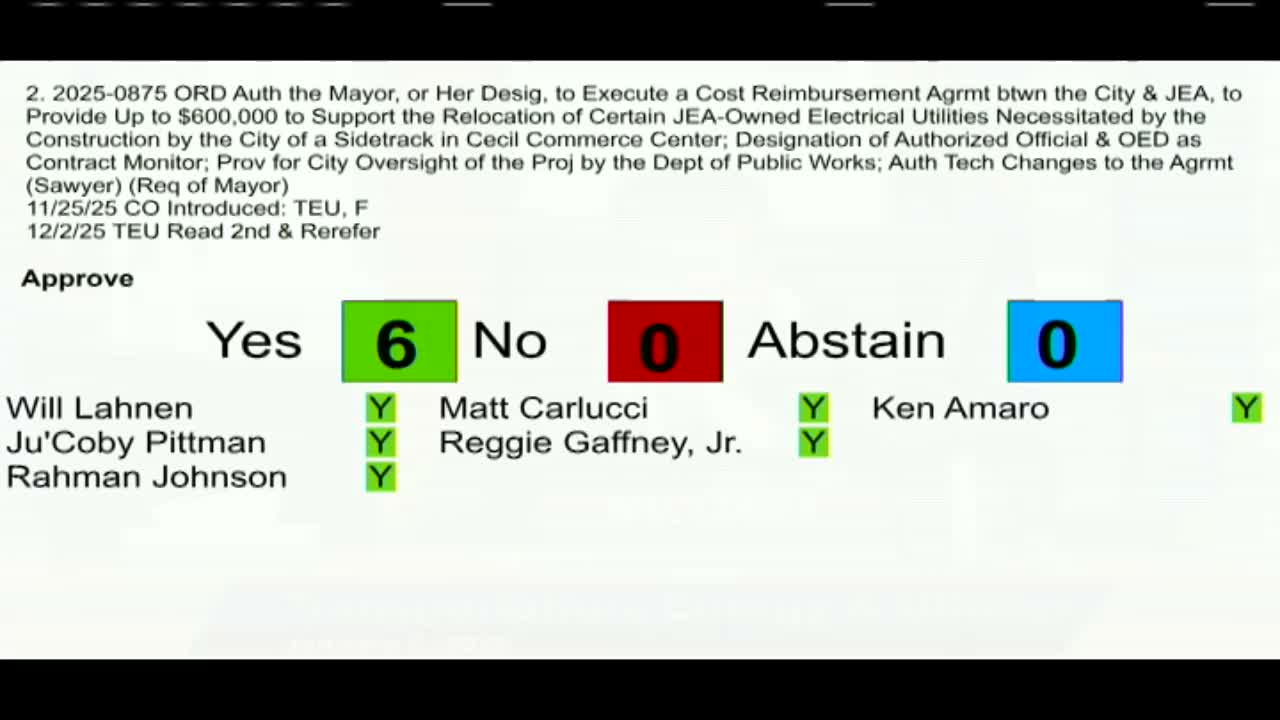
Summary
The Transportation, Energy and Utilities Committee on Jan. 6 approved seven items, including amendments to four JEA agreements to raise a PEA pay‑range maximum to 3%, mobility‑zone funding adjustments, and an emergency measure to meet a construction grant deadline; all votes were 6–0.
The Transportation, Energy and Utilities Committee voted unanimously Tuesday to approve seven agenda items, including a series of JEA agreements amended to correct employee pay‑range language and an emergency measure to allow construction to proceed under an expiring grant.
The actions affect multiple JEA contract documents and local project funding. Will Peterson of the council auditor’s office told the committee that the amendment ‘‘will attach or revise exhibit 1 and exhibit 2 . . . to correctly reflect the increase in the pay range maximum for this Professional Employees Association of 3% rather than 2 and a half percent’’ in the board documents. The committee adopted that correction for four JEA bills and passed each bill as amended by recorded voice vote, 6 yeas, 0 nays.
Why it matters: the correction aligns JEA board documents with the negotiated employee pay standard that staff said is already reflected in the agreements. The committee also considered mobility‑zone allocations and an emergency measure tied to grant timing for a construction project.
Committee members discussed how mobility funds are being applied to two projects tied to the $7 million allocation on the agenda. Nina Sickler of the public works department explained the local funding constraint, saying, ‘‘the current, ordinance code allows for only 20% of the available funding to be used towards an intersection.’’ Sickler told the committee an amendment is expected in Finance that would waive the 20% cap to allow full funding of a high‑priority intersection project without delaying other work.
On the rail spur project (item 2), Will Peterson said the city ‘‘received a state grant, I believe, of 5 and a half million, for construction of a rail spur’’ and that the city previously added about $2.5 million in general‑fund dollars; he described the current ordinance action as establishing a cost‑disbursement agreement with JEA to deliver the work.
The committee also approved an emergency designation and passage of bill 20250899 after Edward Linsky explained that ‘‘they are ready to move forward with construction on this project, and they are trying to meet the requirements of the grant funding that ends later on this year.’’ That emergency designation and the bill passed 6–0.
Votes at a glance: all votes reported on the record as 6 yeas, 0 nays. • Bill 20250871 — Passed (mobility‑zone allocation discussion; amendment planned in Finance to waive 20% intersection cap). • Bill 20250875 — Passed (rail spur cost disbursement agreement; funding: ~ $5.5M state grant + $2.5M general‑fund previously appropriated). • Bill 20250877 — Passed as amended (revised exhibits to reflect PEA pay‑range maximum of 3%). • Bill 20250878 — Passed as amended (PEA pay‑range exhibit correction). • Bill 20250879 — Passed as amended (PEA pay‑range exhibit correction). • Bill 20250880 — Passed as amended (PEA pay‑range exhibit correction). • Bill 20250899 — Passed (emergency to meet grant construction deadline).
Next steps: staff said an amendment to waive the mobility‑zone 20% intersection cap will be introduced in Finance; JEA and OED will carry forward the cost‑disbursement work for the rail spur. The committee did not record individual member roll‑call names beyond the 6‑0 tallies on each item.