Get Full Government Meeting Transcripts, Videos, & Alerts Forever!
Get email alerts on the Public Safety topic
No spam. Unsubscribe anytime.
Consultants outline long-range Jonesboro Fire Department plan recommending staffing increases, wellness and new funding options
Summary
A consultant presented a 10–15 year master plan recommending short-term staffing increases (29 to 33 minimum), NFPA 1582 medical screenings, station exhaust capture, purchase of training grounds, and funding options such as a $1–$2 hotel-occupancy fee and pursuing SAFER/AFG grants.
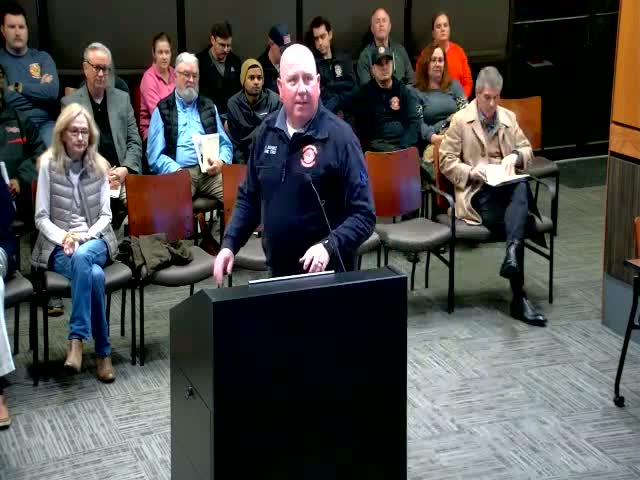
Mike Logan, project director for Emergency Services Consulting International, presented a long-range master plan for the Jonesboro Fire Department on Dec. 2 that lays out a 0–3, 3–7 and 7–15 year roadmap for staffing, health and capital needs.
Logan told the City Council the study used interviews with internal and external stakeholders, growth and call-volume data, and national standards. For the short term (0–3 years) he recommended adding a second assistant chief to split operations and administration, boosting daily minimum staffing from 29 to 33 (a staffing-factor change that the report says would require roughly 15 additional firefighters), expanding wellness and peer-support services, offering full NFPA 1582 medical screenings for all personnel, and installing diesel-exhaust capture systems in fire stations to reduce carcinogenic exposure.
The consultant also recommended securing more training resources. Logan suggested negotiating to purchase the department's currently rented training grounds from the county so the city could build props and training infrastructure without restrictions.
For midterm changes (3–7 years) the plan calls for raising the minimum staffing again to 36 by moving to four-person ladder crews, adding advanced life-support (ALS) capability to improve EMS response, creating a dedicated training FTE, and hiring a data analyst to guide decisions on station placement and staffing. Logan said the report identifies a likely need for Fire Station 8 in that timeframe depending on growth and call-volume projections.
Long-term recommendations (7–15 years) include creating a city emergency-manager role (distinct from existing county and university positions), launching a community paramedicine program to reduce repeat 911 callers, adding logistics and chief-of-staff positions, and planning for possible additional units or a Fire Station 9 as the city grows.
Logan noted the report identifies a range of potential revenue sources to fund the recommendations, including a nominal hotel-occupancy fee of $1–$2 per night, a possible fee applied to Arkansas State University students, and continuing to seek federal fire-service grants such as SAFER and AFG. He also suggested exploring cost-recovery programs for certain responses.
Fire Department leadership told the council many short-term items are already in process and invited council members to review the full ~175-page document for details and timelines. The consultant opened the floor for questions and said staff would be available to follow up.
The presentation did not include a council vote; the report is intended to guide planning and budgeting discussions in upcoming meetings.