Jonesboro council approves three-year Axon agreement for AI-assisted call handling and translation
Loading...
Summary
The City Council approved Resolution 25217 authorizing a three-year agreement with Axon Incorporated for AI-assisted nonemergency call handling, real-time translation and automated QA, with a first-year payment of $211,565 and $199,006.65 for each of the next two years. The council recorded the motion as carried; the transcript does not show a roll-call tally.
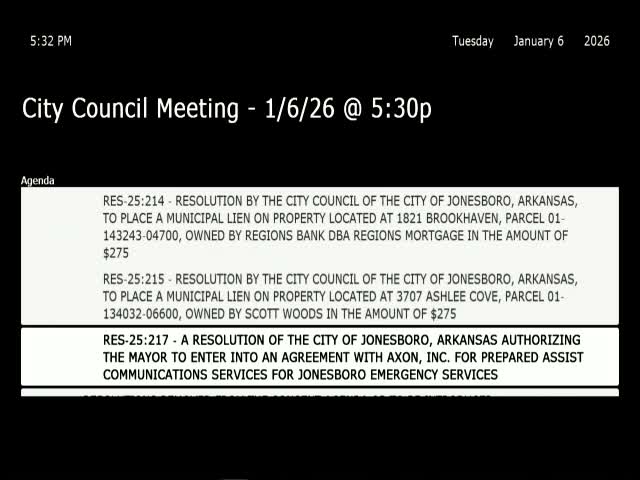
Jonesboro's City Council approved a resolution Jan. 6 authorizing the mayor to sign a three-year agreement with Axon Incorporated to provide Prepared Assist communication services aimed at handling nonemergency calls, offering real-time translation and transcribing radio and phone traffic for dispatch.
Ronnie, the staff presenter, told the council the system would take the city’s nonemergency line calls—about 180,000 calls annually—and route, transcribe and, when necessary, transfer calls to 911 dispatchers. "You can't tell that it's not a human being talking to you," Ronnie said of the vendor's AI voice, describing the system as "almost impossible" to distinguish from a live operator.
The resolution states the contract term is three years with a first-year payment of $211,565 and $199,006.65 for each of the two subsequent years. The agreement had already been approved by the Craighead County 911 board, and the staff said no bidding was required because Axon is on the NASPO state contract list.
Council members raised questions about the scope and operations of the tool. Officials clarified the package will answer nonemergency calls and escalate calls that require 911 intervention to a live dispatcher; it will not replace 911 dispatchers. In describing tests of the system, Ronnie said the vendor tried scenarios meant to trick the bot; in one example the bot answered a mock "pizza" call and redirected the caller to a 911 operator after determining it lacked a resource to complete the request: "I don't have a resource for that. Let me transfer you to a 911 operator," Ronnie said the bot replied.
Staff also described an automated quality-assurance feature that would evaluate 100% of calls and provide checklists and reporting to supervisors, and a real-time translation function the presenter estimated would cover roughly 30 major languages, including Spanish, Vietnamese, Mandarin, Russian and Arabic.
Implementation timing provided by staff was phased: the vendor would send a support team within about two weeks of signature; the first critical phase (automated nonemergency handling) was estimated to be operational within roughly 30 days, with the initial rollout functionally in place within six to eight weeks.
The mayor asked council members to cast their ballots and announced the motion "carried." The transcript records the passage but does not show a roll-call tally.
Next steps: staff said the mayor and city clerk are authorized to execute necessary documents so the vendor can begin work once the executed agreement and purchase order are in place.