Get Full Government Meeting Transcripts, Videos, & Alerts Forever!
Get email alerts on the Land Use Parking topic
No spam. Unsubscribe anytime.
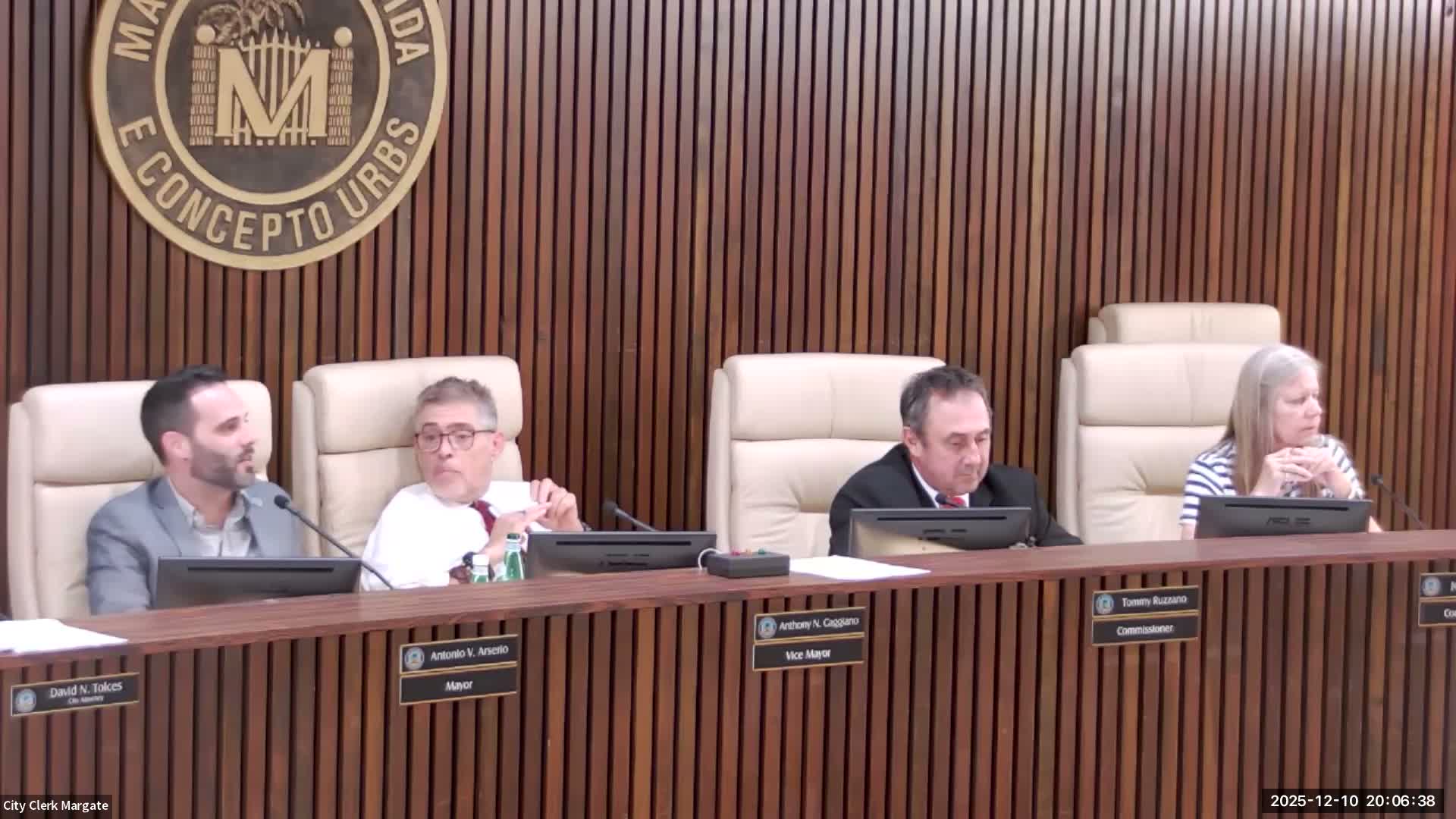
Margate commission overturns Board of Adjustment, grants parking variances for Waterside Landing conversion
Summary
The City Commission voted to overturn a Board of Adjustment denial and grant variances that reduce required parking for a proposed conversion of the former Waterside Landing assisted‑living facility to 174 market‑rate apartments; commissioners conditioned that the project return for a special‑exception/site‑plan review with required improvements.
The Margate City Commission voted to overturn a Board of Adjustment denial and granted variances that reduce parking and waive certain landscape requirements for a proposed conversion of the Waterside Landing assisted‑living facility at 5600 Lakeside Drive into market‑rate apartments.
Attorney Matthew Scott, representing Margate Acquisitions LLC, told the commission the 174‑unit building is landlocked by water and constrained by existing site conditions and that converting it to multifamily without relief would be commercially infeasible. Scott said the applicant’s traffic engineer calculated a demand of 214–230 parking spaces and that the applicant proposed a conceptual minimum of about 250 spaces, while acknowledging the request would fall below the city’s nominal code requirement.
Senior planner Andrew Penny reviewed staff analysis and the variance criteria in the city code, telling commissioners that the request seeks a reduction of roughly 131 parking spaces — about 34% below code — and waivers of perimeter and interior landscape requirements. Penny noted a prior Board of Adjustment denial by a 3–0 vote on Oct. 14, 2025, and said staff recommended denial because the application did not demonstrate the type of hardship the code requires.
Commissioners debated tradeoffs during a multi‑hour hearing. Commissioner Schwartz said she could not support a variance that would “break every rule that we have worked so hard to establish,” arguing the city should not relax standards for parking and landscaping. Other commissioners emphasized the property’s proximity to the city’s planned downtown and the risk an abandoned, deteriorating building posed to the area’s redevelopment plans. Several members discussed narrower approvals (for example, approving 250 or 268 spaces rather than the full relief requested) and imposing conditions tied to landscaping, public access or site improvements.
Vice Mayor Casciano moved to overturn the Board of Adjustment decision; the motion carried, with the clerk announcing the commission had overturned the board and effectively granted the variances. Commissioner Schwartz recorded a dissenting vote. The commission directed the applicant to return for a special‑exception and site‑plan review, where detailed design, landscaping, access and any agreed mitigation measures will be evaluated before final building permits are issued.
Matthew Scott said the variance is only the first step in a two‑step process and that “nothing can happen there until we proceed with a special‑exception process that you must approve.” The commission’s action allows the owner to continue through the more detailed review process required by the city code.
Next steps: the applicant must submit detailed site and building plans for the special exception and for staff review; the commission will have a subsequent public hearing to approve or deny those plans and any conditions attached to final approval.