Get Full Government Meeting Transcripts, Videos, & Alerts Forever!
Get email alerts on the Mental Health Response topic
No spam. Unsubscribe anytime.
MPD outlines mental‑health response: training, CART and SAFER registry show limited detentions and low arrests
Summary
Inspector Eric Pfeiffer told the commission that MPD aims for least‑restrictive responses, citing training, CIT/ACIT staffing, CART outcomes and the SAFER registry; of over 7,000 EDP calls in 2025, roughly 1,300 resulted in emergency detention and fewer than 1 percent in arrest, officials said.
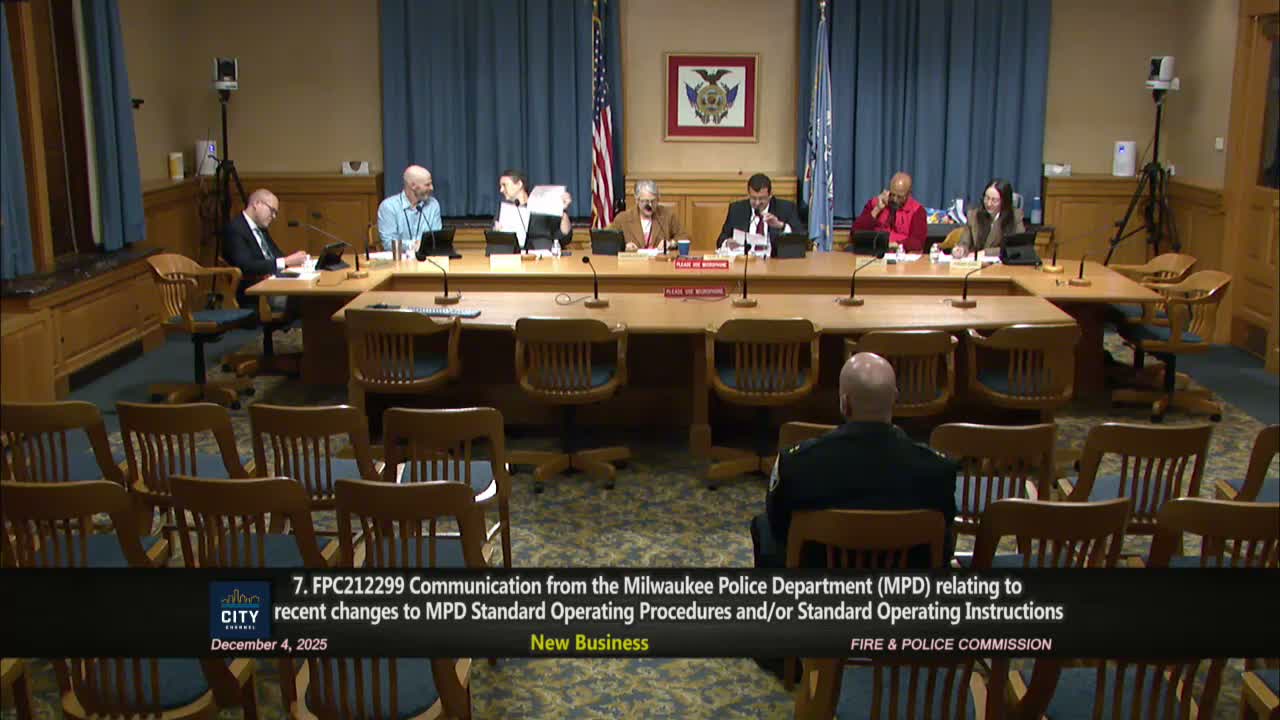
Inspector Eric Pfeiffer of the Milwaukee Police Department briefed the Fire and Police Commission on Dec. 4 about how the department responds to people experiencing mental‑health crises, emphasizing training and partnerships intended to reduce involuntary detentions and arrests.
Pfeiffer said officer training includes 100 hours of mental‑health and wellness training for recruits and ongoing in‑service refreshers; the department has incorporated the ABLE peer‑intervention program and crisis‑intervention and de‑escalation training. "Our goal...is that we want to provide the least restrictive, treatment options, for individuals that are in need of mental health resources," he said.
On call volume and outcomes, Pfeiffer said EDP (emotionally disturbed person) calls have been fairly consistent since 2019. So far in 2025, he said about 30 percent of mental‑health‑related calls ended with a C10 disposition (advised/no emergency detention) and 19 percent resulted in a C7 emergency detention. Of more than 7,000 EDP calls this year, about 1,300 resulted in a C7 and fewer than 1 percent (52) resulted in criminal arrest.
Pfeiffer described voluntary options intended to reduce involuntary custody: the Mental Health Emergency Center (MHEC); the mobile crisis hotline and teams; and the CART unit (Crisis Assessment Response Team), a partnership of officers and clinicians. He said CART — staffed with a lieutenant, five officers and clinicians shared regionally — handled more than 4,500 encounters this year: 41 percent stabilized on scene, 17 percent resulted in voluntary treatment and roughly 8 percent (about 392) led to emergency detention. He added that the CART team has been involved in only seven uses of force in 12 years.
Pfeiffer also described SAFER (Specialized Alerts for Enhanced Response), a voluntary registry that alerts dispatch and officers to individuals with special needs; registrations last one year and can be completed online or via paper at police stations. He said SAFER has 30 registrations to date, 77 related calls and five calls that resulted in emergency detention; 34 of the 77 calls came from one special‑needs group home.
Commissioners asked about clinician availability, CART hours (generally 8 a.m.–midnight), the difficulty of co‑locating clinicians and officers, whether unarmed 24/7 response teams are feasible, and what substances are driving crises (Pfeiffer cited heroin, fentanyl and synthetic marijuana/K2 among others). Pfeiffer said Narcan is signed out daily by officers from district supplies and is not left in squads because of shelf life and storage concerns.
What happens next: Commissioners praised the CART model and urged exploring ways to expand unarmed and clinician‑led responses; MPD said it will return periodically with updates and demonstrations of its dashboard and partnerships.