Get Full Government Meeting Transcripts, Videos, & Alerts Forever!
Get email alerts on the Labor And Personnel topic
No spam. Unsubscribe anytime.
Council adopts finance committee recommendations, including 3% city employee pay adjustment; one item returned by city attorney
Summary
The Common Council approved Finance & Personnel Committee recommendations — including a motion to give eligible general city employees a 3% pay adjustment — and noted that one file (item 16) was returned by the city attorney as "not legal and enforceable." The adoption passed by roll call (14 ayes, 1 excused).
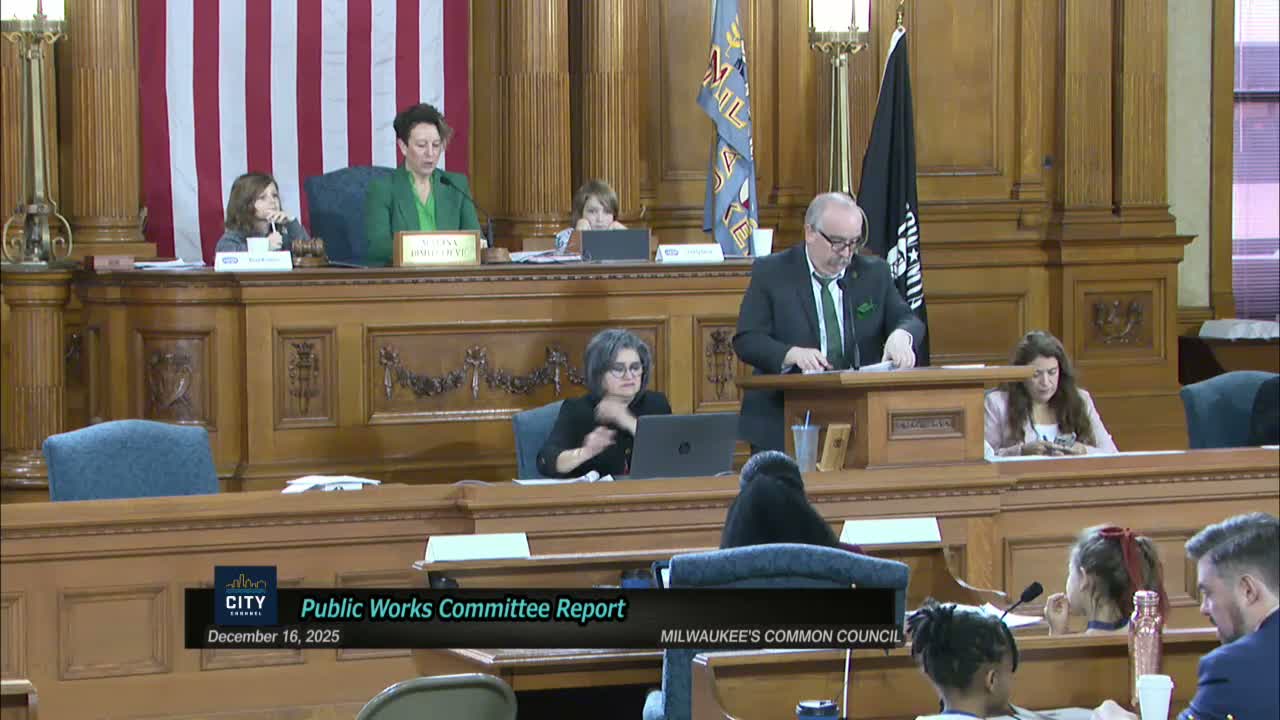
Milwaukee’s Common Council adopted the Finance and Personnel Committee’s recommendations on Dec. 16, approving several ordinances and resolutions and an amendment to enact a 3% salary adjustment for eligible general city employees.
The committee presenter told members item 16 had been returned by the city attorney as not legal and enforceable and, by law, would be referred back to committee. Several alderpersons voiced frustration at receiving the legal opinion late and said they wanted more opportunity to confer with the city attorney and file sponsors before votes.
Alderman Mark Chambers moved a substitute amendment to file 250628 (item 19) to provide a 3% salary adjustment to general city employees, effective in the pay period beginning January 2026. Chambers described the motion as an implementation of the council’s earlier budget decision. He said the motion does not change salary ranges and that employees whose raises would exceed caps would not get the full 3% under the amendment. "Essentially, what this file does is essentially effectuate the 3% increase of the base pay of all general city employees," Chambers said.
Other members pressed for clarity about ranges and fiscal effects; one member estimated a potential $450,000 annual cost for range adjustments affecting several hundred employees if ranges were changed. Council members debated how to address retroactivity and the role of the Civil Service Commission in setting ranges, but the substitute was presented and then adopted with the committee’s recommendations. The clerk recorded the roll call and announced the result as 14 ayes, 1 excused.
The city clerk also noted the digest was produced before the city attorney’s opinion was received, a timing issue members said should be addressed to avoid similar situations in the future.
Members asked that the committee continue to review files that the city attorney returns to ensure sponsors have an opportunity to amend language before floor votes.