Milwaukee police present new generative‑AI policy; commissioners press for public outreach and safeguards
Loading...
Summary
The Fire & Police Commission heard Milwaukee Police Department updates to five SOPs and a newly created SOP 682 governing generative AI; MPD said it currently has no AI tools but will consider report‑writing pilots, and commissioners urged transparency, community engagement and strong guardrails.
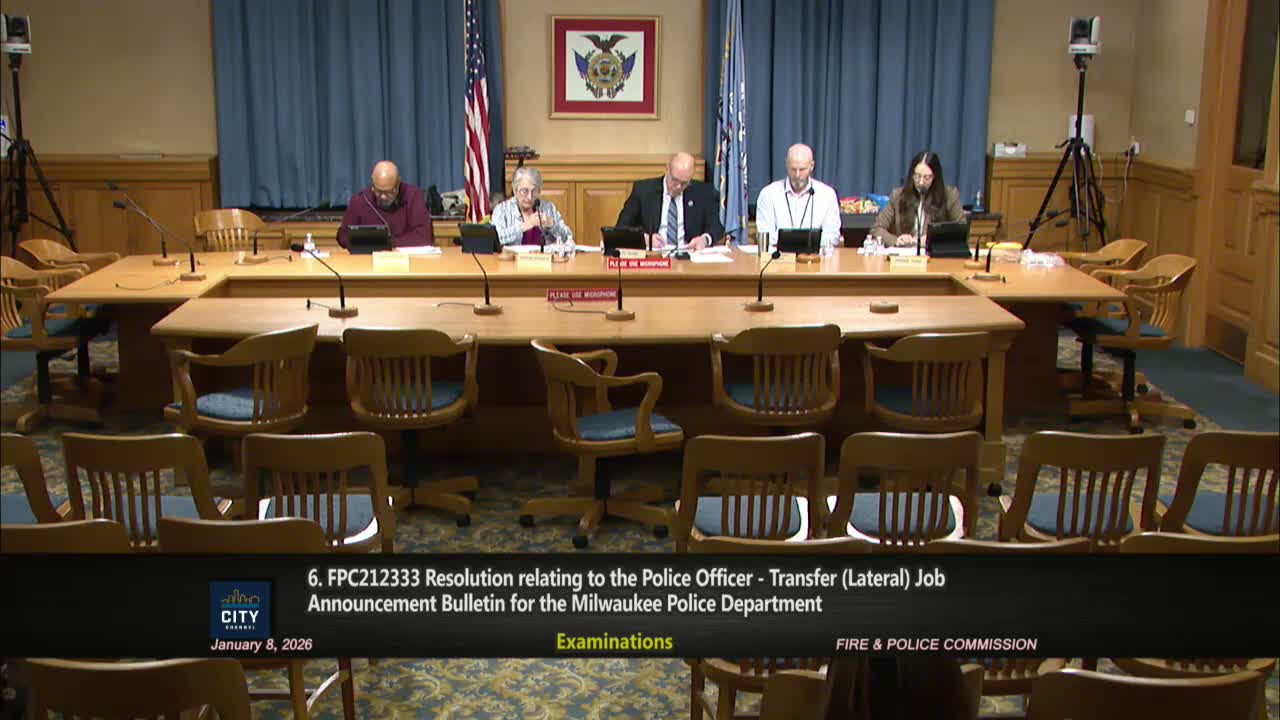
The Milwaukee Fire & Police Commission on Jan. 8 received a communication from the Milwaukee Police Department proposing updates to multiple standard operating procedures and a newly created SOP 682 to govern generative artificial intelligence.
Assistant Chief Craig Sarnoff told the commission the package includes revisions to SOP 250 (communications), SOP 465 (handheld chemical agents), SOP 900 (hazard mitigation), SOP 970 (search warrants) and a nomenclature update to the Department of Defense Law Enforcement Support Office program. He described SOP 682 as “intended to promote responsible and ethical usage of AI technologies within the Milwaukee Police Department,” adding that the department currently “does not have any generative AI technologies” but seeks a policy “ahead of the implementation.”
Jeff Larson, MPD’s IT director, said vendors are increasingly adding generative capabilities to records-management and report systems. He identified report-writing automation as a likely use case — software that transcribes body-worn video and call recordings and generates a narrative — but said MPD has not procured such tools and has only had limited demonstrations of a CentralSquare product. “Some of the ones that we’ve kinda got our eye on are report writing…that takes body cam videos and…transcribes them, and generates a narrative,” Larson said.
Commissioners pressed MPD to pursue public engagement before procurement. Several said prior undisclosed uses of technology have eroded trust and asked the department to publish a list of potential AI use cases, include partners such as the district attorney’s office in early conversations and to pilot tools in narrowly scoped contexts. A staff researcher, Barbara Cooley, noted the draft SOP includes a provision for educating the public and requires that any written material produced with AI be labeled as such: “if AI is used for any written materials, it has to be cited as such.”
Sarnoff and Larson described built‑in procedural safeguards listed in the SOP’s review process: legal review, CJIS and security requirements, anti‑bias checks, attestation that human reviewers sign off on AI‑assisted reports, and compliance with applicable law. They said the department has consulted external resources — including IACP model language and examples from other cities — and plans to update the SOP after any specific procurement based on pilot results.
Commissioners emphasized the court-system downstream impacts of police reports (bail, charging and judicial decisions) and urged careful human review and clear documentation of when AI was used. MPD said pilots would likely target cases without a known suspect at first and that any public communications plan would precede procurement. Because the item was transmitted as a communication, the commission took no formal action on SOP 682 at the meeting.
What’s next: MPD will continue internal review, pursue demos with vendors (CentralSquare and others were named in discussion) and work with the commission on public outreach before any procurement or pilot.